
MitoQ®,
does it really help with Longer healthspan and delayed aging through mitochondrial protection?
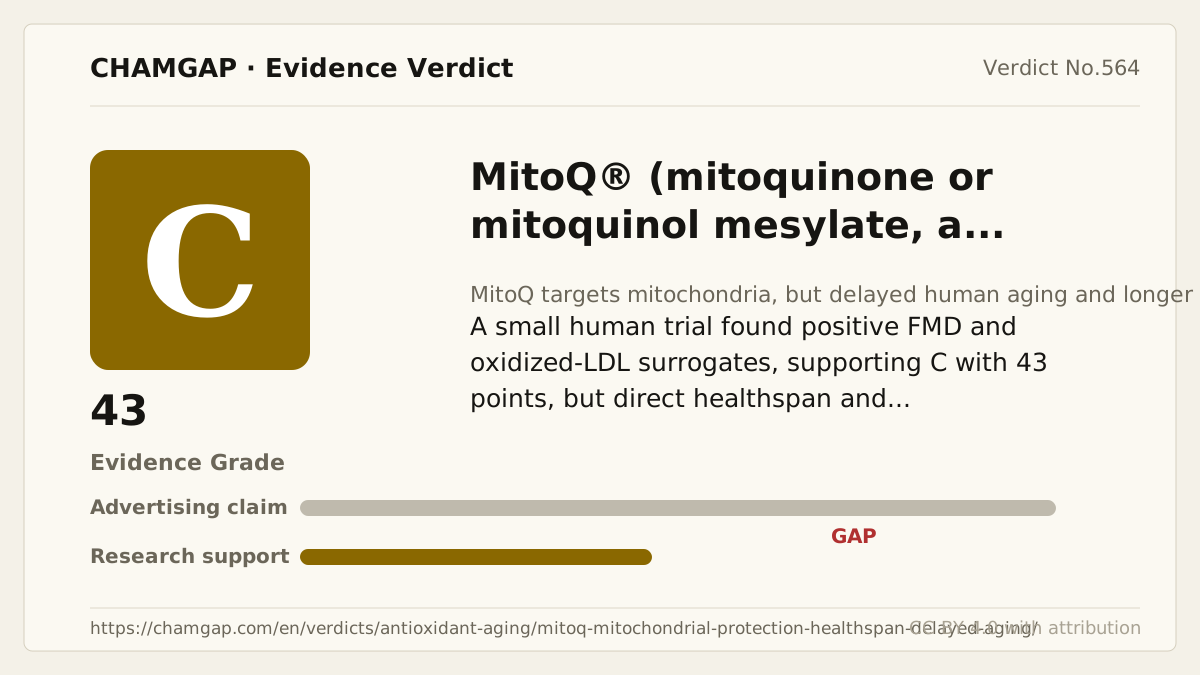
research showsMitoQ® is rated C for the composite claim of mitochondrial protection, delayed aging, and longer healthspan. MitoQ is not a conventional CoQ10 supplement; it is a distinct molecule that links a quinone to lipophilic triphenylphosphonium (TPP+) for mitochondrial accumulation. In the 20-person, six-week randomized double-blind placebo-controlled crossover trial by Rossman et al. 2018, flow-mediated dilation improved by about 42% versus placebo and oxidized LDL decreased, providing genuine positive human surrogate evidence. The claim therefore is not preclinical-only and receives the rule ① surrogate ceiling of C. No human trial has directly shown longer life or healthspan, less frailty or disability, or delayed aging, while a separate 128-person, 12-month Parkinson disease trial was null for progression.
ads claimMarketing turns mitochondrial delivery technology into cellular protection, slower aging, and longer healthspan. Reaching a molecular target is a pharmacokinetic property; improving human lifespan, disease, or function is a separate clinical claim.
Useful facts when choosing a product
- MitoQ is not CoQ10 or ubiquinol itself. It is a mitochondria-targeted molecule in which a quinone or quinol moiety is linked to a triphenylphosphonium cation, and it must be distinguished from prior CoQ10 verdicts 019, 443, 469, and 509.
- The principal vascular trial in healthy older adults used 20 mg/day of mitoquinone mesylate for six weeks. Labels should be checked to determine whether stated MitoQ milligrams and total mesylate-salt mass refer to the same quantity.
- Short human trials generally found acceptable tolerability, but no safety evidence covers years or decades of use for healthspan. High-dose, long-term, pregnancy, lactation, severe liver or kidney disease, and interaction data are inadequate.
- Changes in antioxidant markers, FMD, or DNA damage do not demonstrate slower aging or longer disease-free life. Commercial supplement purity, dose, and co-ingredients may differ from the trial material.
Chamgap Semantic Classification Code
Candidate index · review held
UNK.mitoq.UNK.longer-healthspan-and-delayed-aging-through-mitochondrial-protection.reduce.placeboUnknown > MitoQ® > Unknown > Longer healthspan and delayed aging through mitochondrial protection > Reduction claim > Placebo
An automated migration candidate, not an issued permanent code; exact claim scope remains under review. This machine-generated migration candidate helps retrieval but is not a permanent assignment. The original verdict ID and URL remain authoritative.
What the research actually shows
Rossman et al. 2018 crossed 20 adults aged 60 to 79 years with low FMD through MitoQ 20 mg/day and placebo for six weeks, reporting improved FMD and oxidized LDL. Mason et al. 2022 synthesized 19 trials and 884 participants receiving MitoQ, elamipretide, or MitoTEMPO; FMD was the only positive pooled outcome, while other outcomes were null and certainty was low or very low. Snow et al. 2010 gave 40 or 80 mg/day for 12 months to 128 people with early Parkinson disease and found no effect on any progression measure. Braakhuis et al. 2018 concluded that most aging-biomarker research was preclinical and the true human effect was unknown. Exercise meta-analysis also concerns a few heterogeneous trials and is not healthspan evidence.
Why this is classified as C (43)
Rossman et al. 2018 provides genuine positive human surrogate evidence: a 20-person, six-week placebo-controlled crossover trial found about 42% better FMD and lower oxidized LDL. A preclinical-only D rating is therefore too low, and the rule ① surrogate ceiling yields C with 43 points. Direct healthspan, frailty, and lifespan outcomes are absent and those subclaims remain ungraded; the null 128-person Parkinson trial concerns a separate disease axis. Short-term tolerability and the long-term safety gap are separated from efficacy.
Counterpoint. Surrogate improvement remains worth studying in older adults with impaired vascular function or selected exercise settings. A healthspan claim requires a long-term independent trial measuring frailty, functional decline, age-related disease, and disability-free survival directly.
Rejudgment record. Reassessment (cross-check reflected) — Separated MitoQ from prior CoQ10 verdicts 019, 443, 469, and 509 as a TPP+-linked mitochondria-targeted molecule and applied the rule ① ceiling of C after accepting the approximately 42% FMD improvement and lower oxidized LDL in a 20-person, six-week placebo-controlled crossover trial as positive human surrogate evidence
Sub-claim grades by effect
This ingredient is marketed for several effects. A single overall grade blends strong and weak claims together, so each effect is graded separately here. The overall grade reflects the strongest disconfirming or core claim.
| Effect (sub-claim) | Grade | Basis |
|---|---|---|
| Vascular-function and oxidative-stress surrogates | C | A small FMD trial was positive, but meta-analytic certainty was very low and most other measures were null. |
| Longer healthspan, less frailty, delayed aging, and longer lifespan | ? | No human trial directly measures aging, healthspan, frailty, or lifespan outcomes. |
Cross-check — AI research and Codex final gate
Evidence Table
| Study | Design | Sample | Funding | Endpoint | Result | Weight |
|---|---|---|---|---|---|---|
| Rossman MJ et al. 2018 | Randomized double-blind placebo-controlled six-week crossover trial | 20 healthy older adults with low FMD | United States NIH and academic support; product supplied by MitoQ Ltd | Brachial FMD, arterial stiffness, oxidized LDL, and inflammatory markers | FMD and oxidized LDL improved, inflammatory markers were unchanged, and no clinical event was measured. | Small key surrogate trial |
| Mason SA et al. 2022 | Systematic review and meta-analysis of mitochondrial-targeted antioxidant RCTs | 19 trials and 884 participants; multiple mitoAOXs | Academic research; no conflict reported | Glycemic, cardiovascular, and oxidative-stress outcomes | Only FMD across three trials was positive with very-low certainty; other quantitative outcomes were nonsignificant. | Key synthesis, not exclusive to MitoQ |
| Snow BJ et al. 2010 | Randomized double-blind placebo-controlled 12-month Parkinson disease trial | 128 participants with early Parkinson disease | Academic and commercial links to MitoQ development | Multiple clinical measures of Parkinson disease progression | No Parkinson disease progression measure differed between MitoQ and placebo. | Relatively large direct clinical null trial |
| Braakhuis AJ et al. 2018 | Systematic review and meta-analysis of aging-related biomarkers | Human, animal, and cellular studies; predominantly preclinical | Academic research | Aging surrogates including ROS, protein oxidation, and inflammation | Results were mixed and the true human aging effect was unknown because most research was in animals. | Confirms the direct healthspan gap |
Receipt — 4 References
All 4 cited sources were verified for existence at the original page (as of 2026-07-18).
Final verification and publication gate: Codex · Evidence date: 2026-07-18 · Corrections: none
Cite this verdict
[Chamgap] MitoQ® x longer healthspan and delayed aging through mitochondrial protection — Evidence Grade C·43. 4 cited sources checked. Source: https://chamgap.com/en/verdicts/antioxidant-aging/mitoq-mitochondrial-protection-healthspan-delayed-aging/ · CC BY 4.0CC BY 4.0 — free to use with attribution; do not distort grades, numbers, or verdict meaning.
What this document does and does not do
Chamgap is an information source. It reports what research has and has not confirmed; it does not tell readers what to take or buy. That decision belongs to readers and, when needed, medical or legal professionals. This verdict reflects literature available up to the search date and may change as new research appears. Nothing here is medical advice.