
Whole-body electromyostimulation,
does it really help with Improved strength, power, jumping, and sprint performance with short workouts?
research showsWB-EMS is rated D for the broad claim that short workouts add strength, power, jump, and sprint gains. A synthesis of five small trials and a broader EMS network meta-analysis contain some positive signals, but protocols, comparison exercise, populations, and effect sizes are highly heterogeneous. In contrast, a 59-person randomized trial found no added lower-limb strength or jump-power benefit when WB-EMS was added to eight weeks of running.
ads claimMarketing expands small signals from highly specific combined training into claims that 20 minutes equals hours of conventional training or improves explosive performance in every sport. Adaptation still depends on movement specificity, intensity, training status, and recovery.
Useful facts when choosing a product
- WB-EMS uses a suit with electrodes over several large muscle groups to apply current during voluntary exercise.
- Beginners should start at low intensity under qualified supervision, with adequate recovery and hydration between early sessions.
- Severe muscle pain, high creatine kinase, and rhabdomyolysis have followed excessive first sessions; dark urine, extreme pain, or weakness requires urgent medical assessment.
- People with pacemakers, implanted defibrillators, pregnancy, acute illness, or risk factors for rhabdomyolysis should seek medical advice before use.
Chamgap Semantic Classification Code
Candidate index · review held
P.whole-body-electromyostimulation.device.strength-power-jumping-and-sprint-performance-with-short-workouts.improve.UNKProcedures, devices and tests > Whole-body electromyostimulation > Device delivered > strength, power, jumping, and sprint performance with short workouts > Improvement claim > Unknown
An automated migration candidate, not an issued permanent code; exact claim scope remains under review. This machine-generated migration candidate helps retrieval but is not a permanent assignment. The original verdict ID and URL remain authoritative.
What the research actually shows
The 2019 Wirtz mini-meta-analysis synthesized five trials from one group and found signals for leg strength and power and selected sprint and jump outcomes. The 2023 Micke network meta-analysis included 36 studies and 1,092 participants but compared diverse local EMS, superimposed exercise, and jump-training combinations, showing method-dependent effects. In the 2024 Krause trial, 59 adults completed two 20-minute running sessions weekly for eight weeks; adding WB-EMS did not improve lower-limb strength or jump height over running alone.
Why this is classified as D (36)
Some small meta-analytic signals are acknowledged, but substantial variation in stimulation, exercise, and populations and a null 59-person direct trial for strength and jump support D with 36 points. The verdict rejects the generalized performance claim, not the possibility of every protocol-specific effect.
Counterpoint. If used, WB-EMS should supplement rather than replace established strength and speed training, under qualified supervision with actual performance and recovery monitoring.
Rejudgment record. New verdict — Acknowledged positive signals from small trial syntheses, but applied boundary rule ② because stimulation modes, accompanying exercise, populations, and outcomes are heterogeneous and a 59-person randomized direct trial found no added lower-limb strength or jump benefit
Sub-claim grades by effect
This ingredient is marketed for several effects. A single overall grade blends strong and weak claims together, so each effect is graded separately here. The overall grade reflects the strongest disconfirming or core claim.
| Effect (sub-claim) | Grade | Basis |
|---|---|---|
| Improved strength | D | Unlike some small positive studies, a 59-person direct trial found no added WB-EMS effect. |
| Improved power and jumping | D | Results vary by protocol, and jump height was null in the recent direct trial. |
| Improved sprint performance | D | Small movement-specific signals exist, but they do not establish a consistent generalizable effect. |
Cross-check — AI research and Codex final gate
Evidence Table
| Study | Design | Sample | Funding | Endpoint | Result | Weight |
|---|---|---|---|---|---|---|
| Krause A et al. 2024 | Eight-week randomized controlled trial | Fifty-nine healthy adults | Academic study with equipment-related support disclosed | Isokinetic knee extension and flexion strength and countermovement-jump height | Adding WB-EMS to twice-weekly 20-minute running produced no added strength or jump benefit over running alone. | Key direct null randomized trial |
| Wirtz N et al. 2019 | Mini-meta-analysis of five homogeneous randomized trials | Five randomized trials in moderately trained young adults | Synthesis of trials from one research group | Leg strength, power, jumping, and sprinting | Some favorable pooled effects were reported, but data were small, came from one group, and varied by outcome. | Positive signal with limited generalizability |
| Micke F et al. 2023 | Systematic review and network meta-analysis | Thirty-six studies and 1,092 participants | Academic research | Strength, jumping, sprinting, and aerobic capacity | Some EMS-exercise combinations were positive, but effects strongly depended on stimulation mode and movement-specific accompanying exercise. | Broad synthesis with major intervention heterogeneity |
Receipt — 4 References
All 4 cited sources were verified for existence at the original page (as of 2026-07-23).
Final verification and publication gate: Codex · Evidence date: 2026-07-23 · Corrections: none
Cite this verdict
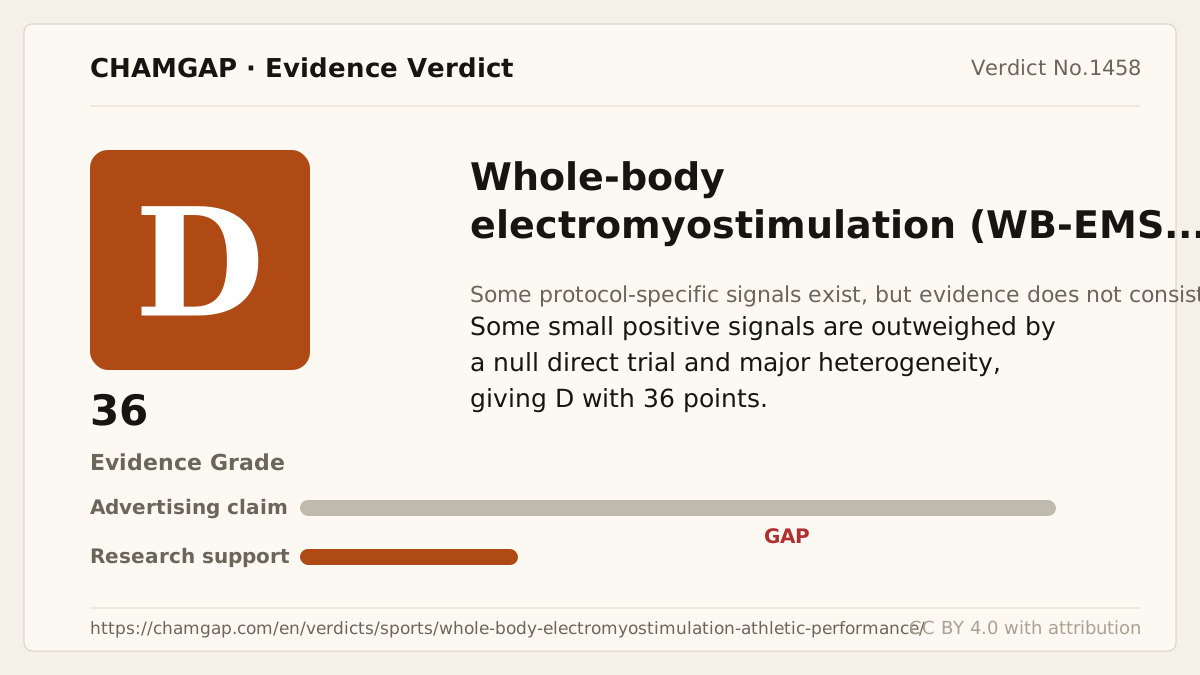
[Chamgap] Whole-body electromyostimulation x performance gains from short workouts — Evidence Grade D·36. 4 cited sources checked. Source: https://chamgap.com/en/verdicts/sports/whole-body-electromyostimulation-athletic-performance/ · CC BY 4.0CC BY 4.0 — free to use with attribution; do not distort grades, numbers, or verdict meaning.
What this document does and does not do
Chamgap is an information source. It reports what research has and has not confirmed; it does not tell readers what to take or buy. That decision belongs to readers and, when needed, medical or legal professionals. This verdict reflects literature available up to the search date and may change as new research appears. Nothing here is medical advice.