
Whole-body cryotherapy,
does it really help with Reduced post-exercise muscle soreness and accelerated recovery of strength and sports performance?
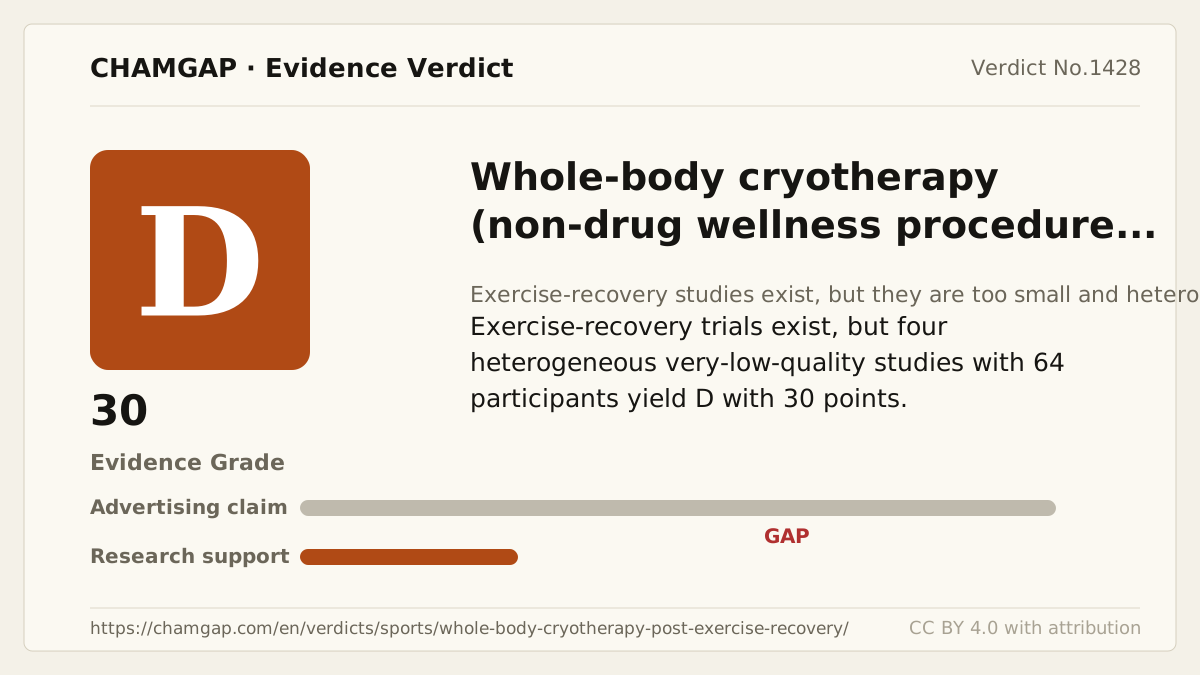
research showsWhole-body cryotherapy for post-exercise recovery is rated D. The Cochrane review found only four randomized trials with 64 participants, all at high risk of bias and providing very-low-quality evidence. Some short-term soreness signals appeared, but confidence intervals included no effect or benefit for control, while strength, performance recovery, and safety remained inadequately established. Human randomized trials do exist for these exercise-recovery outcomes, so this is D with 30 points rather than ?, which denotes no human efficacy literature.
ads claimTemporary cold sensation, analgesia, and inflammatory-marker changes are expanded into rapid restoration of strength and competitive performance. Perceived recovery, biomarkers, and actual performance are distinct outcomes.
Useful facts when choosing a product
- Whole-body cryotherapy commonly exposes a person to very cold dry air below −100°C for about two to four minutes.
- This verdict concerns post-exercise soreness, strength, and performance recovery and is separate from claims about systemic inflammation, biological aging, or longevity.
- Risks include frostbite, cold injury, hypothermia, increased blood pressure, and syncope; nitrogen environments also require control of oxygen-displacement asphyxiation.
- Cardiovascular disease, uncontrolled hypertension, Raynaud phenomenon, cold hypersensitivity, and pregnancy require professional contraindication screening.
Chamgap Semantic Classification Code
Candidate index · review held
P.whole-body-cryotherapy.procedural.post-exercise-muscle-soreness-and-accelerated-recovery-of-strength-and-sports-performance.reduce.noneProcedures, devices and tests > Whole-body cryotherapy > Procedural > post-exercise muscle soreness and accelerated recovery of strength and sports performance > Reduction claim > No intervention
An automated migration candidate, not an issued permanent code; exact claim scope remains under review. This machine-generated migration candidate helps retrieval but is not a permanent assignment. The original verdict ID and URL remain authoritative.
What the research actually shows
The 2015 Costello Cochrane review included four laboratory randomized trials with 64 participants comparing whole-body extreme-cold exposure with rest or no treatment. A one-hour soreness signal favored treatment, but estimates at 24 to 72 hours included no effect or benefit for control and all outcomes had very-low-quality evidence. Lombardi 2017 summarized pain and function signals after repeated exposure, but protocols and findings varied substantially.
Why this is classified as D (30)
Human randomized exercise-recovery trials exist, excluding ?. The pivotal synthesis nevertheless contains only four trials and 64 participants with very low quality, heterogeneity, and absent safety surveillance, yielding D with 30 points.
Counterpoint. Some people may perceive brief pain relief, but superiority over sleep, nutrition, and progressive load management is not established.
Rejudgment record. New verdict — Excluded ? because randomized human trials exist for post-exercise recovery, but applied boundary rule ② because the pivotal Cochrane evidence comprises only four trials and 64 participants with high risk of bias, heterogeneous protocols, and absent active safety monitoring
Sub-claim grades by effect
This ingredient is marketed for several effects. A single overall grade blends strong and weak claims together, so each effect is graded separately here. The overall grade reflects the strongest disconfirming or core claim.
| Effect (sub-claim) | Grade | Basis |
|---|---|---|
| Reduced post-exercise muscle soreness | D | Some short-term signals exist, but four small very-low-quality trials are insufficient to determine benefit. |
| Accelerated strength recovery | D | Measures and time points are heterogeneous, without a consistent controlled effect. |
| Accelerated sports-performance recovery | D | Direct performance evidence is sparse, and perceived recovery or biomarkers cannot be substituted. |
Cross-check — AI research and Codex final gate
Evidence Table
| Study | Design | Sample | Funding | Endpoint | Result | Weight |
|---|---|---|---|---|---|---|
| Costello JT et al. 2015 Cochrane review | Systematic review of randomized and quasi-randomized trials | Four laboratory randomized trials and 64 participants | Cochrane and public or academic support | Muscle soreness, subjective recovery, and adverse events | All outcomes had very-low-quality evidence, insufficient to determine effects on soreness or subjective recovery. | Pivotal synthesis |
| Lombardi G et al. 2017 | Review of exercise-recovery literature | Small whole-body cryotherapy evidence set | No commercial funding reported | Pain, muscle function, inflammation, and damage markers | Repeated exposure produced some positive signals, but studies were small and protocols and findings were heterogeneous. | Supportive but inconclusive evidence |
Receipt — 2 References
All 2 cited sources were verified for existence at the original page (as of 2026-07-23).
Final verification and publication gate: Codex · Evidence date: 2026-07-23 · Corrections: none
Cite this verdict
[Chamgap] Whole-body cryotherapy x post-exercise soreness, strength, and performance recovery — Evidence Grade D·30. 2 cited sources checked. Source: https://chamgap.com/en/verdicts/sports/whole-body-cryotherapy-post-exercise-recovery/ · CC BY 4.0CC BY 4.0 — free to use with attribution; do not distort grades, numbers, or verdict meaning.
What this document does and does not do
Chamgap is an information source. It reports what research has and has not confirmed; it does not tell readers what to take or buy. That decision belongs to readers and, when needed, medical or legal professionals. This verdict reflects literature available up to the search date and may change as new research appears. Nothing here is medical advice.