
Whey protein drink,
does it really help with Increased thigh muscle mass in healthy older adults without resistance exercise?
research showsThe grade is D. CALM randomized 208 healthy adults older than 65 across five groups, and 184 completed one year. In the supplement-only comparison, quadriceps cross-sectional area changed by -0.9 plus or minus 0.4 cm2 with whey and -0.3 plus or minus 0.4 cm2 with isocaloric carbohydrate, showing no whey-only benefit.
ads claimProviding 20 g protein per serving is a true composition fact. Increased protein intake cannot be rewritten as demonstrated muscle-tissue growth without exercise.
Useful facts when choosing a product
- The whey group added 20 g whey hydrolysate and 10 g sucrose twice daily, totaling 40 g protein and 20 g sucrose per day.
- Sodium, saturated fat, and fiber per serving were not reported for the study powder.
- Verdict 074 is B with 78 points for general whey protein in resistance-training and diet contexts; this verdict isolates drink-only use without exercise.
Chamgap Semantic Classification Code
Candidate index · review held
F.drink-providing-whey-protein-hydrolysate-plus-sucrose-twice.oral.thigh-muscle-mass-without-resistance-exercise.increase.UNKFoods and beverages > drink providing whey protein hydrolysate plus sucrose twice > Oral > thigh muscle mass without resistance exercise > Increase claim > Unknown
An automated migration candidate, not an issued permanent code; exact claim scope remains under review. This machine-generated migration candidate helps retrieval but is not a permanent assignment. The original verdict ID and URL remain authoritative.
What the research actually shows
Mertz and colleagues assigned 208 participants to carbohydrate, collagen, whey, light training plus whey, or heavy training plus whey. The supplement-only groups and MRI assessors were blinded. A total of 184 completed the year, and the public table centers on participants with 12-month measurements. The University of Copenhagen, Danish Dairy Research Foundation, and Arla Foods Ingredients supported the work; an Arla employee participated in design.
Why this is classified as D (28)
A one-year randomized trial found no benefit on the registered MRI primary outcome, but a small benefit remained possible, giving D with 28 points.
Counterpoint. Protein deficiency, diagnosed sarcopenia, and exercise-combined use are separate questions.
Rejudgment record. Cross-check applied — Cross-checked the registered primary outcome, completion count, MRI changes and standard errors, prespecified detectable difference, and funding
| Endpoint | S | Surrogate marker - laboratory or imaging measures |
| Replication | R1 | Single confirmatory trial |
| Independence | I1 | Mixed funding sources |
| Effect size | E0 | Null |
| Precision | C0 | The confidence interval leaves room for benefit |
Stored derived and displayed grades match; this is not a current recalculation or validity check (D).
Sub-claim grades by effect
This ingredient is marketed for several effects. A single overall grade blends strong and weak claims together, so each effect is graded separately here. The overall grade reflects the strongest disconfirming or core claim.
| Effect (sub-claim) | Grade | Basis |
|---|---|---|
| Increased thigh muscle mass without exercise | D | The MRI primary outcome did not favor whey over isocaloric carbohydrate. |
Cross-check — AI research and Codex final gate
Evidence Table
| Study | Design | Sample | Funding | Endpoint | Result | Weight |
|---|---|---|---|---|---|---|
| Mertz KH et al., 2021 CALM | One-year five-arm randomized trial | 208 randomized and 184 completed | University, Danish Dairy Research Foundation, and Arla Foods Ingredients support | Primary change in MRI quadriceps cross-sectional area | Whey -0.9 plus or minus 0.4 versus carbohydrate -0.3 plus or minus 0.4 cm2; no whey-only superiority | Direct long-term evidence on the registered primary outcome |
Receipt — 2 References
All 2 cited sources were verified for existence at the original page (as of 2026-08-03).
Final verification and publication gate: Codex · Evidence date: 2026-08-03 · Corrections: none
Cite this verdict
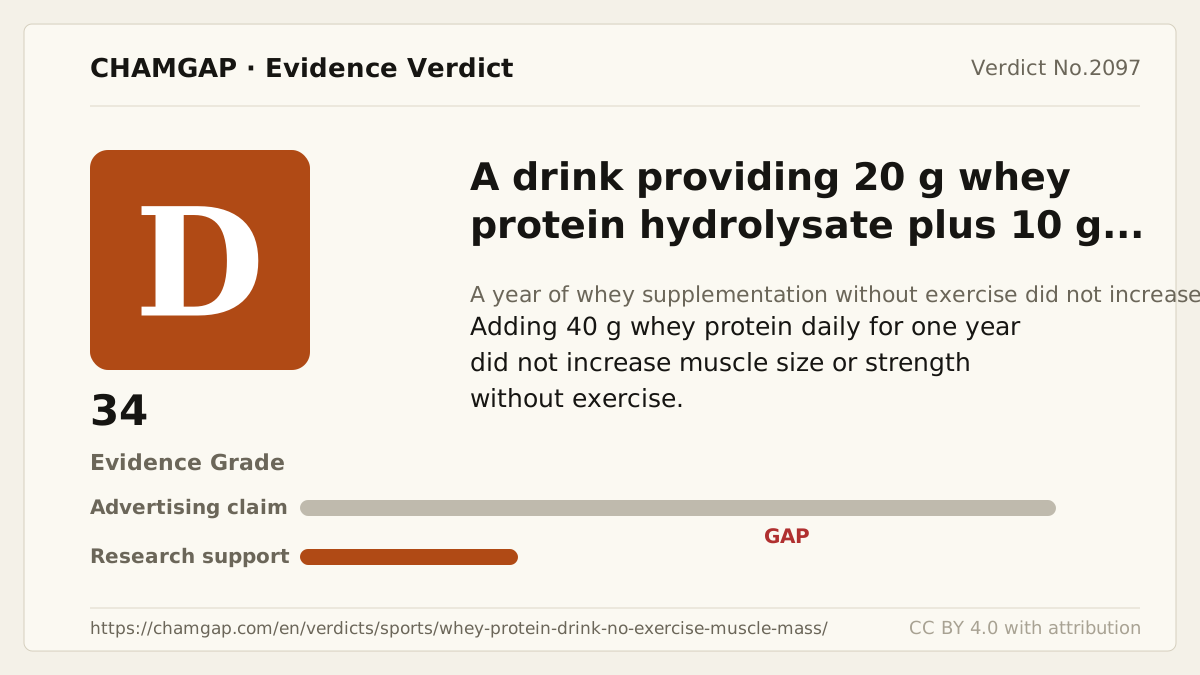
[Chamgap] Whey protein drink x muscle gain without exercise — Evidence Grade D·28. 2 cited sources checked. Source: https://chamgap.com/en/verdicts/sports/whey-protein-drink-no-exercise-muscle-mass/ · CC BY 4.0CC BY 4.0 — free to use with attribution; do not distort grades, numbers, or verdict meaning.
What this document does and does not do
Chamgap is an information source. It reports what research has and has not confirmed; it does not tell readers what to take or buy. That decision belongs to readers and, when needed, medical or legal professionals. This verdict reflects literature available up to the search date and may change as new research appears. Nothing here is medical advice.