
Wearable core-temperature and heat-stress sensor,
does it really help with Prevention of heat exhaustion and heatstroke during exercise or outdoor work?
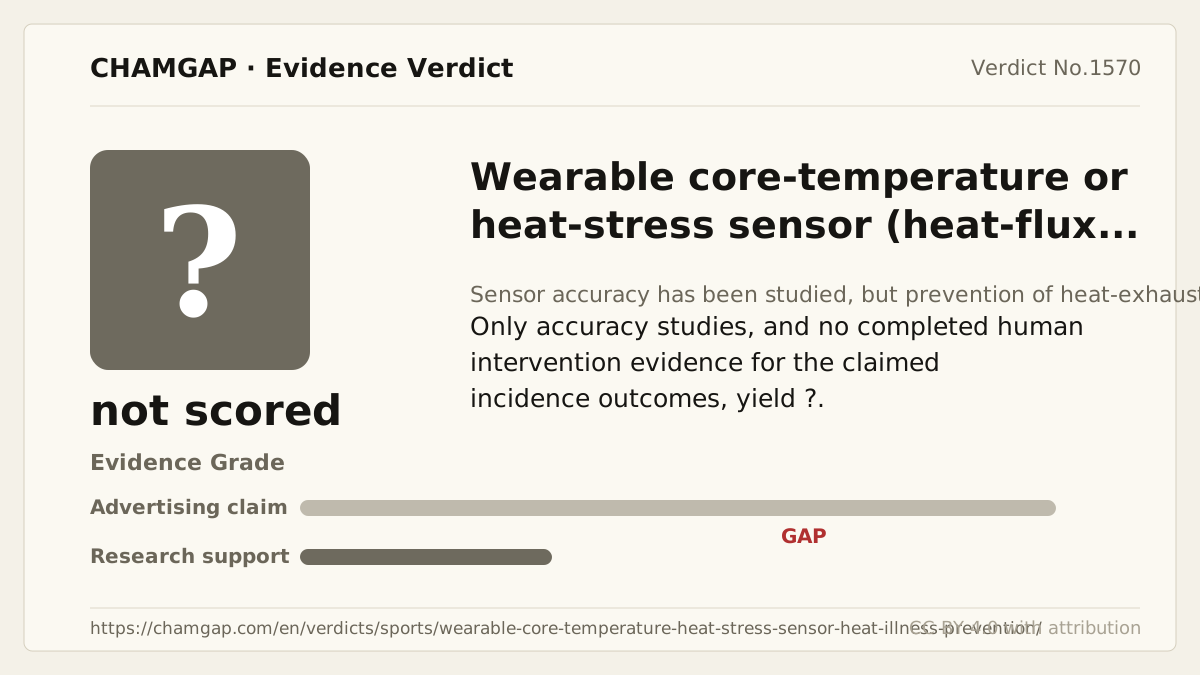
research showsThe grade is ? because no completed human intervention study was found that tested whether a wearable heat-flux core-temperature sensor actually reduced heat-exhaustion or heatstroke incidence during exercise or outdoor work. Located studies compared sensor estimates with rectal, esophageal, or ingestible reference thermometry. Those are accuracy and validity data, not prevention outcomes.
ads claimCore-temperature estimation accuracy and warning capability may be expanded into a proven reduction in actual heat exhaustion or heatstroke.
Useful facts when choosing a product
- Heat-flux wearables estimate rather than directly measure core temperature, using skin temperature, heat flux, and sometimes heart rate.
- Accuracy can vary with exercise intensity, airflow, ambient temperature, attachment site, and the reference method.
- Skin irritation or pressure can occur, and false alarms or underestimation may distort risk perception.
Chamgap Semantic Classification Code
Candidate index · review held
P.wearable-core-temperature-or-heat-stress-sensor.device.heat-exhaustion-and-heatstroke-during-exercise-or-outdoor-work.prevent.UNKProcedures, devices and tests > Wearable core-temperature or heat-stress sensor > Device delivered > heat exhaustion and heatstroke during exercise or outdoor work > Occurrence-prevention claim > Unknown
An automated migration candidate, not an issued permanent code; exact claim scope remains under review. This machine-generated migration candidate helps retrieval but is not a permanent assignment. The original verdict ID and URL remain authoritative.
What the research actually shows
Dolson and colleagues found a limited literature of 20 studies and 25 wearable core-temperature prediction algorithms, mainly assessing error against reference measurements during exercise. Verdel and colleagues found that agreement between CORE and rectal temperature could be inadequate under heat load during cycling. A dual-heat-flux patch study by Tokizawa and colleagues reported an RMSE around 0.22°C during low-intensity acute exercise but did not track heat-illness incidence.
Why this is classified as ?
No completed human intervention trial evaluating reduced heat-exhaustion or heatstroke incidence was found, and the available literature only addresses core-temperature estimation accuracy and validity; therefore the grade is ?.
Counterpoint. Core-temperature estimation accuracy is a separate performance endpoint and was not transferred to heat-illness prevention efficacy.
Rejudgment record. New verdict — Applied boundary rule ③ because no completed human intervention comparing heat-exhaustion or heatstroke incidence with versus without sensor use was found, and accuracy or validity studies were not repurposed as prevention evidence
Sub-claim grades by effect
This ingredient is marketed for several effects. A single overall grade blends strong and weak claims together, so each effect is graded separately here. The overall grade reflects the strongest disconfirming or core claim.
| Effect (sub-claim) | Grade | Basis |
|---|---|---|
| Prevention of heatstroke incidence during exercise or outdoor work | ? | No completed human intervention trial evaluating reduced incidence with sensor use was found. |
| Prevention of heat-exhaustion incidence during exercise or outdoor work | ? | Only accuracy studies were located, with no completed intervention evidence for this incidence endpoint. |
Cross-check — AI research and Codex final gate
Evidence Table
| Study | Design | Sample | Funding | Endpoint | Result | Weight |
|---|---|---|---|---|---|---|
| Dolson CM et al. 2022 | Systematic review of wearable core-temperature prediction | Twenty studies and 25 algorithms in exercising participants | No external funding and no conflicts reported | Error and predictive performance against reference core temperature | The literature was limited and did not evaluate prevention of heat-exhaustion or heatstroke incidence. | Evidence-scope assessment |
| Verdel N et al. 2021 | Repeated-measures validity study of the CORE sensor | Twelve healthy cyclists in the reliability study and 13 in the validity study | Academic research with disclosed manufacturer-provided devices | Agreement of CORE estimates with rectal temperature | Agreement was inadequate under heat load, and heat-illness incidence was not assessed. | Direct device-accuracy validation |
Receipt — 3 References
All 3 cited sources were verified for existence at the original page (as of 2026-07-23).
Final verification and publication gate: Codex · Evidence date: 2026-07-23 · Corrections: none
Cite this verdict
[Chamgap] Wearable core-temperature and heat-stress sensor x prevention of heat exhaustion and heatstroke — Evidence Grade ?. 3 cited sources checked. Source: https://chamgap.com/en/verdicts/sports/wearable-core-temperature-heat-stress-sensor-heat-illness-prevention/ · CC BY 4.0CC BY 4.0 — free to use with attribution; do not distort grades, numbers, or verdict meaning.
What this document does and does not do
Chamgap is an information source. It reports what research has and has not confirmed; it does not tell readers what to take or buy. That decision belongs to readers and, when needed, medical or legal professionals. This verdict reflects literature available up to the search date and may change as new research appears. Nothing here is medical advice.