
Vitamin D3,
does it really help with Additional improvement in strength, power, and anaerobic performance in athletes without vitamin D deficiency?
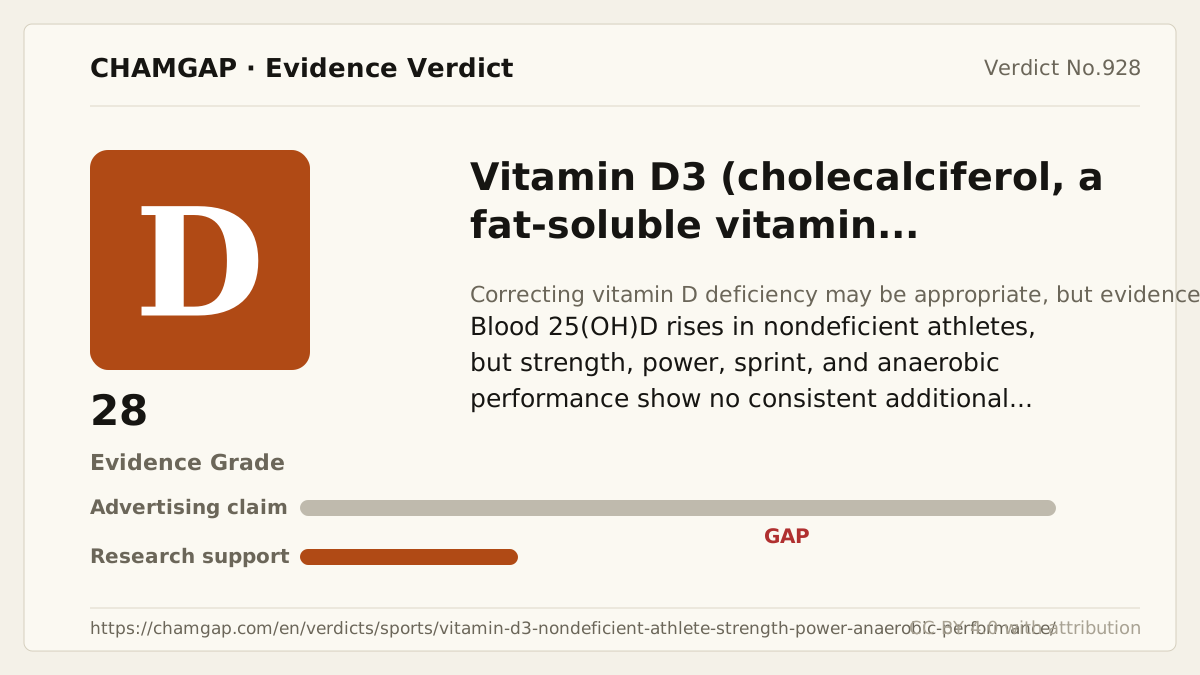
research showsVitamin D3 is rated D for additional strength, power, and anaerobic performance in athletes who are not deficient. A 2023 meta-analysis of 11 randomized trials and 436 athletes found no significant improvement in maximal strength or power; among athletes with baseline 25(OH)D of at least 75 nmol/L, the power effect was trivial and nonsignificant at SMD 0.15. In a 57-player professional rugby trial with mean baseline 25(OH)D of 94 nmol/L, five of six performance outcomes, including the 30-m sprint, did not differ from placebo. Raising vitamin D concentration is correction of nutritional status, not proof of an ergogenic effect in a nondeficient athlete. Direct null evidence gives D with 28 points. This axis differs from immune verdict 012, bone verdict 353, and cardiovascular verdict 908.
ads claimMarketing merges higher serum vitamin D, restoration of function in deficiency, and observational correlations into extra power and sprint performance for nondeficient athletes. Randomized trials show that the blood concentration and performance outcomes can move independently.
Useful facts when choosing a product
- Deficiency status is determined from serum 25-hydroxyvitamin D in clinical context, not merely from whether an athlete currently uses a supplement.
- Trial regimens ranged from daily doses of several thousand international units to intermittent high doses; serum concentration rose without parallel performance gains.
- Correcting a confirmed deficiency supports bone and muscle health and is distinct from targeting supranormal levels as an ergogenic strategy.
- Sustained high doses can cause hypercalcemia, hypercalciuria, kidney injury, and arrhythmia, so vitamin D from multiple products must be totaled.
Chamgap Semantic Classification Code
Candidate index · review held
S.vitamin-d3.UNK.strength-power-and-anaerobic-performance-in-athletes-without-vitamin-d-deficiency.improve.placeboSupplements and nutraceuticals > Vitamin D3 (cholecalciferol) > Unknown > strength, power, and anaerobic performance in athletes without vitamin D deficiency > Improvement claim > Placebo
An automated migration candidate, not an issued permanent code; exact claim scope remains under review. This machine-generated migration candidate helps retrieval but is not a permanent assignment. The original verdict ID and URL remain authoritative.
What the research actually shows
Sist and colleagues in 2023 combined 11 randomized trials and 436 athletes using one-repetition maximum and vertical-jump measures and found no significant effect on maximal strength or power. Power was also null in the subgroup with baseline 25(OH)D of at least 75 nmol/L. Fairbairn and colleagues in 2018 studied 57 professional rugby players, all above 50 nmol/L and averaging 94 nmol/L. Vitamin D3 increased serum concentration but did not improve the primary 30-m sprint outcome or four other performance measures; only the weighted reverse-grip chin-up was positive. Scholten and colleagues in 2020 repleted 42 insufficient or deficient active adults toward 120 nmol/L but found no improvement in Wingate, 10- or 40-m sprint, vertical jump, grip strength, or isokinetic strength. These results separate biochemical repletion from performance enhancement.
Why this is classified as D (28)
Randomized trials and an athlete-specific meta-analysis found no consistent additional gain in maximal strength, power, or sprint performance among sufficient or nondeficient athletes. Higher serum 25(OH)D is a nutritional-status surrogate rather than a performance outcome. Separating deficiency correction from additional intake gives D with 28 points. Hypercalcemia and high-dose toxicity are safety issues independent of efficacy.
Counterpoint. Athletes in indoor sports, winter climates, or other high-risk settings may reasonably be tested and treated for deficiency. Once sufficiency is reached, training, sleep, energy and protein intake, iron status, and other true limitations deserve priority over more vitamin D.
Rejudgment record. New verdict — Separated serum 25(OH)D elevation from actual performance and applied the non-generalization principle for deficiency correction plus rule ② because an 11-trial athlete meta-analysis and a direct trial in vitamin-D-sufficient professional rugby players showed no consistent additional effect on maximal strength, power, or sprint performance
Sub-claim grades by effect
This ingredient is marketed for several effects. A single overall grade blends strong and weak claims together, so each effect is graded separately here. The overall grade reflects the strongest disconfirming or core claim.
| Effect (sub-claim) | Grade | Basis |
|---|---|---|
| Additional improvement in maximal strength in nondeficient athletes | D | An 11-trial meta-analysis found no significant overall effect on upper- or lower-body maximal strength. |
| Improvement in power and sprint performance in nondeficient athletes | D | Power at 25(OH)D of at least 75 nmol/L was nonsignificant at SMD 0.15, and the 30-m sprint was null in sufficient professional rugby players. |
| Additional improvement in anaerobic exercise performance | D | Wingate, sprint, jump, and strength outcomes did not improve even when insufficient participants were repleted to a high-normal concentration. |
Cross-check — AI research and Codex final gate
Evidence Table
| Study | Design | Sample | Funding | Endpoint | Result | Weight |
|---|---|---|---|---|---|---|
| Sist M et al. 2023 | Systematic review and meta-analysis of randomized trials in athletes | Eleven randomized trials and 436 athletes | The authors reported no funding and no conflicts of interest | Upper- and lower-body maximal strength and vertical-jump power | There was no significant overall effect on maximal strength or power, and power at baseline 25(OH)D of at least 75 nmol/L was nonsignificant at SMD 0.15. | Key synthesized null evidence |
| Fairbairn KA et al. 2018 | Randomized double-blind placebo-controlled trial | 57 professional rugby players; mean baseline 25(OH)D 94 nmol/L | Support disclosed from the University of Otago, HAN University, and Invigorate Nutrition | Primary 30-m sprint outcome and five additional fitness and strength tests | Vitamin D3 raised serum 25(OH)D, but five of six performance measures, including the 30-m sprint, did not differ from placebo. | Direct null evidence in nondeficient athletes |
| Scholten SD et al. 2020 | Randomized double-blind placebo-controlled repletion trial | 42 active adults with vitamin D insufficiency or deficiency; 39 completed | Funding source not stated in the public abstract | Wingate, 10- and 40-m sprint, vertical jump, grip, push-up, and isokinetic strength measures | Raising mean 25(OH)D from 61 to 123 nmol/L did not significantly improve any anaerobic performance measure. | Evidence separating repletion from performance enhancement |
Receipt — 4 References
All 4 cited sources were verified for existence at the original page (as of 2026-07-21).
Final verification and publication gate: Codex · Evidence date: 2026-07-21 · Corrections: none
Cite this verdict
[Chamgap] Vitamin D3 x improved strength, power, and anaerobic performance in nondeficient athletes — Evidence Grade D·28. 4 cited sources checked. Source: https://chamgap.com/en/verdicts/sports/vitamin-d3-nondeficient-athlete-strength-power-anaerobic-performance/ · CC BY 4.0CC BY 4.0 — free to use with attribution; do not distort grades, numbers, or verdict meaning.
What this document does and does not do
Chamgap is an information source. It reports what research has and has not confirmed; it does not tell readers what to take or buy. That decision belongs to readers and, when needed, medical or legal professionals. This verdict reflects literature available up to the search date and may change as new research appears. Nothing here is medical advice.