
Vitamin C,
does it really help with Prevention of delayed-onset muscle soreness and strength loss with high doses before and after exercise?
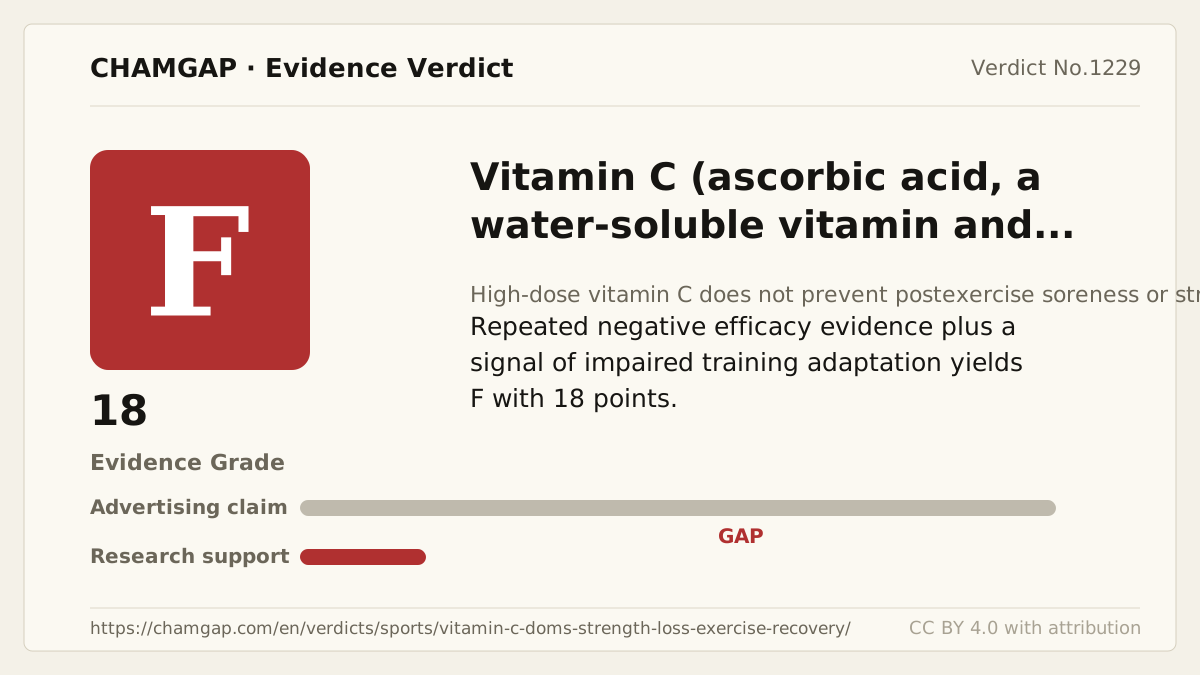
research showsHigh-dose vitamin C is rated F because it does not prevent postexercise soreness or strength loss. A meta-analysis of 18 randomized trials found no effect on soreness or strength, and a direct 3-g/day trial found no advantage for pain, tenderness, range of motion, or strength. A 1-g/day study also raised concern that vitamin C may blunt exercise-induced mitochondrial biogenesis and endurance adaptation.
ads claimThe antioxidant message mistakes lower oxidation markers for less pain and faster functional recovery. Reactive oxygen species also serve as training signals, so indiscriminate suppression is not necessarily beneficial.
Useful facts when choosing a product
- Vitamin C is essential for preventing deficiency, but high-dose recovery supplementation in replete athletes is a separate claim.
- High doses can cause diarrhea, abdominal pain, and nausea and may increase oxalate kidney-stone risk in susceptible people.
- Long-term high-dose antioxidant use around regular training may blunt adaptation signals; food intake and correction of deficiency take priority.
Chamgap Semantic Classification Code
Candidate index · review held
UNK.vitamin-c.UNK.delayed-onset-muscle-soreness-and-strength-loss-with-high-doses-before-and-after-exercise.prevent.placeboUnknown > Vitamin C > Unknown > delayed-onset muscle soreness and strength loss with high doses before and after exercise > Occurrence-prevention claim > Placebo
An automated migration candidate, not an issued permanent code; exact claim scope remains under review. This machine-generated migration candidate helps retrieval but is not a permanent assignment. The original verdict ID and URL remain authoritative.
What the research actually shows
Righi 2020 synthesized 18 trials with 313 participants: vitamin C reduced selected oxidation and IL-6 markers but not CK, CRP, soreness, or strength. Connolly 2006 gave 3 g/day to 24 participants and found no benefit for strength loss, tenderness, range of motion, or pain. Gomez-Cabrera 2008 combined a small human study with animal experiments and suggested that 1 g/day could blunt training adaptation and mitochondrial biogenesis.
Why this is classified as F (18)
Repeated negative findings in a direct trial and an 18-trial meta-analysis, plus a signal of impaired exercise adaptation, support F rather than D, with 14 points.
Counterpoint. Vitamin C use for deficiency or another medical indication is outside this exercise-recovery verdict.
Rejudgment record. Cross-check applied — Applied F because a vitamin-C-only trial and an 18-trial meta-analysis repeatedly found no DOMS or strength-preservation benefit, while human and mechanistic evidence suggests high-dose vitamin C can blunt exercise-induced mitochondrial biogenesis and endurance adaptation
Sub-claim grades by effect
This ingredient is marketed for several effects. A single overall grade blends strong and weak claims together, so each effect is graded separately here. The overall grade reflects the strongest disconfirming or core claim.
| Effect (sub-claim) | Grade | Basis |
|---|---|---|
| Prevention of delayed-onset muscle soreness | F | Direct randomized evidence and meta-analysis repeatedly failed to support the effect. |
| Prevention of postexercise strength loss | F | Neither the 3-g/day trial nor the synthesis found strength preservation. |
| Improved exercise recovery | F | Biomarker changes did not translate into functional recovery, and impaired adaptation is a concern. |
Cross-check — AI research and Codex final gate
Evidence Table
| Study | Design | Sample | Funding | Endpoint | Result | Weight |
|---|---|---|---|---|---|---|
| Righi NC et al. 2020 | Systematic review and meta-analysis of 18 placebo-controlled randomized trials | 313 healthy participants | Academic research | Oxidation, inflammation, muscle damage, soreness, and strength | Selected biomarkers fell, but soreness and strength did not improve. | Key synthesis of repeated null efficacy |
| Connolly DAJ et al. 2006 | Randomized placebo-controlled trial | 24 men and women | Inadequately reported | Strength loss, tenderness, range of motion, and subjective pain | Vitamin C at 3 g/day did not differ from placebo for any DOMS measure. | Direct negative high-dose trial |
| Gomez-Cabrera MC et al. 2008 | Small randomized human training study with mechanistic animal experiments | 14 healthy men and rats | Academic research | Training adaptation and mitochondrial biogenesis | Vitamin C at 1 g/day appeared capable of blunting useful exercise-adaptation signals. | Supporting signal of potential harm |
Receipt — 3 References
All 3 cited sources were verified for existence at the original page (as of 2026-07-23).
Final verification and publication gate: Codex · Evidence date: 2026-07-23 · Corrections: none
Cite this verdict
[Chamgap] Vitamin C x prevention of postexercise soreness and strength loss — Evidence Grade F·18. 3 cited sources checked. Source: https://chamgap.com/en/verdicts/sports/vitamin-c-doms-strength-loss-exercise-recovery/ · CC BY 4.0CC BY 4.0 — free to use with attribution; do not distort grades, numbers, or verdict meaning.
What this document does and does not do
Chamgap is an information source. It reports what research has and has not confirmed; it does not tell readers what to take or buy. That decision belongs to readers and, when needed, medical or legal professionals. This verdict reflects literature available up to the search date and may change as new research appears. Nothing here is medical advice.