
Tummy time,
does it really help with Improved motor development through four months corrected age?
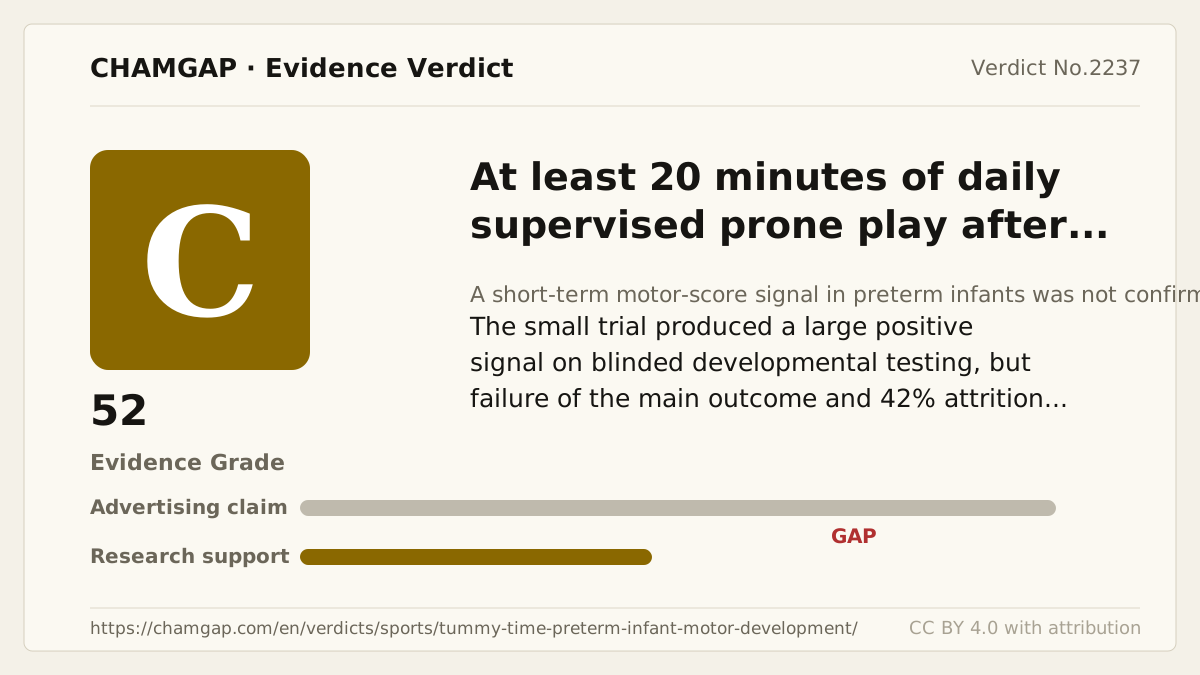
research showsThe grade is C. A single Brazilian trial randomized 31 preterm infants, but only 18 remained through four months corrected age. Bayley-III motor composite scores assessed by a blinded examiner were higher at two and four months, while the registered main outcome, prone head-elevation angle, did not differ between groups.
ads claimThis is a short post-discharge trial in preterm infants. It does not establish long-term walking or motor benefit in healthy term infants.
Useful facts when choosing a product
- The target was at least 20 minutes daily while awake and supervised.
- Head elevation was the angle from the ear tragus to the support surface measured from video with Kinovea software.
- The four-month corrected-age visit occurred one month after the intervention ended and included 18 infants.
Chamgap Semantic Classification Code
Candidate index · review held
UNK.at-least-of-supervised-prone-play-after-discharge.UNK.motor-development-through-corrected-age.improve.usual-careUnknown > At least of supervised prone play after discharge > Unknown > motor development through corrected age > Improvement claim > Usual care
An automated migration candidate, not an issued permanent code; exact claim scope remains under review. This machine-generated migration candidate helps retrieval but is not a permanent assignment. The original verdict ID and URL remain authoritative.
What the research actually shows
The trial enrolled 31 preterm infants born at 30 to 36 weeks 6 days and weighing under 2,500 g in a low-income setting in northeast Brazil, 16 intervention and 15 usual care. Parents were asked to provide at least 20 minutes of daily prone play with weekly telemonitoring and to record minutes in a booklet. A blinded examiner assessed Bayley-III motor and cognitive composites at two and four months corrected age. Twenty-six were assessed at two months and 18 at four months, eight versus ten. The paper did not provide a group summary of actual minutes, so attainment of the 20-minute target could not be verified.
Why this is classified as C (54)
A large short-term signal on blinded Bayley-III motor scores is offset by failure of the main outcome, only 31 randomized infants, and major attrition, giving C with 54 points.
Counterpoint. Parents recorded the three-month head-elevation video, but other visits used blinded assessment. Long-term independent walking, disability, and life function were not measured.
Rejudgment record. Cross-check applied — Large short-term signal on blinded secondary Bayley-III assessment, null main head-elevation outcome, small sample, and major attrition
| Endpoint | P | Symptom or function itself is the target - including patient reports and performance tests |
| Replication | R1 | Single confirmatory trial |
| Independence | I2 | Decisive evidence is publicly or non-profit funded |
| Effect size | E+ | Meets the clinically important threshold |
Stored derived and displayed grades match; this is not a current recalculation or validity check (C).
Sub-claim grades by effect
This ingredient is marketed for several effects. A single overall grade blends strong and weak claims together, so each effect is graded separately here. The overall grade reflects the strongest disconfirming or core claim.
| Effect (sub-claim) | Grade | Basis |
|---|---|---|
| Improved prone head-elevation angle | D | The main outcome showed no between-group difference. |
| Improved Bayley-III motor score | C | A large short-term difference appeared on blinded secondary assessment, but only 18 completed. |
Cross-check — AI research and Codex final gate
Evidence Table
| Study | Design | Sample | Funding | Endpoint | Result | Weight |
|---|---|---|---|---|---|---|
| Sampaio SSS et al. 2024 | Single-blind randomized clinical trial | 31 randomized; 26 assessed at two months and 18 at four months corrected age | Public support from CAPES Code 001 and CNPq | Main prone head-elevation angle; secondary Bayley-III motor and cognitive composites | No between-group head-elevation difference; reported motor effects d=2.81 at two months and 1.46 at four months | Small short-term evidence with major attrition |
Receipt — 2 References
All 2 cited sources were verified for existence at the original page (as of 2026-08-04).
Final verification and publication gate: Codex · Evidence date: 2026-08-04 · Corrections: none
Cite this verdict
[Chamgap] Tummy time x improved motor development in preterm infants — Evidence Grade C·54. 2 cited sources checked. Source: https://chamgap.com/en/verdicts/sports/tummy-time-preterm-infant-motor-development/ · CC BY 4.0CC BY 4.0 — free to use with attribution; do not distort grades, numbers, or verdict meaning.
What this document does and does not do
Chamgap is an information source. It reports what research has and has not confirmed; it does not tell readers what to take or buy. That decision belongs to readers and, when needed, medical or legal professionals. This verdict reflects literature available up to the search date and may change as new research appears. Nothing here is medical advice.