
Taurine alone,
does it really help with Longer time to exhaustion and better endurance performance in healthy exercisers when taken alone before exercise?
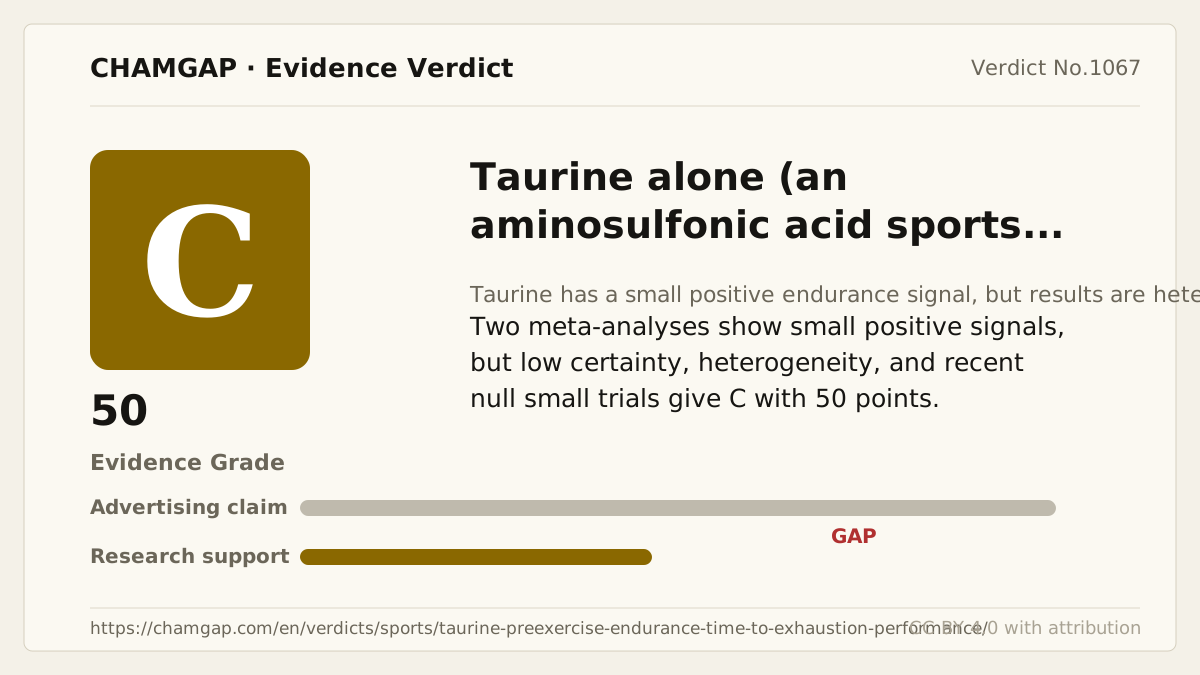
research showsPre-exercise taurine alone is rated C for longer time to exhaustion and better endurance performance in healthy exercisers. A 2018 meta-analysis of 10 articles found small positive effects on overall endurance and time to exhaustion, and a 2025 meta-analysis of 23 randomized trials and 308 participants found a positive overall performance signal with Hedges' g of 0.25. The newer review rated certainty low to very low, however, and prediction intervals often included the null because of heterogeneity, risk of bias, and small samples. Crossover trials with 11 participants in 2025 and 16 in 2026 found no improvement in time to exhaustion. The evidence therefore supports a limited positive signal rather than no effect, warranting C. Separate verdicts on fatigue, lifespan, and sleep address different efficacy axes, and safety remains separate.
ads claimMarketing claims that one dose prevents exhaustion or attributes an energy drink's effect to taurine alone. Most evidence comes from small laboratory crossover studies, and results from drinks containing caffeine or sugar cannot be assigned to taurine alone.
Useful facts when choosing a product
- Studies of taurine alone generally used 1 to 6 g in a capsule or beverage about one to two hours before exercise, but no consistent dose-response or optimal timing has been established.
- An energy drink containing caffeine, sugar, vitamins, and taurine is not a taurine-only intervention, so its alertness or performance effect cannot be attributed solely to taurine.
- Label accuracy, purity, and contamination with prohibited substances vary among sports supplements, so competitive athletes should check independent certification and sport-specific rules.
- Taurine does not replace hydration, carbohydrate availability, training, sleep, or pacing, and trying a new supplement for the first time on race day is unwise.
Chamgap Semantic Classification Code
Candidate index · review held
S.taurine-alone.UNK.longer-time-to-exhaustion-and-better-endurance-performance-when-taken-alone-before-exercise.assess.placeboSupplements and nutraceuticals > Taurine alone > Unknown > Longer time to exhaustion and better endurance performance when taken alone before exercise > Association or change assessment > Placebo
An automated migration candidate, not an issued permanent code; exact claim scope remains under review. This machine-generated migration candidate helps retrieval but is not a permanent assignment. The original verdict ID and URL remain authoritative.
What the research actually shows
Waldron and colleagues synthesized 10 articles on taurine alone and reported g 0.40 for endurance performance and g 0.43 across seven time-to-exhaustion trials, but the number of studies and samples was small and doses, durations, and participants varied. Deng and colleagues used a three-level model for 69 effect sizes from 23 randomized trials and 308 participants in 2025, finding overall performance g 0.25 but rating certainty low to very low. In Balshaw's crossover trial of eight trained runners, 1 g taken two hours before running improved 3-km time by 1.7% on average. In contrast, 6 g in the 11-participant Ghazzagh trial and 1 g in the 16-participant Camarotti Junior trial did not improve time to exhaustion. Blood taurine and fat oxidation were kept separate from actual performance outcomes.
Why this is classified as C (50)
Positive average effects in the 2018 and 2025 meta-analyses support C rather than D. The score is limited to 50 because the newest synthesis rated certainty low to very low, with substantial heterogeneity, bias concerns, small samples, and prediction intervals often including the null, while recent 11- and 16-participant trials found no time-to-exhaustion benefit. Generally good short-term tolerability was not used to raise the efficacy grade.
Counterpoint. A single 1-to-6-g dose may provide a small benefit for some exercisers under particular protocols, but the average effect is small and many people may notice nothing. Testing the same product and dose during training with actual performance measures and tolerability is more informative than advertising language.
Rejudgment record. New verdict — Accepted positive average endurance and overall-performance effects in the 2018 and 2025 meta-analyses, but assigned C for low-to-very-low certainty in the newer synthesis, heterogeneity, small samples, prediction intervals including the null, and null time-to-exhaustion findings in 2025 and 2026 crossover trials
Sub-claim grades by effect
This ingredient is marketed for several effects. A single overall grade blends strong and weak claims together, so each effect is graded separately here. The overall grade reflects the strongest disconfirming or core claim.
| Effect (sub-claim) | Grade | Basis |
|---|---|---|
| Longer time to exhaustion from taurine alone before exercise | C | The meta-analytic average is positive, but recent trials with 11 and 16 participants were null and certainty is low. |
| Improved endurance performance from taurine alone before exercise | C | A small positive average effect exists, but sports, doses, and timing are heterogeneous and replication in real competition is limited. |
| Replicable performance improvement from a single taurine dose across healthy exercisers | C | In the 2025 synthesis, effects weakened after influential studies were excluded and prediction intervals often included the null, leaving general replicability uncertain. |
Cross-check — AI research and Codex final gate
Evidence Table
| Study | Design | Sample | Funding | Endpoint | Result | Weight |
|---|---|---|---|---|---|---|
| Deng H et al. 2025 | Systematic review and three-level meta-analysis of randomized trials | 23 trials, 69 effect sizes, and 308 participants | Academic meta-analysis; funding sources and designs varied across included trials | Overall and modality-specific exercise performance after a single taurine dose | Overall performance favored taurine with g 0.25 (95% CI 0.10 to 0.39), but heterogeneity was 61%, prediction intervals frequently included the null, and certainty was low to very low. | Newest key synthesis with low certainty |
| Waldron M et al. 2018 | Meta-analysis of taurine alone for endurance performance | 10 articles; seven trials in the time-to-exhaustion subgroup | Academic meta-analysis; funding reporting varied among included trials | Overall endurance, time to exhaustion, dose, and acute versus short-term use | Average effects favored taurine for overall endurance at g 0.40 and time to exhaustion at g 0.43, without a dose-response. | Positive synthesis based on a small evidence base |
| Balshaw TG et al. 2013 | Double-blind randomized placebo-controlled crossover trial | Eight trained male middle-distance runners | Small academic trial with limited external-funding reporting | Three-kilometer treadmill time two hours after a single 1-g dose | Taurine improved mean time from 658.5 to 646.6 seconds, a 1.7% change, but only eight runners were studied. | Direct positive evidence with a very small sample |
| Ghazzagh A et al. 2025; Camarotti Junior F et al. 2026 | Two triple-blind randomized placebo-controlled crossover trials | Eleven endurance runners and 16 physically active young adults | Small academic trials with insufficient industry-funding information | Time to exhaustion, peak oxygen uptake, and energy metabolism after single 6-g or 1-g doses | Neither trial significantly improved time to exhaustion versus placebo. | Recent direct null evidence with very small samples |
Receipt — 5 References
All 5 cited sources were verified for existence at the original page (as of 2026-07-21).
Final verification and publication gate: Codex · Evidence date: 2026-07-21 · Corrections: none
Cite this verdict
[Chamgap] Taurine alone x longer time to exhaustion and improved endurance performance — Evidence Grade C·50. 5 cited sources checked. Source: https://chamgap.com/en/verdicts/sports/taurine-preexercise-endurance-time-to-exhaustion-performance/ · CC BY 4.0CC BY 4.0 — free to use with attribution; do not distort grades, numbers, or verdict meaning.
What this document does and does not do
Chamgap is an information source. It reports what research has and has not confirmed; it does not tell readers what to take or buy. That decision belongs to readers and, when needed, medical or legal professionals. This verdict reflects literature available up to the search date and may change as new research appears. Nothing here is medical advice.