
Static stretching,
does it really help with Clinically meaningful reduction in delayed-onset post-exercise muscle-soreness intensity?
research showsThe grade is D. Pure post-exercise stretching produced 24-hour soreness MD -1.04/100 (95% CI -6.88 to 4.79) across four trials, a null result. But no validated between-group minimal important difference exists for the soreness VAS; the often-cited 13 mm is a within-person change criterion for acute emergency-department pain. Meaningful benefit therefore cannot be claimed to be excluded. Repeated null results remain, but the precision condition for the lowest grade fails, giving 30 points.
ads claimFeeling looser after stretching is different from substantially reducing next-day muscle-soreness intensity. Flexibility, range of motion, and injury prevention are separate outcomes; this grade applies only to post-exercise soreness intensity.
Useful facts when choosing a product
- Pure post-exercise stretching and stretching both before and after exercise are different interventions.
- Eleven trials had only 10 to 30 participants per stretching group; the large trial separately had missing weekly reports and adjacent-observation imputation.
- Pre-exercise injury prevention and post-exercise soreness reduction are different questions; 1550 is D 29 points.
Chamgap Semantic Classification Code
Candidate index · review held
X.static-stretching-before-and-after.behavioral.delayed-onset-post-exercise-muscle-soreness-intensity.reduce.baselineBehaviors, exposures and policies > Static stretching before and after > Behavioral delivery > delayed-onset post-exercise muscle-soreness intensity > Reduction claim > Within-group baseline comparison
An automated migration candidate, not an issued permanent code; exact claim scope remains under review. This machine-generated migration candidate helps retrieval but is not a permanent assignment. The original verdict ID and URL remain authoritative.
What the research actually shows
Cochrane included 12 randomized trials. Eleven had only 10 to 30 participants in each stretching group; the separate large field trial included 2,377 participants, 1,220 assigned to stretching. Pure post-exercise stretching produced 24-hour soreness MD -1.04/100 (95% CI -6.88 to 4.79) across four trials. The earlier five-trial, 77-person synthesis found -0.9/100 (-4.4 to 2.6). I-squared was not reported; heterogeneity tests were P=0.97 at 24 hours and P=0.99 at 48 hours. The large before-and-after field intervention found peak soreness MD -3.80/100 (-5.17 to -2.43), statistically positive but very small. Trials were mostly small, and the large study received only 72.1% of required weekly reports and imputed missing values from adjacent observations.
Why this is classified as D (30)
Repeated null results remain, but no validated between-group soreness threshold permits precise exclusion of meaningful benefit, giving D with 30 points.
Counterpoint. The approximate one-in-13 reduction in weeks with bothersome soreness is acknowledged separately. That binary outcome cannot substitute for an intensity-reduction claim.
Rejudgment record. Cross-check applied — Soreness-intensity effects are repeatedly tiny, but no validated between-group minimal important difference exists, so the precise-exclusion condition for the lowest grade is not met
| Endpoint | P | Symptom or function itself is the target - including patient reports and performance tests |
| Replication | RX | Repeatedly refuted in the same indication |
| Independence | I2 | Decisive evidence is publicly or non-profit funded |
| Effect size | E0 | Null |
| Precision | C0 | The confidence interval leaves room for benefit |
Stored derived and displayed grades match; this is not a current recalculation or validity check (D).
Sub-claim grades by effect
This ingredient is marketed for several effects. A single overall grade blends strong and weak claims together, so each effect is graded separately here. The overall grade reflects the strongest disconfirming or core claim.
| Effect (sub-claim) | Grade | Basis |
|---|---|---|
| Noticeable reduction in post-exercise soreness intensity | D | Differences were repeatedly small, but no validated between-group threshold permits precise exclusion of meaningful reduction. |
| Reduced next-day soreness intensity from pre-exercise stretching | D | The three-trial estimate was -0.52/100, but its wide interval did not completely exclude meaningful benefit. |
| Reduced occurrence of weekly bothersome soreness | B | The large trial succeeded at 24.6% versus 32.3%, OR 0.69, but this is a separate binary endpoint. |
Cross-check — AI research and Codex final gate
Evidence Table
| Study | Design | Sample | Funding | Endpoint | Result | Weight |
|---|---|---|---|---|---|---|
| Jamtvedt G et al. 2010 | International internet-based pragmatic randomized trial | 2,377 randomized, stretching 1,220 and no stretching 1,157, analyzed by intention to treat; 72.1% of weekly soreness reports received | Public academic network led by the Norwegian Knowledge Centre for Health Services; no manufacturer sponsorship identified | Co-primary: all injury and weekly bothersome soreness; secondary: peak soreness intensity | Bothersome soreness 24.6% versus 32.3%, OR 0.69 (95% CI 0.59 to 0.82); peak intensity -3.80/100 (-5.17 to -2.43) | Large independent trial for soreness intensity |
| Herbert RD et al. 2011 and 2022 Cochrane review | Systematic review of randomized stretching trials for post-exercise soreness | Twelve trials; four trials for 24-hour soreness after post-exercise stretching | Independent Cochrane review across multiple research groups | Post-exercise soreness intensity on a 0-to-100 scale | At 24 hours, mean difference -1.04 (95% CI -6.88 to 4.79); earlier five-trial, 77-person estimate -0.9 (-4.4 to 2.6) | Synthesis of repeated null findings on the same intensity endpoint |
Receipt — 2 References
All 2 cited sources were verified for existence at the original page (as of 2026-08-02).
Final verification and publication gate: Codex · Evidence date: 2026-08-02 · Corrections: none
Cite this verdict
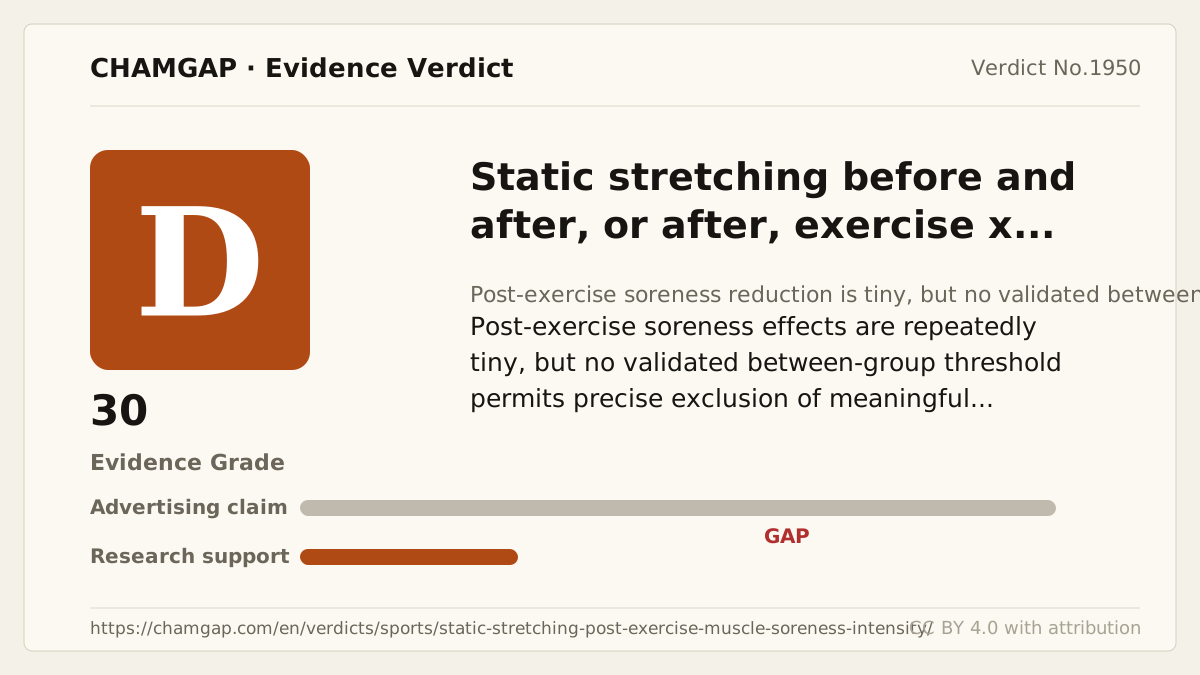
[Chamgap] Static stretching x reduced post-exercise muscle-soreness intensity — Evidence Grade D·30. 2 cited sources checked. Source: https://chamgap.com/en/verdicts/sports/static-stretching-post-exercise-muscle-soreness-intensity/ · CC BY 4.0CC BY 4.0 — free to use with attribution; do not distort grades, numbers, or verdict meaning.
What this document does and does not do
Chamgap is an information source. It reports what research has and has not confirmed; it does not tell readers what to take or buy. That decision belongs to readers and, when needed, medical or legal professionals. This verdict reflects literature available up to the search date and may change as new research appears. Nothing here is medical advice.