
Sports mouthguard,
does it really help with Prevention of dental and orofacial injuries during contact sports?
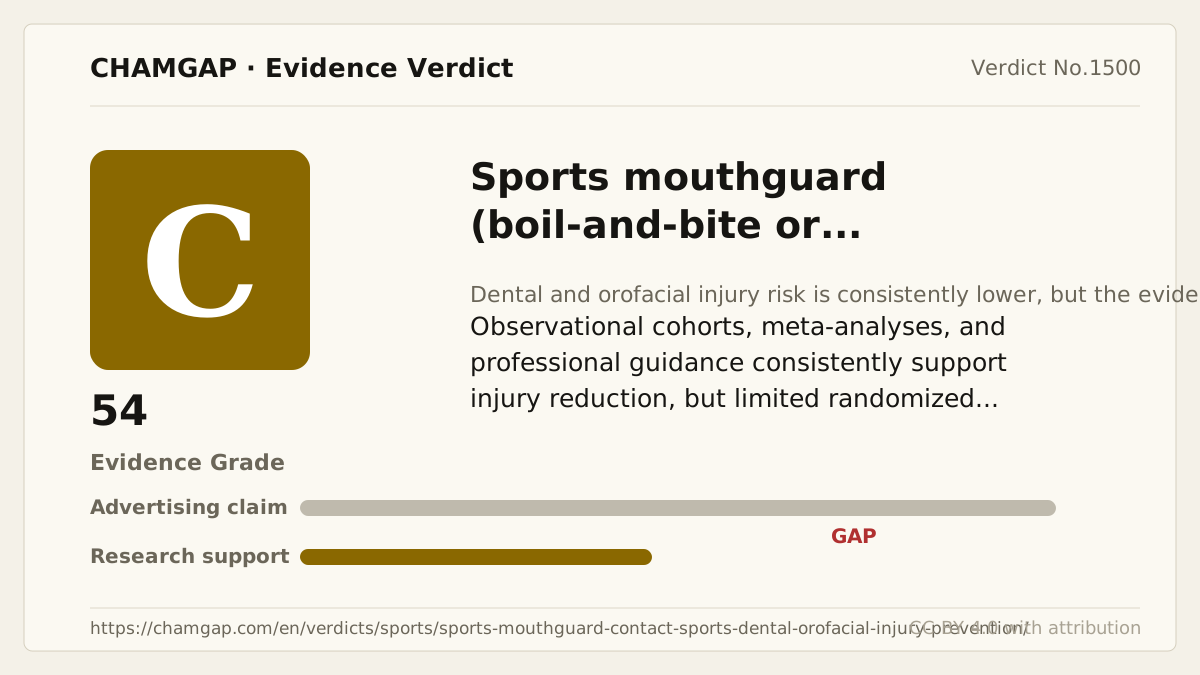
research showsSports mouthguards are rated C for preventing dental and orofacial injuries. In a 2019 meta-analysis of 12 cohort studies, nonusers had 2.33 times the orofacial-injury risk of users, and a separate dentoalveolar-trauma meta-analysis also found lower prevalence among users. Professional organizations including the UK Faculty of Sport and Exercise Medicine recommend a well-fitting mouthguard during training and competition in at-risk sports. Evidence, however, is dominated by observational and nonrandomized studies with varying sports, guard types, and injury definitions, leaving behavioral confounding. Consistent support with limited randomization yields 54 points.
ads claimClaims of complete impact absorption, protection of the entire face, or concussion prevention exceed the evidence. Support is most consistent for dental and orofacial injury; the 2019 concussion estimate was uncertain at RR 1.25 (95% CI 0.90 to 1.74).
Useful facts when choosing a product
- Sports mouthguards include stock, boil-and-bite, and dentist-fabricated custom products, with different fit, retention, and thickness.
- A guard should fit securely, remain in place during impact, and avoid excessive interference with breathing or speech. It should be worn consistently during training and competition.
- Clean and dry it after use and replace it if distorted, torn, sharp-edged, or loose. Growing athletes and people with orthodontic appliances need regular fit checks.
- Discomfort, gagging, speech or breathing interference, excess saliva, odor, and microbial contamination from poor hygiene can occur. An ill-fitting device should be adjusted rather than forced.
Chamgap Semantic Classification Code
Candidate index · review held
UNK.sports-mouthguard.oral.dental-and-orofacial-injuries-during-contact-sports.prevent.UNKUnknown > Sports mouthguard > Oral > dental and orofacial injuries during contact sports > Occurrence-prevention claim > Unknown
An automated migration candidate, not an issued permanent code; exact claim scope remains under review. This machine-generated migration candidate helps retrieval but is not a permanent assignment. The original verdict ID and URL remain authoritative.
What the research actually shows
Knapik and colleagues included 26 studies. Across 12 cohorts, nonusers had 2.33 times the orofacial-injury risk of users; 11 self-report studies pointed in a similar direction, although methods and definitions had multiple weaknesses. Fernandes and colleagues qualitatively synthesized 14 studies and quantitatively synthesized 11. In eight studies free of major problems or with only minor problems, dentoalveolar trauma occurred in 7.75% of users and 48.31% of nonusers. Selection and recall confounding mean this large relative difference should not be treated as an exact individual effect. FSEM recommends a well-fitting guard in both training and competition.
Why this is classified as C (54)
Cohort and prevalence studies across contact sports, two meta-analyses, and professional guidance consistently support lower dental and orofacial injury risk. Predominantly nonrandomized evidence, methodological and product heterogeneity, and adherence confounding limit the grade to C with 54 points.
Counterpoint. Protection is not complete, so sport rules, facial protection, safe technique, and an immediate dental-trauma plan remain necessary. Concussion prevention is a separate uncertain claim.
Rejudgment record. New verdict — Applied the rule ① ceiling of C because dentoalveolar and orofacial injury meta-analyses and professional recommendations consistently support risk reduction, while evidence is dominated by observational and nonrandomized studies with heterogeneous sports, products and injury definitions and residual adherence and safety-behavior confounding
Sub-claim grades by effect
This ingredient is marketed for several effects. A single overall grade blends strong and weak claims together, so each effect is graded separately here. The overall grade reflects the strongest disconfirming or core claim.
| Effect (sub-claim) | Grade | Basis |
|---|---|---|
| Prevention of dental injury | C | Dentoalveolar-trauma meta-analysis shows consistent reduction, but evidence is predominantly nonrandomized. |
| Prevention of orofacial injury | C | Twelve pooled cohorts favor users, but sports, products, and injury definitions are heterogeneous. |
| Reduced severity of dental injury | C | Professional guidance supports lower risk and severity, but direct quantitative evidence is more limited than for injury occurrence. |
Cross-check — AI research and Codex final gate
Evidence Table
| Study | Design | Sample | Funding | Endpoint | Result | Weight |
|---|---|---|---|---|---|---|
| Knapik JJ et al. 2019 | Systematic review and meta-analysis | 26 studies, including 12 orofacial-injury cohorts and 11 self-report studies | United States Army research institutions and academic research | Orofacial injury and concussion incidence | Nonusers had 2.33 times the orofacial-injury risk across 12 cohorts, while the concussion RR of 1.25 was nonsignificant. | Key observational synthesis with concussion separated |
| Fernandes LM et al. 2019 | Systematic review and meta-analysis of dentoalveolar trauma | 14 studies in qualitative and 11 in quantitative synthesis | Brazilian public academic institutions | Prevalence of dentoalveolar trauma in contact-sport athletes | Across eight principal studies, prevalence was 7.75% in users and 48.31% in nonusers, with OR 0.18. | Supports consistency for dental trauma |
| Ahmed I et al. 2024 FSEM position statement | Multidisciplinary professional position statement | Sports dentistry and medicine evidence plus athlete and coach perspectives | Faculty of Sport and Exercise Medicine UK | Prevention of sports-related orofacial trauma | Recommended a well-fitting mouthguard during training and competition for all athletes at anticipated risk. | Current professional recommendation |
Receipt — 3 References
All 3 cited sources were verified for existence at the original page (as of 2026-07-23).
Final verification and publication gate: Codex · Evidence date: 2026-07-23 · Corrections: none
Cite this verdict
[Chamgap] Sports mouthguard x prevention of dental and orofacial injuries in contact sports — Evidence Grade C·54. 3 cited sources checked. Source: https://chamgap.com/en/verdicts/sports/sports-mouthguard-contact-sports-dental-orofacial-injury-prevention/ · CC BY 4.0CC BY 4.0 — free to use with attribution; do not distort grades, numbers, or verdict meaning.
What this document does and does not do
Chamgap is an information source. It reports what research has and has not confirmed; it does not tell readers what to take or buy. That decision belongs to readers and, when needed, medical or legal professionals. This verdict reflects literature available up to the search date and may change as new research appears. Nothing here is medical advice.