
Spirulina,
does it really help with Improved aerobic endurance and time to exhaustion in healthy exercisers?
research showsSpirulina is rated C because a small positive signal for aerobic endurance and time to exhaustion conflicts with null results. A nine-person crossover trial increased high-intensity time to exhaustion after a two-hour run from 2.05 to 2.70 minutes, but a 17-person cycling crossover trial found no difference in maximal oxygen uptake, maximal work rate, or time to exhaustion. A 2025 trial in 20 cyclists lowered heart rate at lactate threshold slightly but did not improve major performance variables such as power, oxygen uptake, or perceived exertion. A 2026 meta-analysis reported a pooled positive signal for time to exhaustion, but it combined spirulina, chlorella, brown algae, and astaxanthin and cannot be attributed directly to spirulina. The small positive trial is accepted, while inconsistency, limited samples, and differing protocols produce C with 46 points.
ads claimMarketing converts antioxidant activity, phycocyanin, or changes in hemoglobin into claims of longer endurance and faster race times. Results actually vary by protocol, and one trial increased hemoglobin without improving time to exhaustion.
Useful facts when choosing a product
- Exercise trials commonly used spirulina 6 g/day for two to four weeks, but this dose and duration have not been established as optimal across products or sports.
- Spirulina is a microalgal ingredient containing phycocyanin and protein. Results for isolated phycocyanin, chlorella, or brown algae cannot automatically be assigned to spirulina.
- Controlled products were generally well tolerated, but contamination with heavy metals, microbes, or microcystins can vary with cultivation and purification quality.
- Third-party quality testing is prudent, and people with liver or autoimmune disease, pregnancy or lactation, or immune- or coagulation-related medication use should seek professional advice.
Chamgap Semantic Classification Code
Candidate index · review held
S.spirulina.UNK.aerobic-endurance-and-time-to-exhaustion.improve.placeboSupplements and nutraceuticals > Spirulina > Unknown > aerobic endurance and time to exhaustion > Improvement claim > Placebo
An automated migration candidate, not an issued permanent code; exact claim scope remains under review. This machine-generated migration candidate helps retrieval but is not a permanent assignment. The original verdict ID and URL remain authoritative.
What the research actually shows
Kalafati and colleagues gave nine moderately trained men spirulina 6 g/day or placebo for four weeks each in a crossover trial and reported longer time to exhaustion after a prolonged preliminary run. Ali and colleagues gave 17 recreationally active cyclists 6 g/day for 14 days and found no difference in maximal oxygen uptake, maximal work rate, time to exhaustion, or other aerobic outcomes. Gurney and colleagues studied 20 healthy cyclists in a three-week crossover trial at simulated altitude; heart rate at lactate threshold fell by 3 beats per minute, but power, oxygen uptake, perceived exertion, and respiratory exchange ratio did not differ. Wei in 2026 pooled 22 algae trials with 822 participants and reported a time-to-exhaustion SMD of 1.06, but the ingredient classes were mixed and time-trial performance was not significant, so this does not confirm spirulina alone.
Why this is classified as C (46)
A randomized crossover trial directly improved time to exhaustion, so the evidence is neither absent nor exclusively null. Its sample was only nine, however, and later trials were null for maximal oxygen uptake, work rate, time to exhaustion, power, and other major outcomes, while the newest meta-analysis mixed algae ingredients. Limited positive evidence, inconsistency, and ingredient indirectness yield C with 46 points; contamination and product variability are separate safety issues.
Counterpoint. Training, carbohydrate availability, sleep, and correction of iron deficiency have much stronger roles in endurance. Anyone trying spirulina can track performance under comparable training conditions and should not continue solely because a surrogate such as hemoglobin changed.
Rejudgment record. Cross-verification incorporated — Applied C for limited and conflicting evidence by accepting the direct positive time-to-exhaustion signal in a nine-person crossover trial while incorporating null maximal oxygen uptake, maximal work rate, and exhaustion results in a 17-person crossover trial, null major performance variables in a newer 20-person trial, and ingredient indirectness in a mixed-algae meta-analysis
Sub-claim grades by effect
This ingredient is marketed for several effects. A single overall grade blends strong and weak claims together, so each effect is graded separately here. The overall grade reflects the strongest disconfirming or core claim.
| Effect (sub-claim) | Grade | Basis |
|---|---|---|
| Improved aerobic endurance in healthy exercisers | C | Some physiological and performance signals exist, but maximal oxygen uptake, power, and time-trial results are inconsistent. |
| Longer time to exhaustion in healthy exercisers | C | A nine-person running trial was positive, a 17-person cycling trial was null, and the pooled positive result combines several algae ingredients. |
| Improved time-trial performance in healthy exercisers | D | The 16.1-km trial and the 2026 pooled time-trial result were not significant. |
Cross-check — AI research and Codex final gate
Evidence Table
| Study | Design | Sample | Funding | Endpoint | Result | Weight |
|---|---|---|---|---|---|---|
| Kalafati M et al. 2010 | Randomized double-blind placebo-controlled counterbalanced crossover trial | Nine moderately trained men | Funding source not stated in the public abstract | Time to exhaustion at 95% of maximal oxygen uptake after a two-hour run, substrate oxidation, and redox measures | After four weeks of spirulina 6 g/day, time to exhaustion increased from 2.05 ± 0.68 to 2.70 ± 0.79 minutes. | Direct positive evidence with a very small sample |
| Ali Y et al. 2024 | Randomized double-blind placebo-controlled crossover trial | Seventeen recreationally active cyclists; 18 in the hemoglobin analysis | No potential conflict reported; an Indigo Herbs product was used | Maximal oxygen uptake, maximal work rate, time to exhaustion, heart rate, lactate, and hemoglobin | Hemoglobin increased by 3.4%, but maximal oxygen uptake, maximal work rate, time to exhaustion, and cardiorespiratory variables did not differ from placebo. | Core direct null evidence separating a surrogate from performance |
| Gurney T et al. 2025 | Randomized double-blind placebo-controlled crossover trial | Twenty healthy cyclists | University research; external funding details not stated in the public abstract | Power, oxygen uptake, heart rate, perceived exertion, respiratory exchange ratio, and blood measures at lactate threshold under simulated altitude | Heart rate was lower at 152 versus 155 beats per minute, but power, oxygen uptake, perceived exertion, respiratory exchange ratio, and most blood measures did not differ. | Recent null evidence for major performance variables |
| Wei Y et al. 2026 | Systematic review and meta-analysis of randomized algae-supplement trials | Twenty-two randomized trials and 822 participants | Chinese academic research; detailed funding not stated in the public abstract | Maximal oxygen uptake, time to exhaustion, maximal work rate, time trial, and creatine kinase | The pooled algae time-to-exhaustion SMD was 1.06, while time-trial performance was null and spirulina, chlorella, brown algae, and astaxanthin were combined. | Supportive synthesis with major ingredient indirectness |
Receipt — 5 References
All 5 cited sources were verified for existence at the original page (as of 2026-07-21).
Final verification and publication gate: Codex · Evidence date: 2026-07-21 · Corrections: none
Cite this verdict
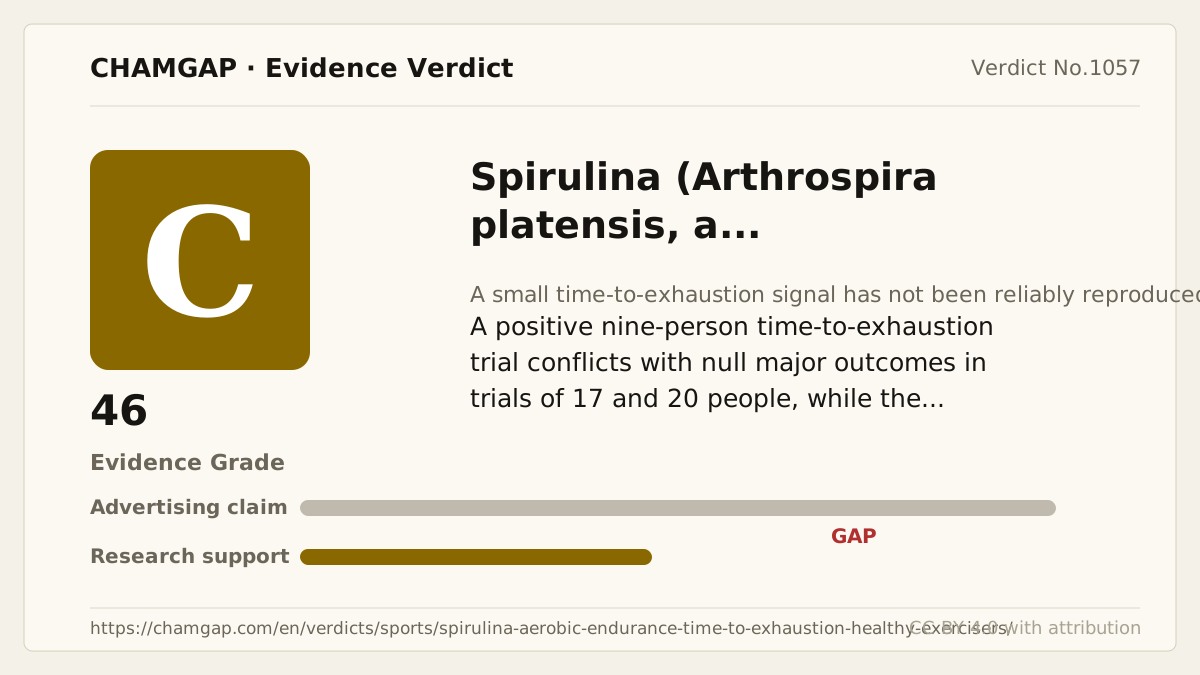
[Chamgap] Spirulina x improved aerobic endurance and time to exhaustion in healthy exercisers — Evidence Grade C·46. 5 cited sources checked. Source: https://chamgap.com/en/verdicts/sports/spirulina-aerobic-endurance-time-to-exhaustion-healthy-exercisers/ · CC BY 4.0CC BY 4.0 — free to use with attribution; do not distort grades, numbers, or verdict meaning.
What this document does and does not do
Chamgap is an information source. It reports what research has and has not confirmed; it does not tell readers what to take or buy. That decision belongs to readers and, when needed, medical or legal professionals. This verdict reflects literature available up to the search date and may change as new research appears. Nothing here is medical advice.