
Sodium phosphate loading,
does it really help with Improved endurance and time-trial performance in trained cyclists?
research showsThe claim that sodium phosphate loading improves endurance and time-trial performance in trained cyclists is rated C. A 2008 double-blind crossover trial in six trained men reported a 3.0% faster 16.1-km time versus placebo and 9.8% higher mean power, but completion time did not differ significantly from a separate unsupplemented control. Later 500-kJ testing in 13 women, 100- and 250-kJ testing in 10 trained cyclists, and a 2023 30-km trial in 16 well-trained cyclists did not replicate faster performance. A 2019 systematic review identified 17 phosphate studies with 247 participants but found that the broader mineral-supplement evidence was generally moderate to weak, and the Australian Institute of Sport places phosphate in Group C because findings are equivocal. Crossover trials with only 6, 13, and 16 participants failed to separate reliably from an unsupplemented control or conflicted with one another, placing the verdict at the bottom of C with 40 points.
ads claimMarketing converts mechanisms such as greater oxygen transport, ATP replenishment, and higher peak oxygen uptake into a promise of faster race times. Trials used different mono-, di-, or tribasic and hydrated salts, different absolute phosphate and sodium quantities, loading periods, distances, and sexes, with no standard protocol; physiological changes often failed to improve time-trial performance.
Useful facts when choosing a product
- Sports studies generally used approximately 3 to 5 g/day of sodium phosphate, or a fat-free-mass-based dose, divided for three to six days. This is not an established performance dose, and phosphate and sodium delivery varies by salt form.
- Sodium phosphate is not sodium bicarbonate. Performance evidence for sodium bicarbonate cannot be transferred to phosphate loading.
- Even short loading can cause abdominal discomfort, nausea, or diarrhea. People with impaired kidney function, heart failure, electrolyte disorders, or prescribed phosphorus or sodium restriction should avoid unsupervised loading.
- High phosphate exposure can cause hyperphosphatemia, hypocalcemia, and a sodium burden. High-dose oral sodium-phosphate bowel preparation is not identical to sports loading, but its harms should not be used to assume lower-dose loading is risk free.
Chamgap Semantic Classification Code
Candidate index · review held
S.sodium-phosphate.oral.endurance-and-time-trial-performance-in-trained-cyclists.improve.MULTISupplements and nutraceuticals > Sodium phosphate > Oral > endurance and time-trial performance in trained cyclists > Improvement claim > Multiple: primary unresolved
An automated migration candidate, not an issued permanent code; exact claim scope remains under review. This machine-generated migration candidate helps retrieval but is not a permanent assignment. The original verdict ID and URL remain authoritative.
What the research actually shows
In the randomized double-blind Folland 2008 crossover trial, six men completed 16.1 km an average 3.0% faster after sodium phosphate than after placebo, but not significantly faster than an unsupplemented control. Buck 2014 gave 13 women 25, 50, and 75 mg/kg fat-free mass for six days and found no 500-kJ time benefit, with P=0.73. Brewer 2014 found no 100- or 250-kJ time benefit one or eight days after loading in 10 trained cyclists. Pope 2023 gave 16 cyclists dibasic sodium phosphate 3.5 g/day for four days and found 30-km times of 3,059 versus 2,995 seconds, with no benefit. The Heffernan 2019 systematic review identified 17 phosphate studies involving 247 participants, including 13 randomized trials, but judged the broader evidence quality and functional consistency inadequate. The Australian Institute of Sport places phosphate in Group C, describing the performance evidence as equivocal and gastrointestinal distress as common with loading of about 3 to 5 g/day for three to six days.
Why this is classified as C (40)
A positive signal of 3.0% faster performance and 9.8% higher mean power in six men is weakened by no time difference from an unsupplemented control and by failures to replicate benefit in crossover trials with 13 and 16 participants and another trial with 10 cyclists. Rule ①-ⓒ caps small, short, conflicting evidence at C, and the extreme sample limitations place the verdict at C with 40 points.
Counterpoint. An athlete could test individual response under professional supervision, but one good performance is difficult to separate from training status, learning, and ordinary variation. Evidence does not support routine use as a race supplement; training, carbohydrate availability, hydration, and better-validated strategies take priority.
Rejudgment record. Cross-check applied — Rule ①-ⓒ: evidence that is small, single-manufacturer, short-term, or conflicting is capped at C. A positive crossover trial in six men conflicts with negative trials in 13 women, 10 trained cyclists, and 16 well-trained cyclists, while formulations, doses, and distances remain unstandardized, so C applies.
Sub-claim grades by effect
This ingredient is marketed for several effects. A single overall grade blends strong and weak claims together, so each effect is graded separately here. The overall grade reflects the strongest disconfirming or core claim.
| Effect (sub-claim) | Grade | Basis |
|---|---|---|
| Improved time-trial performance in trained cyclists | C | A 3.0% signal in six men was not replicated in later trials with 10, 13, and 16 participants. |
| Improved peak oxygen uptake and aerobic capacity | C | Some studies reported positive physiological markers, but findings conflict and did not consistently translate into faster performance. |
| Consistent performance improvement across doses, sexes, and distances | D | Results did not replicate across formulations, doses, sexes, and distances, so a consistent benefit is not supported. |
Cross-check — AI research and Codex final gate
Evidence Table
| Study | Design | Sample | Funding | Endpoint | Result | Weight |
|---|---|---|---|---|---|---|
| Folland JP et al. 2008 | Randomized double-blind placebo-controlled crossover trial | Six trained male cyclists | Academic study; no commercial funding reported | 16.1-km time-trial time, mean power, and oxygen uptake | Time improved by 3.0% and mean power by 9.8% versus placebo, but time did not differ significantly from the unsupplemented control. | Positive signal from an extremely small sample |
| Buck CL et al. 2014 | Randomized Latin-square placebo-controlled multiple-dose crossover trial | Thirteen female cyclists | Academic research at the University of Western Australia | 500-kJ time-trial time, mean power, and peak power | No dose of 25, 50, or 75 mg/kg fat-free mass improved time versus placebo (P=0.73). | Direct negative replication trial |
| Pope H et al. 2023 | Randomized single-blind sodium-matched crossover trial | Sixteen well-trained cyclists | Academic research at the University of Bath | 30-km time-trial time, mean power, and cardiovascular strain | Times were 3,059 seconds with sodium phosphate versus 2,995 seconds with sodium control, with no meaningful mean-power benefit. | Recent direct negative trial |
| Heffernan SM et al. 2019 | Systematic review of mineral and trace-element supplementation | Seventeen phosphate studies with 247 participants, including 13 randomized trials | Irish academic research | Exercise capacity, performance, and physiological measures | Some positive findings existed, but study quality and consistency of functional performance were inadequate and required better trials. | Synthesis of conflicting low-quality evidence |
Receipt — 5 References
All 5 cited sources were verified for existence at the original page (as of 2026-07-24).
Final verification and publication gate: Codex · Evidence date: 2026-07-24 · Corrections: none
Cite this verdict
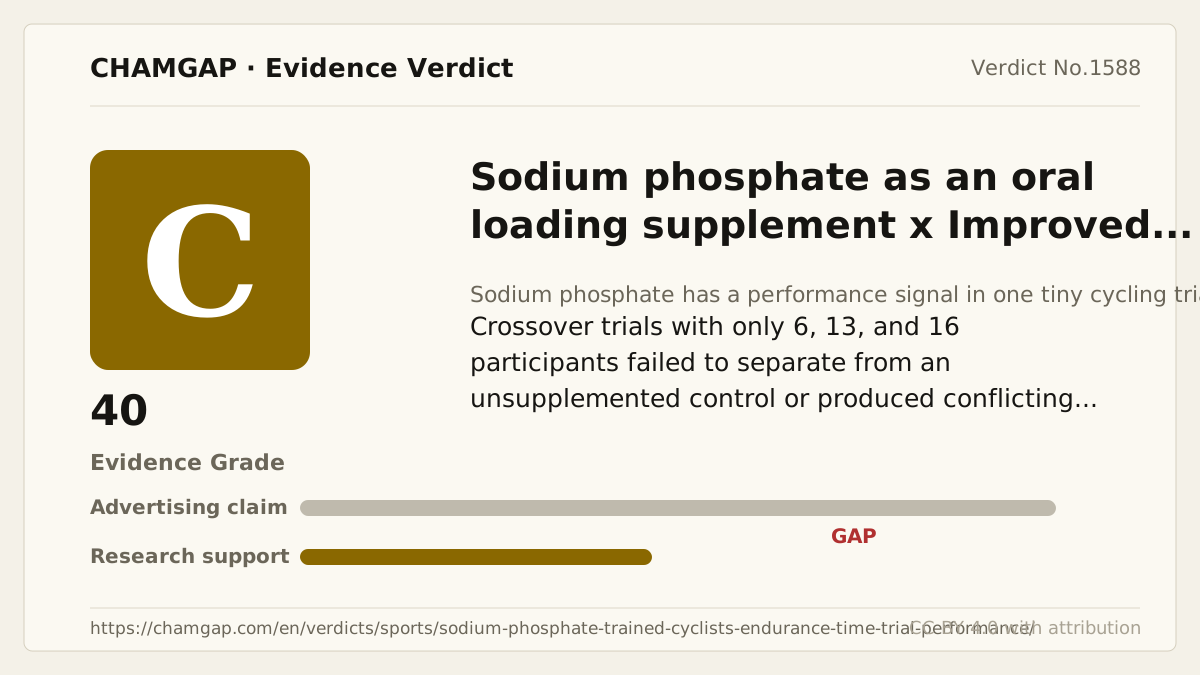
[Chamgap] Sodium phosphate loading x improved endurance and time-trial performance in trained cyclists — Evidence Grade C·40. 5 cited sources checked. Source: https://chamgap.com/en/verdicts/sports/sodium-phosphate-trained-cyclists-endurance-time-trial-performance/ · CC BY 4.0CC BY 4.0 — free to use with attribution; do not distort grades, numbers, or verdict meaning.
What this document does and does not do
Chamgap is an information source. It reports what research has and has not confirmed; it does not tell readers what to take or buy. That decision belongs to readers and, when needed, medical or legal professionals. This verdict reflects literature available up to the search date and may change as new research appears. Nothing here is medical advice.