
Snowboard wrist guard,
does it really help with Prevention of wrist fractures and sprains during snowboarding?
research showsSnowboard wrist guards are rated B because randomized evidence shows fewer clinically important combined wrist fractures and sprains. In the Rønning trial, which randomized 5,029 snowboarder-day observations, wrist injuries numbered 8 with a guard versus 29 without one. The component counts were 3 versus 2 fractures and 5 versus 27 sprains, however, so the large trial's benefit was driven mainly by fewer sprains and did not establish fracture prevention by itself. A separate 721-person trial found 1 versus 9 severe wrist injuries, but the intention-to-treat hazard ratio of 0.13 had a 95% confidence interval extending to 1.04. Two direct injury-prevention trials support efficacy, but design specificity, repeat enrollment, adherence, and uncertain fracture benefit limit the verdict to B with 68 points.
ads claimMarketing may promise complete fracture prevention or equivalent performance from every guard. The clear reduction in the large trial was driven by sprains, while the fracture-prevention signal came from a separate borderline trial and depended on specific guard designs.
Useful facts when choosing a product
- A snowboard wrist guard is nonmedical protective equipment that uses reinforcement on the palm or back of the wrist to limit hyperextension and impact during a fall.
- Randomized trials tested specific designs, including a D-ring brace and a separately optimized protector. Products with different lengths, stiffness, reinforcement positions, and fixation methods have not been shown to provide equivalent protection.
- A guard must fit correctly, avoid interfering with gloves or clothing, and remain on throughout riding. In one trial, 12 protected participants secretly discarded their guards, and the only severe protected-arm injury occurred in one of them.
- The two randomized trials found no statistically significant increase in injuries to the arm, shoulder, or other sites, but event counts were too small to completely exclude injury transfer. A guard does not replace instruction, speed control, or safer falling technique.
Chamgap Semantic Classification Code
Candidate index · review held
M.snowboard-wrist-guard.UNK.wrist-fractures-and-sprains-during-snowboarding.prevent.UNKMedicinal interventions > Snowboard wrist guard > Unknown > wrist fractures and sprains during snowboarding > Occurrence-prevention claim > Unknown
An automated migration candidate, not an issued permanent code; exact claim scope remains under review. This machine-generated migration candidate helps retrieval but is not a permanent assignment. The original verdict ID and URL remain authoritative.
What the research actually shows
Rønning 2001 block-randomized 5,029 one-day snowboard observations at a Norwegian resort to a D-ring wrist brace or no brace. Wrist injuries fell from 29 to 8, comprising 2 versus 3 fractures and 27 versus 5 sprains in the control and braced groups. The examining physician was blinded, but a person could be included on multiple days and each observation was analyzed as independent. Machold 2002 randomized 721 Austrian snowboarders to an optimized guard or no protection and recorded 1 versus 9 severe wrist injuries. The intention-to-treat hazard ratio was 0.13 (95% CI 0.02 to 1.04), 12 protected participants stopped wearing the guard, and the sole severe injury in the protected arm occurred in one of them. Neither trial found a statistically significant increase in other injuries, but event counts limited power to exclude injury transfer.
Why this is classified as B (68)
A 5,029-snowboarder-day randomized trial directly reduced combined wrist fracture or sprain from 29 to 8 events, and a separate 721-person trial pointed in the same direction with 1 versus 9 severe wrist injuries. The large result was driven by sprains at 5 versus 27 while fractures were 3 versus 2, the second trial's intention-to-treat confidence interval crossed one, and product and adherence limitations support B with 68 points.
Counterpoint. Beginners have especially high wrist-injury risk and may gain practical value from consistently wearing a properly fitted guard. Guards do not prevent every fracture, and pain, swelling, deformity, or restricted motion after a fall still requires assessment.
Rejudgment record. New verdict — A 5,029-snowboarder-day randomized trial reduced combined wrist fracture or sprain from 29 to 8 events and a separate 721-person trial pointed toward fewer severe injuries, but the large benefit was driven by sprains and fracture-specific efficacy, product generalizability, and adherence remain limited, supporting B
Sub-claim grades by effect
This ingredient is marketed for several effects. A single overall grade blends strong and weak claims together, so each effect is graded separately here. The overall grade reflects the strongest disconfirming or core claim.
| Effect (sub-claim) | Grade | Basis |
|---|---|---|
| Prevention of combined wrist fracture or sprain | B | The large randomized trial found a significant reduction from 29 events without a guard to 8 with a guard. |
| Prevention of wrist sprain | B | Sprains numbered 5 in the guarded group versus 27 in controls and drove the Rønning composite benefit. |
| Prevention of wrist fracture | C | Fractures were 3 versus 2 in the large trial, while a separate severe-injury trial found 1 versus 9 but its intention-to-treat confidence interval crossed one. |
Cross-check — AI research and Codex final gate
Evidence Table
| Study | Design | Sample | Funding | Endpoint | Result | Weight |
|---|---|---|---|---|---|---|
| Rønning R et al. 2001 | Prospective randomized clinical trial with blinded injury assessment | 5,029 snowboarder-day observations; 2,515 guarded and 2,514 control | Authors and related institutions reported no financial benefit; sponsorship details were not provided in the abstract | Radiographically confirmed fracture or wrist sprain with pain and at least three days of restricted motion | Wrist injuries numbered 8 versus 29 (P=0.001); fractures 3 versus 2 and sprains 5 versus 27. | Pivotal large direct prevention trial with repeat-enrollment and component limitations |
| Machold W et al. 2002 | Prospective randomized controlled trial | 721 snowboarders; 342 protected and 379 control | Not reported in the PubMed abstract | Time to moderate or severe wrist injury | Severe wrist injuries numbered 1 versus 9, intention-to-treat hazard ratio 0.13 (95% CI 0.02 to 1.04); 12 protected participants were nonadherent and the per-protocol P value was 0.003. | Independent directional replication with borderline intention-to-treat and adherence limitations |
Receipt — 2 References
All 2 cited sources were verified for existence at the original page (as of 2026-07-24).
Final verification and publication gate: Codex · Evidence date: 2026-07-24 · Corrections: none
Cite this verdict
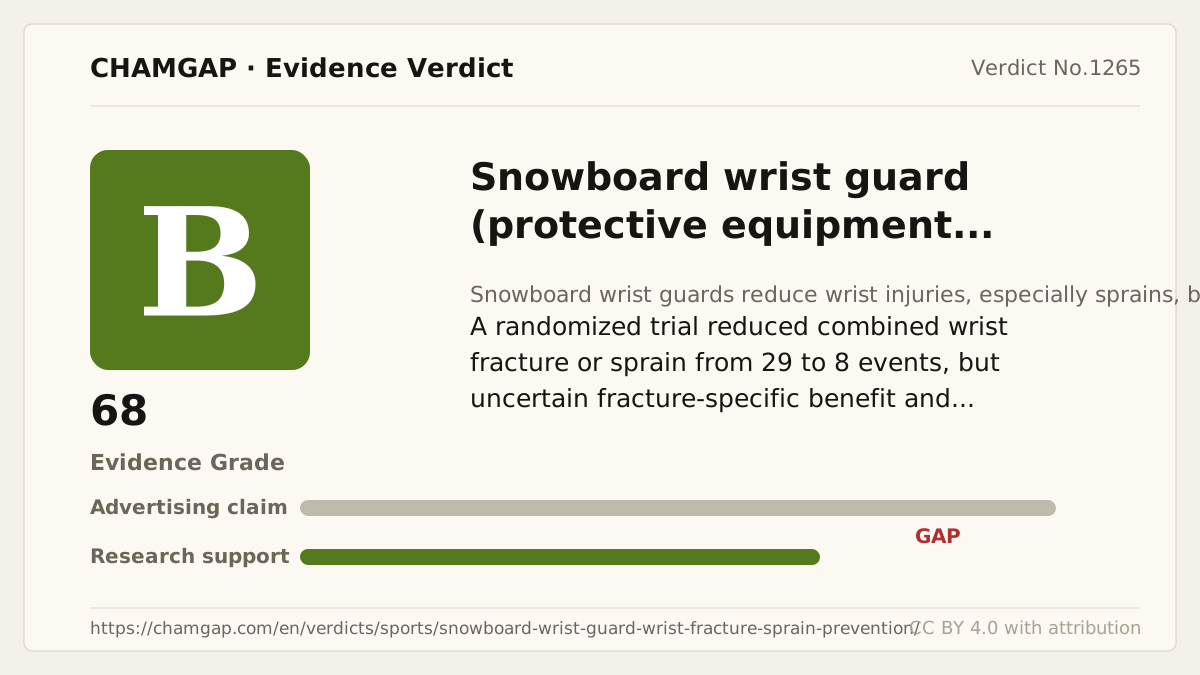
[Chamgap] Snowboard wrist guard x prevention of wrist fractures and sprains — Evidence Grade B·68. 2 cited sources checked. Source: https://chamgap.com/en/verdicts/sports/snowboard-wrist-guard-wrist-fracture-sprain-prevention/ · CC BY 4.0CC BY 4.0 — free to use with attribution; do not distort grades, numbers, or verdict meaning.
What this document does and does not do
Chamgap is an information source. It reports what research has and has not confirmed; it does not tell readers what to take or buy. That decision belongs to readers and, when needed, medical or legal professionals. This verdict reflects literature available up to the search date and may change as new research appears. Nothing here is medical advice.