
Singing for Lung Health,
does it really help with Replacement of standard exercise training in COPD pulmonary rehabilitation?
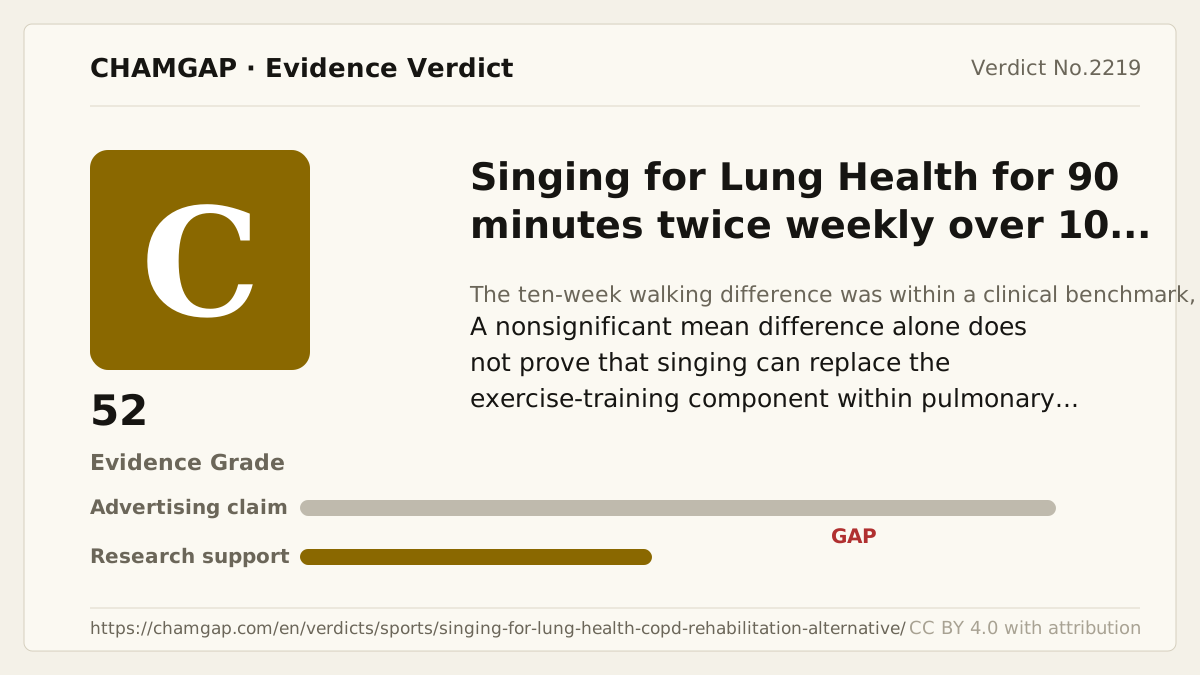
research showsThe grade is C with 54 points. In a 10-week trial of 270 people with COPD, six-minute walk change was 13.1 plus or minus 36.3 m with singing and 14.1 plus or minus 32.3 m with standard exercise; the between-group difference was 1.0 m (95% CI -7.3 to 9.3, P=.81). The entire interval lies within the 30-m minimal important difference, so the observed difference is within a clinical benchmark. However, the paper used an 8% noninferiority margin for its sample-size calculation and did not convert it into a one-sided distance boundary. Attrition of 75 participants, or 27.8%, weakens replacement of the exercise-training component.
ads claimSinging was tested as a substitute for the conventional physical exercise-training component within pulmonary rehabilitation, not for the whole program. A 10-week walk-distance difference within the 30-m minimal important difference does not establish replacement of education, supervision, or long-term outcomes such as exacerbations, admissions, and quality of life.
Useful facts when choosing a product
- The active comparator was physiotherapist-led standard strength and endurance training for 90 minutes twice weekly over 10 weeks, including walking, stepping, stairs, and cycling.
- Both groups received the same weekly pulmonary-rehabilitation education, and the singing group also performed warm-ups and movement.
- The six-minute walk difference was 1.0 m (95% CI -7.3 to 9.3, P=.81), within the 30-m minimal important difference, but 30 m was not a prespecified noninferiority boundary.
- Only 195 of 270 participants completed post-assessment; 75, or 27.8%, dropped out, potentially biasing the result toward similarity.
Chamgap Semantic Classification Code
Candidate index · review held
UNK.singing.UNK.replacement-of-standard-exercise-training-in-copd-pulmonary-rehabilitation.assess.activeUnknown > Singing > Unknown > Replacement of standard exercise training in COPD pulmonary rehabilitation > Association or change assessment > Active comparator
An automated migration candidate, not an issued permanent code; exact claim scope remains under review. This machine-generated migration candidate helps retrieval but is not a permanent assignment. The original verdict ID and URL remain authoritative.
What the research actually shows
Twenty-nine pulmonary-rehabilitation classes were cluster-randomized, with 145 participants assigned to singing and 125 to exercise. The active comparator received physiotherapist-led standard strength and endurance training for 90 minutes twice weekly over 10 weeks, including walking, stepping, stairs, and cycling. Both groups received the same weekly pulmonary-rehabilitation education, and the singing group also performed warm-ups and movement. Only 195 completed post-assessment; 75, or 27.8%, dropped out, with arm-specific rates of 25.5% and 30.4%. Dropouts had poorer lung function, shorter baseline walk distance, and more symptoms, which may bias an equivalence-oriented trial toward apparent similarity. Mean attendance was 16.6 and 16.3 of 20 sessions, and 60.7% and 56.8% attended at least 75%. The registered primary endpoint was six-minute walk distance at 12 weeks plus or minus two weeks. NCT03280355 listed a study start of August 1, 2017, initial submission on September 1, a quality-control submission on September 8, and first posting on September 12, so registration followed study start.
Why this is classified as C (54)
The observed six-minute walk interval lies within the 30-m minimal important difference, but prespecification of a numeric boundary was not verified and a single 10-week trial with 27.8% attrition gives C with 54 points.
Counterpoint. The result supports short-term potential to replace the exercise-training component within the program, not education, supervision, or long-term clinical outcomes.
Rejudgment record. Cross-check applied — Cross-checked the registered primary outcome, distinction between the 8% margin and 30-m minimal important difference, registration timing, active-comparator content, randomized and completed counts, attrition direction, and attendance
| Endpoint | P | Symptom or function itself is the target - including patient reports and performance tests |
| Replication | R1 | Single confirmatory trial |
| Independence | I2 | Decisive evidence is publicly or non-profit funded |
| Effect size | E+ | Meets the clinically important threshold |
Stored derived and displayed grades match; this is not a current recalculation or validity check (C).
Sub-claim grades by effect
This ingredient is marketed for several effects. A single overall grade blends strong and weak claims together, so each effect is graded separately here. The overall grade reflects the strongest disconfirming or core claim.
| Effect (sub-claim) | Grade | Basis |
|---|---|---|
| Clinically similar ten-week six-minute walk difference versus standard exercise training | C | The between-group interval was within the 30-m minimal important difference, but prespecification of a numeric boundary was not verified. |
| Achieving a 30-m individual improvement | D | Rates were 21.8% versus 25.0%, with no difference and most participants in neither group reaching 30 m. |
| Replacement of pulmonary-rehabilitation education, supervision, and long-term clinical outcomes | ? | The trial changed only the exercise-training component within the program for 10 weeks and did not test long-term exacerbation or admission outcomes. |
Cross-check — AI research and Codex final gate
Evidence Table
| Study | Design | Sample | Funding | Endpoint | Result | Weight |
|---|---|---|---|---|---|---|
| Kaasgaard et al. Sing-a-Lung RCT 2022 | Multicenter cluster-randomized active-control noninferiority trial | 270 randomized (145/125), 195 with post-assessment, and 75 dropouts (27.8%) | Public and nonprofit support including Tryg Foundation, Danish Health Foundation, Danish Lung Foundation, regions, and universities | Change in six-minute walk distance after 10 weeks; registered timing was 12 weeks plus or minus two weeks | 13.1 plus or minus 36.3 m with singing and 14.1 plus or minus 32.3 m with exercise; 1.0 m between groups (95% CI -7.3 to 9.3, P=.81); 30 m reached by 21.8% versus 25.0%. | Pivotal direct evidence comparing the exercise-training component |
Receipt — 2 References
All 2 cited sources were verified for existence at the original page (as of 2026-08-04).
Final verification and publication gate: Codex · Evidence date: 2026-08-04 · Corrections: none
Cite this verdict
[Chamgap] Singing for Lung Health x replacing exercise rehabilitation in COPD — Evidence Grade C·54. 2 cited sources checked. Source: https://chamgap.com/en/verdicts/sports/singing-for-lung-health-copd-rehabilitation-alternative/ · CC BY 4.0CC BY 4.0 — free to use with attribution; do not distort grades, numbers, or verdict meaning.
What this document does and does not do
Chamgap is an information source. It reports what research has and has not confirmed; it does not tell readers what to take or buy. That decision belongs to readers and, when needed, medical or legal professionals. This verdict reflects literature available up to the search date and may change as new research appears. Nothing here is medical advice.