
Sildenafil,
does it really help with Improved cycling endurance and time-trial performance at sea level or moderate altitude in healthy exercisers?
research showsSildenafil is rated D because it does not reliably improve cycling endurance or time-trial performance at sea level or moderate altitude in healthy exercisers. A 2019 systematic review of 14 randomized trials with 210 sildenafil-exposed participants found that some physiological measures, including pulmonary artery pressure, cardiac output, and oxygen saturation, changed favorably but performance did not improve. A 6-km time trial in 35 trained men and women at a simulated altitude of about 3,900 m and a 16.1-km time trial in 12 men at 3,000 m were null, while a 10-person trial found no effect at sea level. Small studies in severe hypoxia or extreme altitude and a post hoc responder subgroup provide a limited positive signal that cannot be generalized to the sea-level and moderate-altitude claim. The resulting grade is D with 30 points. Headache, flushing, hypotension, the nitrate contraindication, and off-label misuse of a prescription drug remain separate safety issues.
ads claimOff-label promotion and sports discussions translate vasodilation, lower pulmonary artery pressure, or higher oxygen saturation directly into faster race times. A physiological mechanism can move without improving an actual time trial in healthy athletes at sea level or moderate altitude.
Useful facts when choosing a product
- Sildenafil is a prescription phosphodiesterase-5 inhibitor used for erectile dysfunction and pulmonary arterial hypertension; improving race performance in healthy athletes is not an approved indication.
- Exercise studies generally tested a single 50-mg or 100-mg dose but did not consistently reproduce better cycling time trials at sea level or at approximately 3,000 to 3,900 m.
- Headache, flushing, dyspepsia, nasal congestion, dizziness, reduced blood pressure, and visual symptoms can occur, and exercise, dehydration, or altitude exposure may amplify discomfort or risk.
- Combining sildenafil with nitrates is contraindicated because of potentially dangerous hypotension; alpha blockers, other blood-pressure medicines, or cardiovascular disease require assessment by the prescribing clinician.
Chamgap Semantic Classification Code
Candidate index · review held
M.sildenafil-citrate.UNK.cycling-endurance-and-time-trial-performance-at-sea-level-or-moderate-altitude.improve.placeboMedicinal interventions > Sildenafil citrate > Unknown > cycling endurance and time-trial performance at sea level or moderate altitude > Improvement claim > Placebo
An automated migration candidate, not an issued permanent code; exact claim scope remains under review. This machine-generated migration candidate helps retrieval but is not a permanent assignment. The original verdict ID and URL remain authoritative.
What the research actually shows
The Carter systematic review included 14 randomized placebo-controlled studies searched through August 2018 and 210 sildenafil-exposed participants. Pulmonary artery pressure clearly decreased and cardiac output and oxygen saturation showed small physiological effects, but performance did not improve; the review also identified possible missing nonsignificant studies. Jacobs and colleagues used a double-blind crossover design in 20 endurance-trained men and 15 women and found no benefit of 50 mg on a 6-km time trial at about 3,900 m. In the 12-person Carter study at 3,000 m, average power was 230 plus or minus 22 W with placebo and 230 plus or minus 20 W with sildenafil during a 16.1-km time trial. The 10-person Hsu study found no sea-level effect and very large between-person variability at altitude.
Why this is classified as D (30)
Sea-level performance was null in a direct 10-person crossover trial, and time trials in 12 people at about 3,000 m and 35 people at about 3,900 m were also null. A systematic review of 14 randomized trials concluded that performance did not improve despite physiological changes, meeting the predominantly null independent-human-trial criterion for D with 30 points. A small extreme-altitude signal remains C only as a separate subclaim, while prescription-drug harms and the nitrate contraindication are kept independent of efficacy.
Counterpoint. A benefit in a particular high responder under severe hypoxia or far above 4,000 m cannot be excluded completely. There is no practical way to identify such a responder, however, and the average effect at moderate altitude has not been reproduced, so the signal does not support self-use by healthy athletes seeking faster times.
Rejudgment record. Cross-check incorporated — Applied rule ② and D because randomized crossover trials directly assessing cycling performance in healthy exercisers at sea level and simulated moderate altitude were repeatedly null, and a systematic review of 14 trials found no performance effect despite changes in pulmonary artery pressure and oxygen saturation. Preserved small severe-hypoxia, extreme-altitude, and post hoc responder findings only as a limited subgroup signal and kept this axis entirely separate from erectile-dysfunction treatment verdict 629
Sub-claim grades by effect
This ingredient is marketed for several effects. A single overall grade blends strong and weak claims together, so each effect is graded separately here. The overall grade reflects the strongest disconfirming or core claim.
| Effect (sub-claim) | Grade | Basis |
|---|---|---|
| Improved cycling endurance or performance at sea level | D | A direct crossover trial found no effect on cardiovascular measures or time-trial performance. |
| Improved cycling time-trial performance at moderate altitude | D | The 16.1-km trial at 3,000 m and 6-km trial at about 3,900 m were null, and the systematic review found no performance effect. |
| Improved exercise performance at extreme altitude or under severe hypoxia | C | Small crossover trials and a post hoc responder group provide a positive signal, but samples are small, individual variability is large, and confirmation is lacking. |
Cross-check — AI research and Codex final gate
Evidence Table
| Study | Design | Sample | Funding | Endpoint | Result | Weight |
|---|---|---|---|---|---|---|
| Carter EA et al. 2019 systematic review | Systematic review and meta-analysis of randomized placebo-controlled trials | 14 trials; 210 sildenafil-exposed participants | No specific funding reported; no competing interests declared | Exercise performance, pulmonary artery pressure, cardiac output, and oxygen saturation | Pulmonary artery pressure decreased and some physiological measures changed, but exercise performance did not improve. | Key pooled null performance evidence |
| Jacobs KA et al. 2011 | Randomized double-blind placebo-controlled crossover trial | 20 endurance-trained men and 15 endurance-trained women | Funding source not reported in the PubMed abstract | A 6-km cycling time trial at a simulated altitude of about 3,900 m | A 50-mg dose did not significantly improve hemodynamics or the time trial, and only one of 35 participants showed a meaningful individual response. | Relatively large direct null moderate-altitude trial |
| Hsu AR et al. 2006 | Randomized double-blind placebo-controlled crossover trial | 10 trained men | Funding source not reported in the PubMed abstract | Sea-level 10-km and simulated-3,874-m 6-km time trials plus cardiovascular measures | All sea-level performance and cardiovascular measures were null; the positive altitude result showed large individual variation and was driven by a post hoc responder group. | Direct sea-level null evidence with limited severe-altitude positivity |
Receipt — 4 References
All 4 cited sources were verified for existence at the original page (as of 2026-07-21).
Final verification and publication gate: Codex · Evidence date: 2026-07-21 · Corrections: none
Cite this verdict
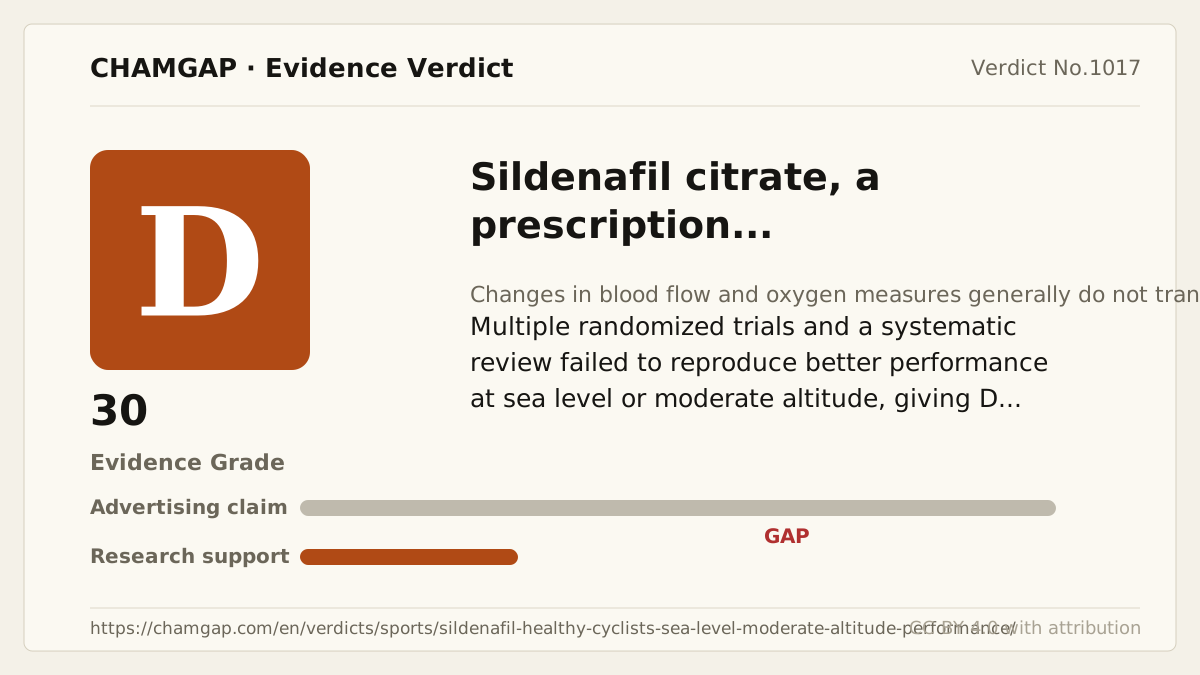
[Chamgap] Sildenafil x improved cycling performance at sea level or moderate altitude in healthy exercisers — Evidence Grade D·30. 4 cited sources checked. Source: https://chamgap.com/en/verdicts/sports/sildenafil-healthy-cyclists-sea-level-moderate-altitude-performance/ · CC BY 4.0CC BY 4.0 — free to use with attribution; do not distort grades, numbers, or verdict meaning.
What this document does and does not do
Chamgap is an information source. It reports what research has and has not confirmed; it does not tell readers what to take or buy. That decision belongs to readers and, when needed, medical or legal professionals. This verdict reflects literature available up to the search date and may change as new research appears. Nothing here is medical advice.