
Resveratrol,
does it really help with Improved maximal oxygen uptake, aerobic exercise capacity, and training response in healthy adults?
research showsResveratrol is rated D for improving maximal oxygen uptake, aerobic performance, or training response in healthy adults. A 2018 systematic review identified 14 small randomized trials, but the five trials with 139 participants that could be pooled for peak oxygen uptake showed a between-group difference of only 0.30 mL/kg/min (95% CI −2.49 to 3.09), meeting neither statistical significance nor the prespecified minimal clinically important difference of 2 mL/kg/min. Individual training trials conflicted, and a trial in 27 healthy older men found a smaller increase after eight weeks of training with resveratrol. Product safety and quality variation are separate from efficacy.
ads claimMarketing translates mitochondrial and SIRT1 mechanisms in animals, along with red-wine imagery, directly into greater human maximal oxygen uptake, endurance, and training gains. Human studies are small and conflicting, while pooled peak oxygen uptake shows no clinically meaningful difference.
Useful facts when choosing a product
- Resveratrol is a stilbene polyphenol found in grape skins and peanuts, but supplement doses can greatly exceed amounts obtained from food.
- Trials used different trans-resveratrol doses and formulations, so results from one preparation cannot automatically be transferred to every commercial product.
- It is generally tolerated by healthy adults, although higher doses can increase gastrointestinal symptoms such as diarrhea, abdominal discomfort, and nausea.
- People taking anticoagulant or antiplatelet medicines or preparing for surgery should discuss possible interactions with a clinician; this is a safety issue separate from exercise efficacy.
Chamgap Semantic Classification Code
Candidate index · review held
S.resveratrol.oral.maximal-oxygen-uptake-aerobic-exercise-capacity-and-training-response.improve.placeboSupplements and nutraceuticals > Resveratrol > Oral > maximal oxygen uptake, aerobic exercise capacity, and training response > Improvement claim > Placebo
An automated migration candidate, not an issued permanent code; exact claim scope remains under review. This machine-generated migration candidate helps retrieval but is not a permanent assignment. The original verdict ID and URL remain authoritative.
What the research actually shows
The 2018 systematic review screened 1,210 records, included 14 randomized trials, and pooled the five trials with 139 participants reporting the same peak-oxygen-uptake outcome. The estimate was null at 0.30 mL/kg/min (95% CI −2.49 to 3.09) and fell short of the stated clinically important difference of 2 mL/kg/min. In a 2013 double-blind trial, 27 healthy inactive older men took trans-resveratrol 250 mg/day or placebo during eight weeks of high-intensity training; the maximal-oxygen-uptake increase was 45% greater with placebo. A 2022 meta-analysis of polyphenols and training found a nonsignificant direction toward impaired adaptation in the resveratrol subgroup, with SMD −0.54 (95% CI −1.15 to 0.07). This verdict concerns exercise performance, not the separate anti-aging or testosterone claims.
Why this is classified as D (28)
The direct meta-analysis of five randomized trials and 139 participants found a peak-oxygen-uptake difference of 0.30 mL/kg/min (95% CI −2.49 to 3.09), which was statistically and clinically null, and an independent 27-participant training trial found blunted adaptation. Limited positive small trials are conflicting and emphasize surrogate outcomes, so they do not overturn the central null evidence. The result is D with 28 points. Gastrointestinal adverse effects and possible drug interactions remain separate from efficacy.
Counterpoint. Exercise itself is an established way to improve maximal oxygen uptake and aerobic capacity. Evidence does not show that resveratrol adds to this benefit, and it may blunt adaptation in some settings, so the supplement should not be treated as a training substitute or a reliable enhancer.
Rejudgment record. New verdict — Applied D because the meta-analysis of five randomized trials and 139 participants found no statistical or clinical peak-oxygen-uptake efficacy and an independent training trial found blunted adaptation; conflicting positive surrogate outcomes from small studies did not justify an upgrade
Sub-claim grades by effect
This ingredient is marketed for several effects. A single overall grade blends strong and weak claims together, so each effect is graded separately here. The overall grade reflects the strongest disconfirming or core claim.
| Effect (sub-claim) | Grade | Basis |
|---|---|---|
| Improved maximal oxygen uptake | D | The five-trial meta-analysis of 139 participants found 0.30 mL/kg/min (95% CI −2.49 to 3.09), which was statistically and clinically null. |
| Improved aerobic exercise performance | D | Small trials conflicted, and a direct crossover trial found no improvement in exercise duration or peak oxygen uptake. |
| Augmented exercise-training response | D | A randomized trial in healthy older men and a resveratrol subgroup meta-analysis suggested possible blunting of training adaptation. |
Cross-check — AI research and Codex final gate
Evidence Table
| Study | Design | Sample | Funding | Endpoint | Result | Weight |
|---|---|---|---|---|---|---|
| Srilacorn C et al. 2018 | Systematic review and meta-analysis of randomized trials | Fourteen randomized trials included; five trials and 139 participants in the peak-oxygen-uptake meta-analysis | Supported by the Rangsit University Research Institute; no conflicts of interest reported | Change in peak oxygen uptake and measures of physical activity and exercise performance | The resveratrol-versus-control peak-oxygen-uptake difference was 0.30 mL/kg/min (95% CI −2.49 to 3.09), which was not statistically significant and did not reach the 2 mL/kg/min minimal clinical difference. | Key direct synthesis |
| Gliemann L et al. 2013 | Randomized double-blind placebo-controlled training trial | 27 healthy inactive older men | Funding details were not specified in the PubMed record; the article acknowledgments state that Fluxome Inc. supplied the trans-resveratrol and placebo tablets | Maximal oxygen uptake, blood pressure, and blood lipids after eight weeks of high-intensity training | Maximal oxygen uptake increased by 443±38 mL/min with placebo and 308±46 mL/min with resveratrol, a 45% greater increase in the placebo group. | Direct randomized evidence in the opposite direction |
| Martinez-Negrin G et al. 2022 | Systematic review and meta-analysis of human polyphenol-plus-training interventions | Twenty-two studies overall; two studies in the resveratrol subgroup | Funding details were not specified in the PubMed record | Training-induced adaptations in maximal oxygen uptake, strength, power, and exercise capacity | The resveratrol subgroup favored impaired training adaptation, SMD −0.54 (95% CI −1.15 to 0.07), but the result was not statistically significant. | Assessment of inconsistency and direction toward blunted adaptation |
Receipt — 4 References
All 4 cited sources were verified for existence at the original page (as of 2026-07-21).
Final verification and publication gate: Codex · Evidence date: 2026-07-21 · Corrections: none
Cite this verdict
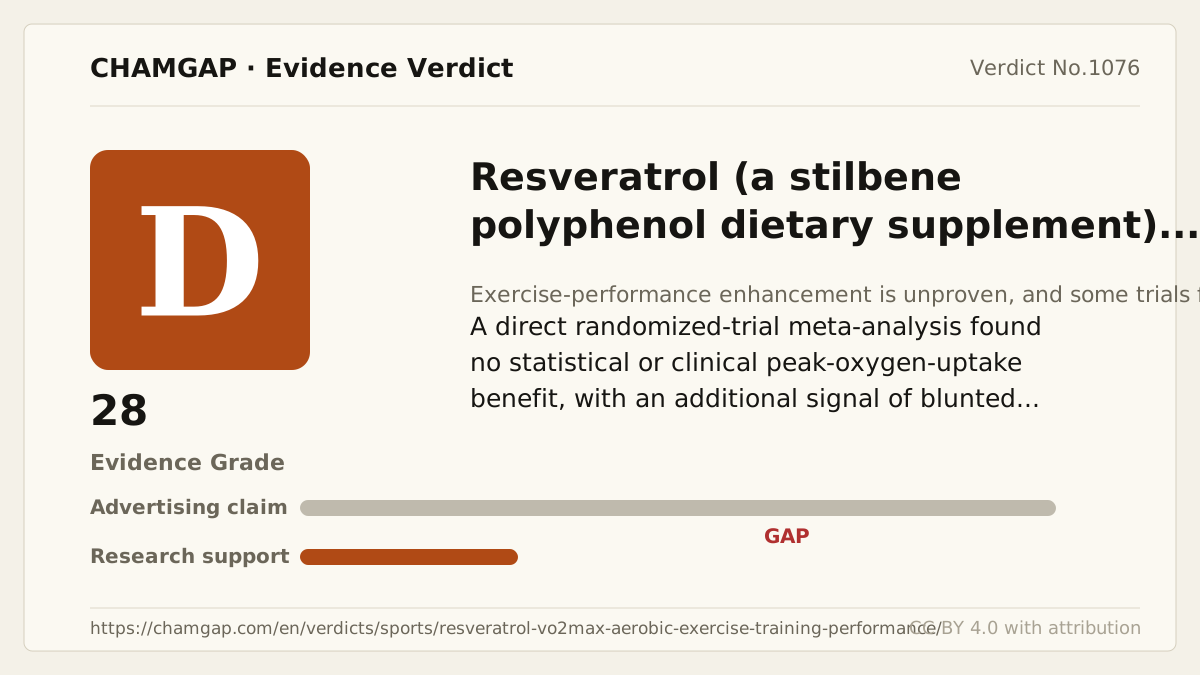
[Chamgap] Resveratrol x improved maximal oxygen uptake, aerobic performance, and training response — Evidence Grade D·28. 4 cited sources checked. Source: https://chamgap.com/en/verdicts/sports/resveratrol-vo2max-aerobic-exercise-training-performance/ · CC BY 4.0CC BY 4.0 — free to use with attribution; do not distort grades, numbers, or verdict meaning.
What this document does and does not do
Chamgap is an information source. It reports what research has and has not confirmed; it does not tell readers what to take or buy. That decision belongs to readers and, when needed, medical or legal professionals. This verdict reflects literature available up to the search date and may change as new research appears. Nothing here is medical advice.