
Pre-exercise static stretching,
does it really help with Prevention of exercise and sports injuries when used as the sole warm-up component?
research showsThe claim that adding pre-exercise static stretching alone prevents overall injury is rated D because the key meta-analysis was null. A 2020 military systematic review pooled three randomized trials and 3,532 participants at RR 0.93 (95% CI 0.79 to 1.09) for all musculoskeletal injuries, finding no significant reduction and low-certainty evidence. A 1,538-person Army-recruit trial likewise recorded 158 versus 175 lower-limb injuries over 12 weeks without a clinically useful preventive effect. Signals for selected muscle or tendon injuries are inconsistent, and increased flexibility is a different endpoint.
ads claimAn immediate increase in flexibility or range of motion can be represented as a lower incidence of sprains, muscle injuries, bone injuries, or all injuries. Injury-prevention claims must separate static stretching alone from programs that combine strength, balance, agility, and sport-specific warm-up.
Useful facts when choosing a product
- Static stretching holds a muscle in a lengthened position without movement and is distinct from eccentric strengthening such as the Nordic hamstring exercise.
- Military trials compared adding static stretches of major lower-limb muscles to a general active warm-up with the active warm-up alone.
- Short-term increases in range of motion are repeatedly observed but are separate from the actual injury-incidence endpoint in this verdict.
- Forceful stretching beyond discomfort can irritate muscle or tendon, and long static stretches of at least 60 seconds per muscle can transiently reduce maximal strength or explosive output.
Chamgap Semantic Classification Code
Candidate index · review held
X.pre-exercise-static-stretching.behavioral.exercise-and-sports-injuries-when-used-as-the-sole-warm-up-component.prevent.UNKBehaviors, exposures and policies > Pre-exercise static stretching > Behavioral delivery > exercise and sports injuries when used as the sole warm-up component > Occurrence-prevention claim > Unknown
An automated migration candidate, not an issued permanent code; exact claim scope remains under review. This machine-generated migration candidate helps retrieval but is not a permanent assignment. The original verdict ID and URL remain authoritative.
What the research actually shows
Dijksma et al. 2020 reviewed 15 military exercise-prevention trials and pooled three static-stretching randomized trials with 3,532 participants at RR 0.93 (95% CI 0.79 to 1.09) for all injuries, concluding there was no favorable effect. Pope et al. 2000 randomized 1,538 male Army recruits for 12 weeks to static stretches for six major lower-limb muscle groups plus active warm-up or active warm-up alone; 333 lower-limb injuries occurred, without a preventive effect. A performance systematic review found that long static stretches of at least 60 seconds per muscle were more likely to acutely reduce maximal force or power, whereas shorter 30-to-45-second stretches had small or null average effects.
Why this is classified as D (29)
The pooled all-injury RR across three static-stretching trials and 3,532 participants was null at 0.93 (95% CI 0.79 to 1.09), with inconsistent injury-subtype findings, giving D with 29 points.
Counterpoint. Improved flexibility and range of motion are separate effects and do not substitute for reduced injury incidence.
Rejudgment record. New verdict — Applied rule ② because a large Army-recruit randomized trial and a meta-analysis of three randomized trials with 3,532 participants found a null overall injury RR and muscle or tendon subtype results were inconsistent; eccentric-strengthening evidence was excluded
Sub-claim grades by effect
This ingredient is marketed for several effects. A single overall grade blends strong and weak claims together, so each effect is graded separately here. The overall grade reflects the strongest disconfirming or core claim.
| Effect (sub-claim) | Grade | Basis |
|---|---|---|
| Prevention of all exercise and sports injuries | D | The core pooled effect was null at RR 0.93 (95% CI 0.79 to 1.09) across three military trials and 3,532 participants. |
| Prevention of muscle and tendon injuries | D | Some trials reported subtype signals, but findings were inconsistent and did not persist as an overall pooled effect. |
| Increased flexibility and range of motion | C | Short-term range-of-motion gains are observed as a separate endpoint and do not establish lower injury incidence. |
Cross-check — AI research and Codex final gate
Evidence Table
| Study | Design | Sample | Funding | Endpoint | Result | Weight |
|---|---|---|---|---|---|---|
| Dijksma I et al. 2020 | Systematic review and meta-analysis of military exercise injury-prevention randomized trials | 15 trials and 14,370 participants overall; three static-stretching randomized trials and 3,532 participants | Supported by the Dutch Ministry of Defence and academic institutions | Incidence of all musculoskeletal injuries | Static stretching versus no stretching yielded RR 0.93 (95% CI 0.79 to 1.09), with low-certainty evidence of no favorable effect. | Key injury-incidence synthesis |
| Pope RP, Herbert RD, Kirwan JD, and Graham BJ. 2000 | Large randomized controlled trial | 1,538 male Army recruits over 12 weeks | Public and academic research in the Australian Army setting | All lower-limb and soft-tissue injury incidence | There were 333 injuries, 158 with stretching and 175 in control, without a clinically useful reduction in injury risk. | Large direct randomized trial |
| Kay AD and Blazevich AJ. 2012 | Systematic review of acute static stretching and performance | 106 eligible studies | Academic research; no commercial funding reported | Maximal strength, power, and performance | Effects were nonsignificant at -1.1% below 30 seconds and -1.9% at 30 to 45 seconds, while performance impairment was more likely at 60 seconds or longer per muscle. | Safety and performance context |
Receipt — 3 References
All 3 cited sources were verified for existence at the original page (as of 2026-07-23).
Final verification and publication gate: Codex · Evidence date: 2026-07-23 · Corrections: none
Cite this verdict
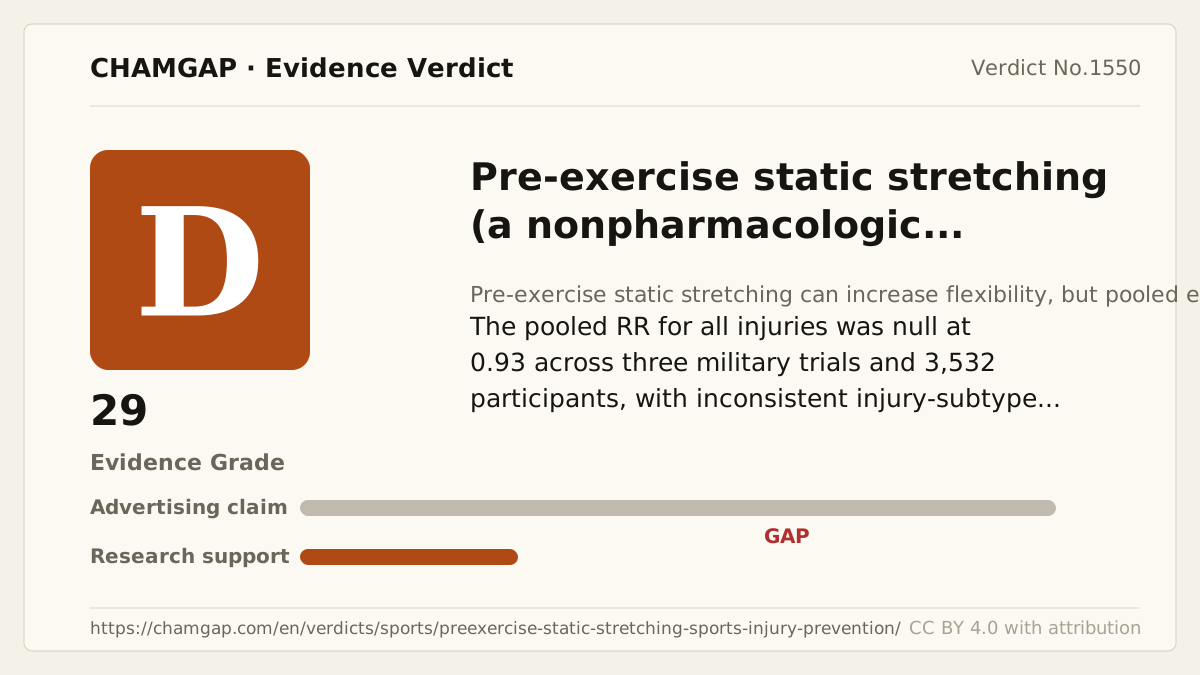
[Chamgap] Pre-exercise static stretching x prevention of exercise and sports injuries — Evidence Grade D·29. 3 cited sources checked. Source: https://chamgap.com/en/verdicts/sports/preexercise-static-stretching-sports-injury-prevention/ · CC BY 4.0CC BY 4.0 — free to use with attribution; do not distort grades, numbers, or verdict meaning.
What this document does and does not do
Chamgap is an information source. It reports what research has and has not confirmed; it does not tell readers what to take or buy. That decision belongs to readers and, when needed, medical or legal professionals. This verdict reflects literature available up to the search date and may change as new research appears. Nothing here is medical advice.