
Power Balance bracelet,
does it really help with Improved balance, flexibility, strength, and jump power?
research showsThe Power Balance bracelet is rated F with 5 points after repeated independent placebo-controlled refutation. In the 42-participant double-blind crossover study by Porcari 2011 in J Sports Sci Med, flexibility, balance, strength, and jump outcomes were all null. The 43-participant Sari 2012 study in J Phys Ther Sci 24(7):577-580 and the 30-participant Valcarcel Perez 2011 study in Apunts Sports Medicine 46(171):109-115 were also null versus placebo. None of the three studies reported commercial support.
ads claimClaims that a hologram resonates with the body's energy field and instantly improves balance, strength, or flexibility did not produce measurable performance differences. Better second demonstrations occur with placebo as a practice and expectation effect.
Useful facts when choosing a product
- Power Balance is a wearable silicone bracelet containing hologram disks.
- The pivotal study used a randomized double-blind crossover comparison of the real bracelet and a visually matched placebo.
- The number randomized in the crossover and the actual number analyzed were both 42, and all four efficacy outcomes were null.
- The main practical concern is spending money on unproven efficacy or substituting the bracelet for training or rehabilitation, rather than a major inherent safety hazard.
Chamgap Semantic Classification Code
Candidate index · review held
UNK.power-balance-hologram-bracelet.UNK.balance-flexibility-strength-and-jump-power.improve.placeboUnknown > Power Balance hologram bracelet > Unknown > balance, flexibility, strength, and jump power > Improvement claim > Placebo
An automated migration candidate, not an issued permanent code; exact claim scope remains under review. This machine-generated migration candidate helps retrieval but is not a permanent assignment. The original verdict ID and URL remain authoritative.
What the research actually shows
In the 42-participant double-blind crossover study by Porcari 2011 in J Sports Sci Med, flexibility, balance, strength, and jump outcomes were all null. Independent replications by Sari 2012 in J Phys Ther Sci 24(7):577-580 with 43 participants and Valcarcel Perez 2011 in Apunts Sports Medicine 46(171):109-115 with 30 participants were also null versus placebo. None of the three studies reported commercial support. This is repeated null evidence in the same wearable-device family as verdict 650, which is F with 10 points, and verdict 749, which is F with 10 points.
Why this is classified as F (5)
Flexibility, balance, strength, and jump outcomes all failed in the pivotal double-blind crossover trial, and independent placebo-controlled trials with 43 and 30 participants did not reproduce the same performance claims. Repeated refutation within the same efficacy axis gives F with 5 points.
Counterpoint. Wearing it as jewelry or as a personal routine is a matter of preference. There is no scientific basis for replacing training, balance rehabilitation, or injury prevention with the bracelet.
Rejudgment record. Cross-check applied — In the 42-participant double-blind crossover study by Porcari 2011 in J Sports Sci Med, flexibility, balance, strength, and jump outcomes were all null. The 43-participant Sari 2012 study in J Phys Ther Sci 24(7):577-580 and the 30-participant Valcarcel Perez 2011 study in Apunts Sports Medicine 46(171):109-115 were also null versus placebo; none reported commercial support. This is repeated null evidence in the same wearable-device family as verdict 650, which is F with 10 points, and verdict 749, which is F with 10 points.
Sub-claim grades by effect
This ingredient is marketed for several effects. A single overall grade blends strong and weak claims together, so each effect is graded separately here. The overall grade reflects the strongest disconfirming or core claim.
| Effect (sub-claim) | Grade | Basis |
|---|---|---|
| Improved balance | F | Placebo-controlled trials with 42, 43, and 30 participants repeatedly found no superiority. |
| Improved flexibility and strength | F | The real bracelet was not better than placebo in the pivotal and independent crossover trials. |
| Improved vertical-jump power | F | The 42-participant trial found 57.4 versus 56.9 cm, with no significant difference. |
Cross-check — AI research and Codex final gate
Evidence Table
| Study | Design | Sample | Funding | Endpoint | Result | Weight |
|---|---|---|---|---|---|---|
| Porcari J et al. 2011 | Randomized double-blind placebo-controlled crossover trial | 42 NCAA Division III athletes randomized in crossover order; all 42 analyzed | Supported by the nonprofit American Council on Exercise; no commercial support reported | No single primary endpoint designated; four efficacy outcomes of flexibility, balance, strength, and vertical jump | All four efficacy outcomes had P values above 0.05 between real and placebo bracelets; second-attempt improvement was independent of bracelet type. | Pivotal direct product trial |
| Sari Z et al. 2012 | Double-blind placebo- and no-wristband-controlled crossover trial | 43 healthy university students; all 43 analyzed | Funding source not reported; no commercial support reported | Grip strength, eyes-open and eyes-closed balance, and flexibility | Hologram wristbands did not improve performance over placebo or no wristband, and some comparisons favored placebo. | Independent replication of refutation |
| Valcarcel Perez F and Abian Vicen J. 2011 | Blinded placebo- and no-wristband-controlled crossover trial | 30 physically active adults; all 30 analyzed | Funding source not reported; no commercial support reported | Static and dynamic balance | Power Balance did not improve balance versus no wristband or placebo. | Additional independent replication of refutation |
Receipt — 3 References
All 3 cited sources were verified for existence at the original page (as of 2026-07-24).
Final verification and publication gate: Codex · Evidence date: 2026-07-24 · Corrections: none
Cite this verdict
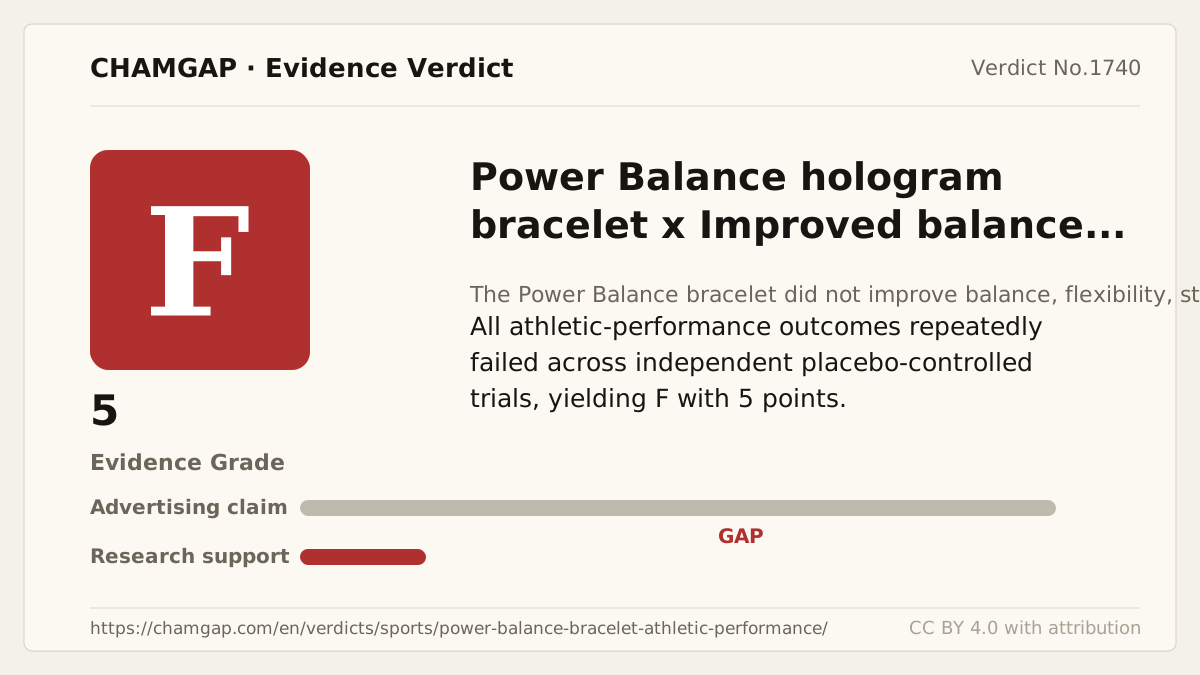
[Chamgap] Power Balance bracelet x improved balance, flexibility, strength, and jump power — Evidence Grade F·5. 3 cited sources checked. Source: https://chamgap.com/en/verdicts/sports/power-balance-bracelet-athletic-performance/ · CC BY 4.0CC BY 4.0 — free to use with attribution; do not distort grades, numbers, or verdict meaning.
What this document does and does not do
Chamgap is an information source. It reports what research has and has not confirmed; it does not tell readers what to take or buy. That decision belongs to readers and, when needed, medical or legal professionals. This verdict reflects literature available up to the search date and may change as new research appears. Nothing here is medical advice.