
Repeated 10°C cold-water immersion immediately after resistance training,
does it really help with Blunted hypertrophy and strength adaptation over weeks?
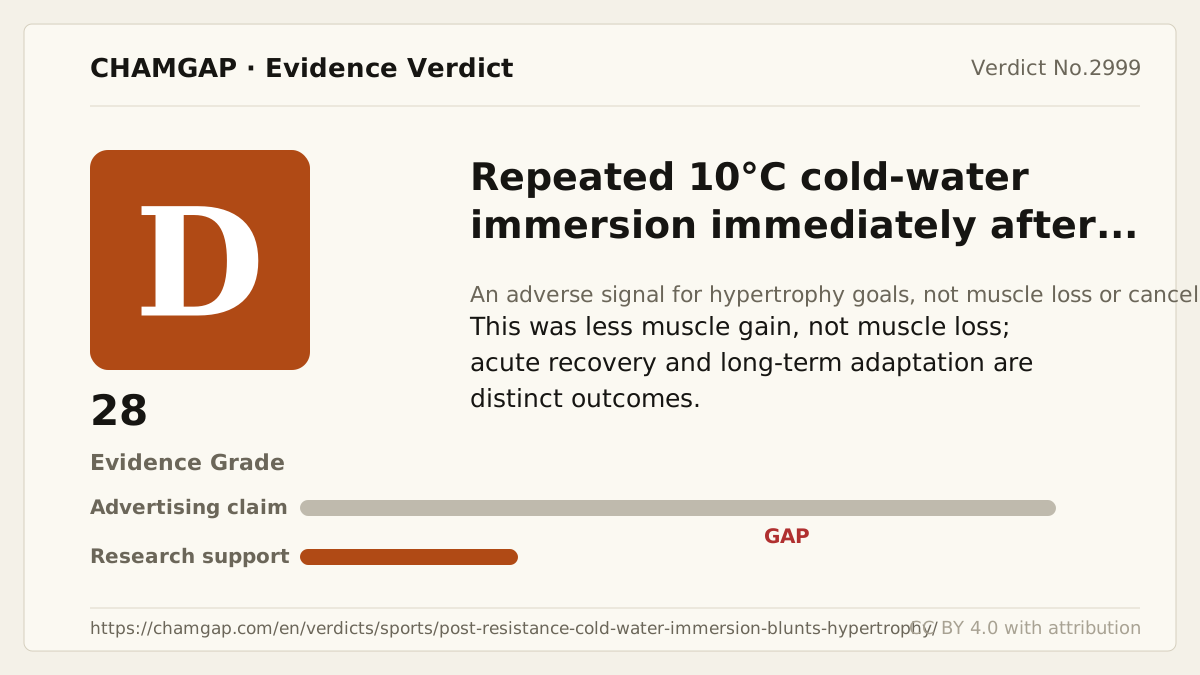
research showsGrade D with 28 points and an adverse E- direction. In a 12-week small trial, MRI quadriceps gains were 309±73 g with active recovery and 103±71 g with cold immersion, 206 g less with cold, but both groups gained muscle and strength findings differed across trials.
ads claimBoth 'faster recovery means more growth' and 'ice baths destroy muscle' distort a difference in gains.
Useful facts when choosing a product
- The key exposure was 10°C for 10 minutes within 10 minutes after training, twice weekly.
- The comparator was active low-intensity cycling, not passive rest.
- Verdict 1247's acute soreness question differs from this long-term hypertrophy question.
Chamgap Semantic Classification Code
Permanent code issued
X.post-exercise-cold-water-immersion.behavioral.quadriceps-hypertrophy.reduce.active-recoveryBehaviors, exposures and policies > Repeated 10°C cold-water immersion immediately after resistance training > Behavioral delivery > Blunted hypertrophy and strength adaptation over weeks > Reduction claim > Active recovery
Codex retrospectively verified the principal intervention, delivery, population, endpoint, and comparator from the existing reviewed verdict and issued a permanent semantic code. Secondary outcomes on the page are not transferred as separate claims. The code identifies the intervention and claim; it never contains the evidence grade, score, or safety result.
Exact Claim Classification
These independent facets prevent evidence from different forms, routes, populations, effects, and comparators from being mixed.
| Intervention class | X · Behavior, exposure, or policy |
|---|---|
| Canonical ingredient or intervention | Repeated 10°C cold-water immersion immediately after resistance training |
| Source or part used | Plant source not applicable; specified behavior or training |
| Formulation or processing | Repeated 10°C cold-water immersion immediately after resistance training |
| Route | Behavioral delivery |
| Dose | Repeated 10°C cold-water immersion immediately after resistance training |
| Duration | 12 weeks |
| Population | 24 assigned, 21 completed |
| Effect or condition | Blunted hypertrophy and strength adaptation over weeks |
| Primary endpoint | MRI quadriceps gain and strength |
| Comparator | Active recovery |
| Duplicate-detection key | post-exercise-cold-water-immersion|behavioral|24 assigned, 21 completed|quadriceps-hypertrophy|12 weeks |
What the research actually shows
Resistance-trained young men performed lower-body training twice weekly for 12 weeks, followed within 10 minutes by 10 minutes in 10°C water or 10 minutes of low-intensity cycling. A separate 16-person trial compared 15 minutes at 10°C with room-temperature passive rest over seven weeks.
Why this is classified as D (28)
The adverse adaptation direction E-, complete-case analysis, n below 200, active control, and mixed support produce grade D with 28 points. The grade does not mean the attenuation result was null.
Counterpoint. The cold group still gained 103 g, and maximum strength was not blunted in the independent trial, limiting claims of muscle loss or universal impairment.
Rejudgment record. Codex cross-check of two long-term trials, MRI, strength, and funding — Separated muscle loss from attenuated gain and combined Roberts complete-case active-control data with Fyfe fiber support and null maximum-strength difference
| Endpoint | S | Surrogate marker - laboratory or imaging measures |
| Replication | R1 | Single confirmatory trial |
| Independence | I1 | Mixed funding sources |
| Effect size | E- | Harm increased in the trials |
| Precision | CX | No pooled confidence interval could be confirmed |
Stored derived and displayed grades match; this is not a current recalculation or validity check (D).
Sub-claim grades by effect
This ingredient is marketed for several effects. A single overall grade blends strong and weak claims together, so each effect is graded separately here. The overall grade reflects the strongest disconfirming or core claim.
| Effect (sub-claim) | Grade | Basis |
|---|---|---|
| Attenuated hypertrophy gains with repeated cold immersion | D | Two small trials supported an adverse E- direction. |
| Muscle loss or impairment of every strength adaptation | D | Both groups gained muscle and maximum-strength results differed. |
Cross-check — AI research and Codex final gate
Evidence Table
| Study | Design | Sample | Funding | Endpoint | Result | Weight |
|---|---|---|---|---|---|---|
| Roberts LA et al. 2015 | Twelve-week active-recovery controlled resistance-training trial | 24 assigned, 21 completed | Public/university support; nutrition products supplied by Body Science | MRI quadriceps gain and strength | Active recovery 309±73 g vs CWI 103±71 g; difference -206 g, P<.001 | Key long-term hypertrophy trial |
| Fyfe JJ et al. 2019 | Seven-week passive-rest controlled resistance-training trial | 16 participants | Public sport and university support | Muscle-fiber area and strength | Less type II hypertrophy; no clear maximum-strength attenuation | Supports hypertrophy direction but qualifies strength |
Receipt — 2 References
All 2 cited sources were verified for existence at the original page (as of 2026-09-07).
Final verification and publication gate: Codex · Evidence date: 2026-09-07 · Corrections: none
Cite this verdict
[Chamgap] Repeated Post-Lifting Cold-Water Immersion and Blunted Hypertrophy Gains — Evidence Grade D·28. 2 cited sources checked. Source: https://chamgap.com/en/verdicts/sports/post-resistance-cold-water-immersion-blunts-hypertrophy/ · CC BY 4.0CC BY 4.0 — free to use with attribution; do not distort grades, numbers, or verdict meaning.
What this document does and does not do
Chamgap is an information source. It reports what research has and has not confirmed; it does not tell readers what to take or buy. That decision belongs to readers and, when needed, medical or legal professionals. This verdict reflects literature available up to the search date and may change as new research appears. Nothing here is medical advice.