
Percussive massage gun,
does it really help with Reduced post-exercise delayed-onset muscle soreness and faster recovery of strength and explosive performance?
research showsThe post-exercise recovery claim for percussive massage guns is rated C. A 2026 meta-analysis of 12 randomized trials found improved countermovement-jump recovery, with g = 0.78, but certainty was low; the reduction in early creatine kinase had very-low certainty. Maximum voluntary contraction recovery and delayed-onset muscle soreness did not improve significantly. A 2023 systematic review of massage guns also found that ten of 11 small, heterogeneous studies had moderate risk of bias and one had high risk; strength, balance, acceleration, agility, and explosive performance either failed to improve or sometimes worsened. A small positive signal for explosive-performance recovery is accepted, but inconsistent strength and soreness recovery plus major device, dose, and timing differences give C with 49 points. Bruising, worsening pain, nerve irritation, and overuse are separate safety concerns.
ads claimMarketing expands the sensation of vibration and immediate relaxation or range-of-motion changes into muscle-damage repair, pain elimination, restored strength, and better explosive performance in the next event. The evidence supports only limited signals for selected short-term jump recovery and biochemical markers, not universal recovery.
Useful facts when choosing a product
- A percussive massage gun uses a motor to deliver repeated pressure and vibration to soft tissue. Amplitude, speed, attachment shape, and actual output vary across devices, so findings cannot be transferred automatically to every product.
- No standard frequency, pressure, or duration per muscle group is established for post-exercise recovery. Starting at low intensity for a short period and stopping if pain worsens is prudent.
- Strong repeated percussion should be avoided over bony prominences, the front of the neck, superficial major nerves or vessels, open wounds, and acutely injured tissue.
- Excess pressure or prolonged use can cause bruising, tenderness, numbness, or nerve irritation. People with bleeding risk, anticoagulant use, suspected thrombosis, or impaired sensation should seek clinical advice before use.
Chamgap Semantic Classification Code
Candidate index · review held
P.percussive-massage-gun.device.post-exercise-delayed-onset-muscle-soreness-and-faster-recovery-of-strength-and-explosive-performance.reduce.UNKProcedures, devices and tests > Percussive massage gun > Device delivered > post-exercise delayed-onset muscle soreness and faster recovery of strength and explosive performance > Reduction claim > Unknown
An automated migration candidate, not an issued permanent code; exact claim scope remains under review. This machine-generated migration candidate helps retrieval but is not a permanent assignment. The original verdict ID and URL remain authoritative.
What the research actually shows
Zhu and colleagues synthesized 12 randomized trials published through November 2025. Jump recovery favored percussive therapy across 13 comparisons, with g = 0.78, and early creatine kinase favored it across seven comparisons, with g = -0.87. Eight comparisons for maximum voluntary contraction and 17 for soreness were not significant. Dose subgroup analyses were exploratory and should not be treated as prescribing thresholds. Ferreira and colleagues reviewed 11 randomized and nonrandomized studies directly testing massage guns; ten had moderate and one had high risk of bias. Short-term range-of-motion and selected recovery signals appeared, but strength, balance, acceleration, agility, and explosive performance did not improve consistently. Small samples and varied devices, frequencies, durations, and exercise-damage models restrict generalizability.
Why this is classified as C (49)
The meta-analysis of 12 randomized trials found low-certainty benefit for jump recovery and very-low-certainty benefit for early creatine kinase, but no significant benefit for maximal strength or delayed-onset muscle soreness. Small studies and heterogeneous devices, doses, and exercise-damage models yield C with 49 points. Bruising, nerve irritation, and overuse remain safety issues separate from efficacy.
Counterpoint. Brief use may be reasonable as an adjunct for mild post-exercise stiffness, but it does not replace sleep, nutrition, graded return to training, or evaluation of an injury.
Rejudgment record. New verdict — Accepted the low-certainty jump-recovery and very-low-certainty early creatine-kinase signals in the 2026 meta-analysis of 12 randomized trials, but applied C for limited and conflicting evidence because maximum voluntary contraction and soreness were null, studies and protocols were small and heterogeneous, and the 2023 direct massage-gun review found substantial risk-of-bias limitations
Sub-claim grades by effect
This ingredient is marketed for several effects. A single overall grade blends strong and weak claims together, so each effect is graded separately here. The overall grade reflects the strongest disconfirming or core claim.
| Effect (sub-claim) | Grade | Basis |
|---|---|---|
| Reduced delayed-onset muscle soreness after exercise | D | Across 17 comparisons in the current 12-trial meta-analysis, the soreness effect was not significant at g = 0.14 and certainty was very low. |
| Faster recovery of explosive performance after exercise | C | Countermovement-jump recovery favored therapy with g = 0.78, but low certainty, small studies, and protocol heterogeneity make this a limited signal. |
| Faster recovery of maximal strength after exercise | D | Maximum-voluntary-contraction recovery was not significant across eight comparisons, with g = 0.12, so no clear benefit is established. |
Cross-check — AI research and Codex final gate
Evidence Table
| Study | Design | Sample | Funding | Endpoint | Result | Weight |
|---|---|---|---|---|---|---|
| Zhu Y et al. 2026 | Systematic review and meta-analysis of randomized trials of percussive therapy after exercise-induced muscle damage | 12 randomized trials; 13 jump, eight maximum-voluntary-contraction, 17 soreness, and seven creatine-kinase comparisons | Funding was not stated in the PubMed abstract; authors reported no commercial or financial conflicts | Recovery of countermovement jump, maximum voluntary contraction, delayed-onset muscle soreness, and creatine kinase | Jump recovery favored therapy with g = 0.78 and creatine kinase with g = -0.87, but certainty was low and very low; maximum voluntary contraction at g = 0.12 and soreness at g = 0.14 were not significant. | Current key synthesis with conflicting outcomes |
| Ferreira RM et al. 2023 | Systematic review of massage-gun effects on performance and recovery | 11 randomized and nonrandomized studies | The article reported no external funding | Range of motion, flexibility, strength, balance, acceleration, agility, explosive performance, and recovery outcomes | Short-term range-of-motion and selected recovery signals were reported, but strength, balance, acceleration, agility, and explosive performance did not improve or sometimes decreased; ten studies had moderate and one had high risk of bias. | Direct device evidence confirming methodological limitations |
Receipt — 2 References
All 2 cited sources were verified for existence at the original page (as of 2026-07-23).
Final verification and publication gate: Codex · Evidence date: 2026-07-23 · Corrections: none
Cite this verdict
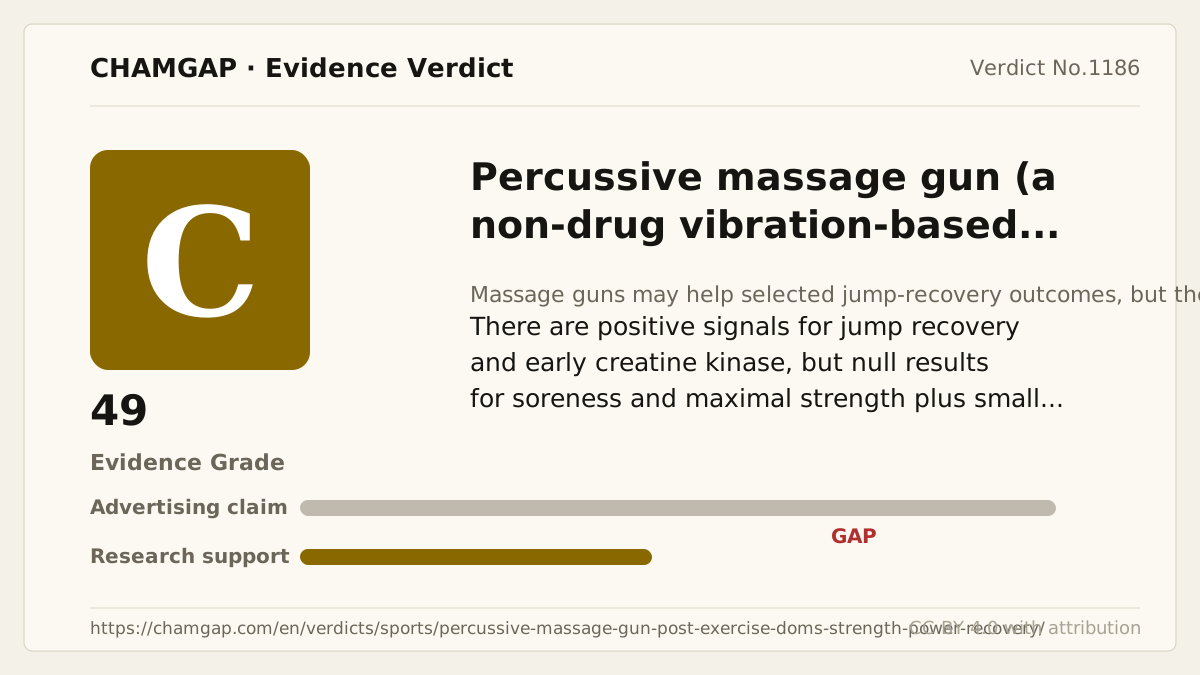
[Chamgap] Percussive massage gun x post-exercise soreness, strength, and explosive-performance recovery — Evidence Grade C·49. 2 cited sources checked. Source: https://chamgap.com/en/verdicts/sports/percussive-massage-gun-post-exercise-doms-strength-power-recovery/ · CC BY 4.0CC BY 4.0 — free to use with attribution; do not distort grades, numbers, or verdict meaning.
What this document does and does not do
Chamgap is an information source. It reports what research has and has not confirmed; it does not tell readers what to take or buy. That decision belongs to readers and, when needed, medical or legal professionals. This verdict reflects literature available up to the search date and may change as new research appears. Nothing here is medical advice.