
Supervised group balance training plus home exercise,
does it really help with Reduced injurious falls in women aged 75-85?
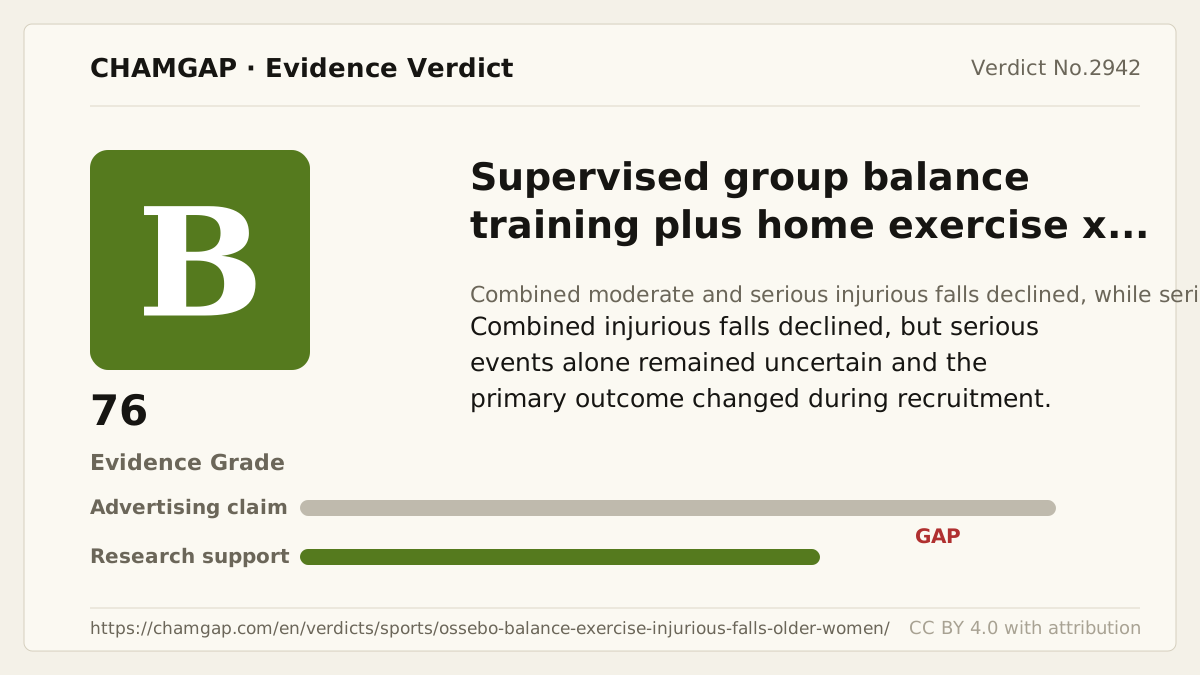
research showsThe grade is B. Among 706 community-dwelling women with impaired balance or gait, moderate-plus-serious injurious falls were 305 versus 397, HR 0.81 (95% CI 0.67-0.99), P=.04. Serious injurious falls alone were not significant: 68 versus 87, HR 0.83 (0.60-1.16).
ads claimClaims should describe fewer combined moderate and serious injurious falls in this high-risk population, not proven reduction of every serious fall.
Useful facts when choosing a product
- The program combined weekly supervised group sessions and home exercise for two years.
- The primary outcome changed during recruitment.
- Five exercise-related injurious falls occurred.
Chamgap Semantic Classification Code
Candidate index · review held
X.supervised-group-balance-training-plus-home-exercise.behavioral.injurious-falls.reduce.UNKBehaviors, exposures and policies > Supervised group balance training plus home exercise > Behavioral delivery > injurious falls > Reduction claim > Unknown
An automated migration candidate, not an issued permanent code; exact claim scope remains under review. This machine-generated migration candidate helps retrieval but is not a permanent assignment. The original verdict ID and URL remain authoritative.
What the research actually shows
Ossébo randomized 352 women to exercise and 354 to control for two years. About eight months after recruitment began, logistical and recruitment delays led investigators to reduce the target from 1,000 per arm and change the primary outcome from serious falls to moderate-plus-serious injurious falls. It was not reported as data-driven, but limits prespecification. Public support came from AP-HP, the French Ministry of Health, ANR, INPES, and Ile-de-France, with no funder role. Consistent comparison verdicts are [verdict 1812, A with 86 points](/verdicts/joint-bone/tai-ji-quan-fall-prevention-high-risk-older-adults/) and [verdict 1834, A with 86 points](/verdicts/joint-bone/otago-exercise-community-older-adult-fall-reduction/).
Why this is classified as B (76)
A large publicly funded randomized hard-outcome trial supports benefit, but it is one pivotal trial with an outcome-change limitation, giving B with 76 points.
Counterpoint. The serious-injury-only result was not statistically significant.
Rejudgment record. Cross-check applied — A large publicly funded randomized trial found fewer adjudicated injurious falls, with a mid-recruitment primary-outcome amendment
| Endpoint | H | Hard endpoint - actual events such as death |
| Replication | R1 | Single confirmatory trial |
| Independence | I2 | Decisive evidence is publicly or non-profit funded |
| Effect size | E+ | Meets the clinically important threshold |
Stored derived and displayed grades match; this is not a current recalculation or validity check (B).
Sub-claim grades by effect
This ingredient is marketed for several effects. A single overall grade blends strong and weak claims together, so each effect is graded separately here. The overall grade reflects the strongest disconfirming or core claim.
| Effect (sub-claim) | Grade | Basis |
|---|---|---|
| Reduced moderate-plus-serious injurious falls | B | HR was 0.81, P=.04. |
| Reduced serious injurious falls | D | The HR 0.83 interval included 1. |
Cross-check — AI research and Codex final gate
Evidence Table
| Study | Design | Sample | Funding | Endpoint | Result | Weight |
|---|---|---|---|---|---|---|
| El-Khoury F et al. 2015 Ossébo | Two-year 20-center randomized controlled trial | 706 participants, 352 versus 354 | Public funding from AP-HP, French Ministry of Health, ANR, INPES, and Ile-de-France | Rate of moderate and serious injurious falls | 305 versus 397 events; HR 0.81 (95% CI 0.67-0.99), P=.04; serious-only HR 0.83 (0.60-1.16) | Pivotal large hard-outcome evidence |
Receipt — 1 References
All 1 cited sources were verified for existence at the original page (as of 2026-08-26).
Final verification and publication gate: Codex · Evidence date: 2026-08-26 · Corrections: none
Cite this verdict
[Chamgap] Benefit of Two-Year Balance Training for Reducing Injurious Falls in At-Risk Older Women — Evidence Grade B·76. 1 cited sources checked. Source: https://chamgap.com/en/verdicts/sports/ossebo-balance-exercise-injurious-falls-older-women/ · CC BY 4.0CC BY 4.0 — free to use with attribution; do not distort grades, numbers, or verdict meaning.
What this document does and does not do
Chamgap is an information source. It reports what research has and has not confirmed; it does not tell readers what to take or buy. That decision belongs to readers and, when needed, medical or legal professionals. This verdict reflects literature available up to the search date and may change as new research appears. Nothing here is medical advice.