
Nordic hamstring exercise,
does it really help with Prevention of first and recurrent hamstring injuries in athletes including football players?
research showsNordic hamstring exercise is rated B because randomized and cluster-randomized trials, mainly in football, recorded fewer actual hamstring injuries. A meta-analysis of 8,459 athletes reported an overall risk ratio of 0.49 for programs including the exercise and 0.52 when restricted to eight randomized studies. A direct 50-team, 942-player cluster trial found an adjusted injury rate ratio of 0.293. Mixed programs, cluster designs, low adherence, between-study variation, and a conservative 2021 reanalysis that judged the evidence inconclusive prevent an A grade.
ads claimAn injury-rate reduction may be expanded into improved sprint performance or prevention of all injuries in every sport. The core data concern hamstring injury under progressive protocols, mainly in football teams.
Useful facts when choosing a product
- The Nordic hamstring exercise is performed from a kneeling position with the ankles fixed while the trunk is slowly lowered forward under eccentric hamstring control.
- Prevention trials generally progressed repetitions over several weeks and then used in-season maintenance; they did not test a one-time session.
- Early delayed-onset muscle soreness and exercise discomfort are common, and excessive repetitions or abrupt loading can increase overload risk.
- Real-world adherence can be low, so effectiveness depends on completing and maintaining the protocol.
Chamgap Semantic Classification Code
Candidate index · review held
X.nordic-hamstring-exercise.behavioral.first-and-recurrent-hamstring-injuries-in-athletes-including-football-players.prevent.UNKBehaviors, exposures and policies > Nordic hamstring exercise > Behavioral delivery > first and recurrent hamstring injuries in athletes including football players > Occurrence-prevention claim > Unknown
An automated migration candidate, not an issued permanent code; exact claim scope remains under review. This machine-generated migration candidate helps retrieval but is not a permanent assignment. The original verdict ID and URL remain authoritative.
What the research actually shows
The 2019 van Dyk review pooled 15 studies and 8,459 athletes and reported RR 0.49 for hamstring injury with programs including Nordic exercise (95% CI 0.32 to 0.74; p=0.0008); restriction to eight randomized studies gave RR 0.52 (95% CI 0.32 to 0.85). Petersen 2011 cluster-randomized 50 Danish men's football teams and 942 players to a progressive 10-week program with seasonal maintenance or usual training. There were 52 injuries in controls and 15 with intervention, yielding adjusted RR 0.293 (95% CI 0.150 to 0.572), with an NNT of 13 for one new or recurrent injury. Impellizzeri 2021 re-examined eligibility and few-study random-effects methods and concluded that only a conditional conclusion for football was supportable.
Why this is classified as B (70)
The 8,459-athlete meta-analysis reported overall RR 0.49 and randomized-study RR 0.52, while the 942-player cluster trial directly reduced first and recurrent injuries with adjusted RR 0.293. Multicomponent programs, cluster randomization, low adherence, variable bias, and an inconclusive conservative reanalysis give B with 70 points.
Counterpoint. Recurrent-injury results were strongly positive in the Petersen trial, but recurrence events were fewer than first injuries. Performance and sprint claims require separate evidence.
Rejudgment record. New verdict — Team-randomized football trials and randomized-study synthesis directly reduced hamstring injuries after randomizing the addition of Nordic exercise, but cluster design, mixed programs, low adherence, variable bias, and uncertainty in a conservative reanalysis impose the moderate-or-lower-certainty ceiling of B
Sub-claim grades by effect
This ingredient is marketed for several effects. A single overall grade blends strong and weak claims together, so each effect is graded separately here. The overall grade reflects the strongest disconfirming or core claim.
| Effect (sub-claim) | Grade | Basis |
|---|---|---|
| Prevention of first hamstring injury | B | Football-focused cluster trials and randomized-study synthesis show direct injury reduction with methodological limitations. |
| Prevention of recurrent hamstring injury | B | A direct trial showed a large signal, but recurrence events and applicable populations were limited. |
| Improvement in sprinting and athletic performance | C | This is separate from the injury endpoint, and consistent performance benefit has not been established. |
Cross-check — AI research and Codex final gate
Evidence Table
| Study | Design | Sample | Funding | Endpoint | Result | Weight |
|---|---|---|---|---|---|---|
| van Dyk N, Behan FP, and Whiteley R. 2019 | Systematic review and meta-analysis | 15 studies and 8,459 athletes; eight randomized studies | No external study funding reported | Hamstring injury incidence and risk | Overall RR was 0.49 (95% CI 0.32 to 0.74; p=0.0008), and randomized-study RR was 0.52 (95% CI 0.32 to 0.85). | Key synthesis with mixed designs |
| Petersen J et al. 2011 | Team-level cluster-randomized controlled trial | 50 Danish men's football teams and 942 players | Danish sports, foundation, and academic support | Overall, first, and recurrent acute hamstring injuries | Controls had 52 injuries versus 15 with intervention; adjusted RR was 0.293 (95% CI 0.150 to 0.572; p<0.001), with NNT 13 for a new or recurrent injury. | Pivotal direct trial of adding the exercise |
| Impellizzeri FM, McCall A, and van Smeden M. 2021 | Methodological reappraisal and meta-analysis of randomized trials | Reselected and updated eligible randomized trials | No external funding and no conflicts reported | Risk of hamstring injury | With stricter eligibility and few-study modeling, the preventive effect was judged inconclusive and only a conditional conclusion for football was supported. | Certainty-limiting evidence |
Receipt — 3 References
All 3 cited sources were verified for existence at the original page (as of 2026-07-23).
Final verification and publication gate: Codex · Evidence date: 2026-07-23 · Corrections: none
Cite this verdict
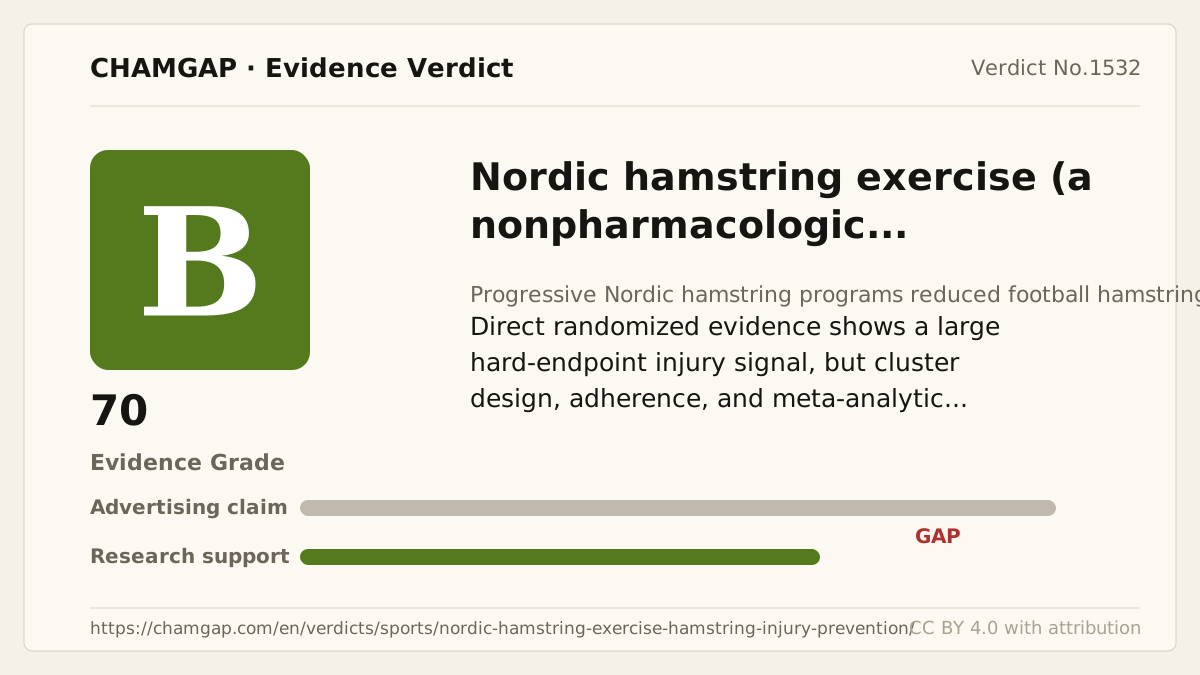
[Chamgap] Nordic hamstring exercise x prevention of first and recurrent hamstring injuries in athletes — Evidence Grade B·70. 3 cited sources checked. Source: https://chamgap.com/en/verdicts/sports/nordic-hamstring-exercise-hamstring-injury-prevention/ · CC BY 4.0CC BY 4.0 — free to use with attribution; do not distort grades, numbers, or verdict meaning.
What this document does and does not do
Chamgap is an information source. It reports what research has and has not confirmed; it does not tell readers what to take or buy. That decision belongs to readers and, when needed, medical or legal professionals. This verdict reflects literature available up to the search date and may change as new research appears. Nothing here is medical advice.