
Motorcycle helmet use,
does it really help with Reduced head injury and fatal injury in crashes?
research showsThe grade is B with 72 points. In the 882-rider Hurt crash cohort, head injury occurred in 207/530 (39.1%) unhelmeted versus 55/352 (15.6%) helmeted riders, adjusted RR 0.40 (95% CI 0.31 to 0.52). Fatal injury occurred in 40/530 (7.5%) versus 12/352 (3.4%), adjusted RR 0.44 (0.26 to 0.74). A separate FARS matched-pair cohort found death RR 0.61 (0.54 to 0.70). These were not randomized studies, and residual behavioral confounding limits the grade to B.
ads claimA shell and energy-absorbing liner are genuine protective structures, but the clinical evidence concerns injury reduction in a crash. It does not mean helmets prevent speeding, alcohol-impaired riding, or all crashes, nor that every product performs equally.
Useful facts when choosing a product
- Rice used in-depth crash investigation and reconstruction data in a retrospective cross-sectional reanalysis of 882 of 900 riders with complete core variables.
- Norvell used matched-pair cohort methods with driver-passenger pairs on the same motorcycle to control part of the vehicle and crash context.
- Rice was a retrospective cross-sectional reanalysis of Hurt crash data, whereas Norvell was a matched-pair cohort; neither randomized helmet use.
Chamgap Semantic Classification Code
Candidate index · review held
UNK.wearing-a-standards-compliant-motorcycle-helmet-at-the-time-of-a-crash.UNK.head-injury-and-fatal-injury-in-crashes.reduce.UNKUnknown > Wearing a standards-compliant motorcycle helmet at the time of a crash > Unknown > head injury and fatal injury in crashes > Reduction claim > Unknown
An automated migration candidate, not an issued permanent code; exact claim scope remains under review. This machine-generated migration candidate helps retrieval but is not a permanent assignment. The original verdict ID and URL remain authoritative.
What the research actually shows
Rice and colleagues conducted a retrospective cross-sectional reanalysis of 882 of 900 riders from already occurred crashes in the 1976-1977 Los Angeles Hurt Study, using records with known helmet, age, sex, and speed data. Models included age, sex, alcohol or drug use, speed, and below-neck injury severity. Norvell and Cummings applied matched-pair cohort methods to riders on the same motorcycle in 1980-1998 FARS crashes where at least one rider died, adjusting age, sex, and seating position. Thus Rice was a retrospective cross-sectional reanalysis of Hurt crash data, whereas Norvell was a matched-pair cohort. Rice received NHTSA support through California OTS, and Norvell had CDC grants.
Why this is classified as B (72)
Two independently sourced public crash cohorts showed large hard-outcome associations, but nonrandomized exposure and residual behavioral confounding give B with 72 points.
Counterpoint. This verdict concerns individual helmet use, not the policy effect of helmet laws or comparative performance of specific certification classes. Neck injury did not increase in Rice and was lower, adjusted RR 0.63 (0.40 to 0.99), but the primary claim here is head injury and death.
Rejudgment record. Cross-check applied — Cross-checked study design, analyzed counts, event counts, adjustment variables, estimates, confidence intervals, and public funding in both original reports and classified each as a cohort
| Endpoint | H | Hard endpoint - actual events such as death |
| Replication | R1 | Single confirmatory trial |
| Independence | I2 | Decisive evidence is publicly or non-profit funded |
| Effect size | E+ | Meets the clinically important threshold |
Stored derived and displayed grades match; this is not a current recalculation or validity check (B).
Sub-claim grades by effect
This ingredient is marketed for several effects. A single overall grade blends strong and weak claims together, so each effect is graded separately here. The overall grade reflects the strongest disconfirming or core claim.
| Effect (sub-claim) | Grade | Basis |
|---|---|---|
| Reduced head injury in a crash | B | Rates were 39.1% versus 15.6%, adjusted RR 0.40 (95% CI 0.31 to 0.52). |
| Reduced fatal injury in a crash | B | The adjusted Hurt fatal-injury RR was 0.44 and the FARS matched-pair death RR was 0.61. |
Cross-check — AI research and Codex final gate
Evidence Table
| Study | Design | Sample | Funding | Endpoint | Result | Weight |
|---|---|---|---|---|---|---|
| Rice TM, Troszak L, Ouellet JV, Erhardt T, Smith GS, Tsai BW. 2016 | Retrospective cross-sectional reanalysis of Hurt crash data | 882 of 900 riders with complete core variables analyzed, 530 unhelmeted and 352 helmeted | NHTSA support through the California Office of Traffic Safety, grant OTS-MC1501 | Head injury and fatal injury | Head injury 207/530 (39.1%) versus 55/352 (15.6%), adjusted RR 0.40 (95% CI 0.31 to 0.52); fatal injury 40/530 (7.5%) versus 12/352 (3.4%), adjusted RR 0.44 (0.26 to 0.74) | Detailed crash-covariate evidence for head and fatal injury |
| Norvell DC, Cummings P. 2002 | Retrospective matched-pair cohort of riders on the same motorcycle in FARS | 1980-1998 crashes with at least one death among two riders on the same motorcycle; absolute rider denominators were not verified in the public abstract | CDC grants R49/CCR002570 and R49/CCR019477-01 | Death after crash | Adjusted RR 0.61 (95% CI 0.54 to 0.70) for helmeted versus unhelmeted riders | Independent mortality evidence matched on the same crash and motorcycle |
Receipt — 2 References
All 2 cited sources were verified for existence at the original page (as of 2026-08-15).
Final verification and publication gate: Codex · Evidence date: 2026-08-15 · Corrections: none
Cite this verdict
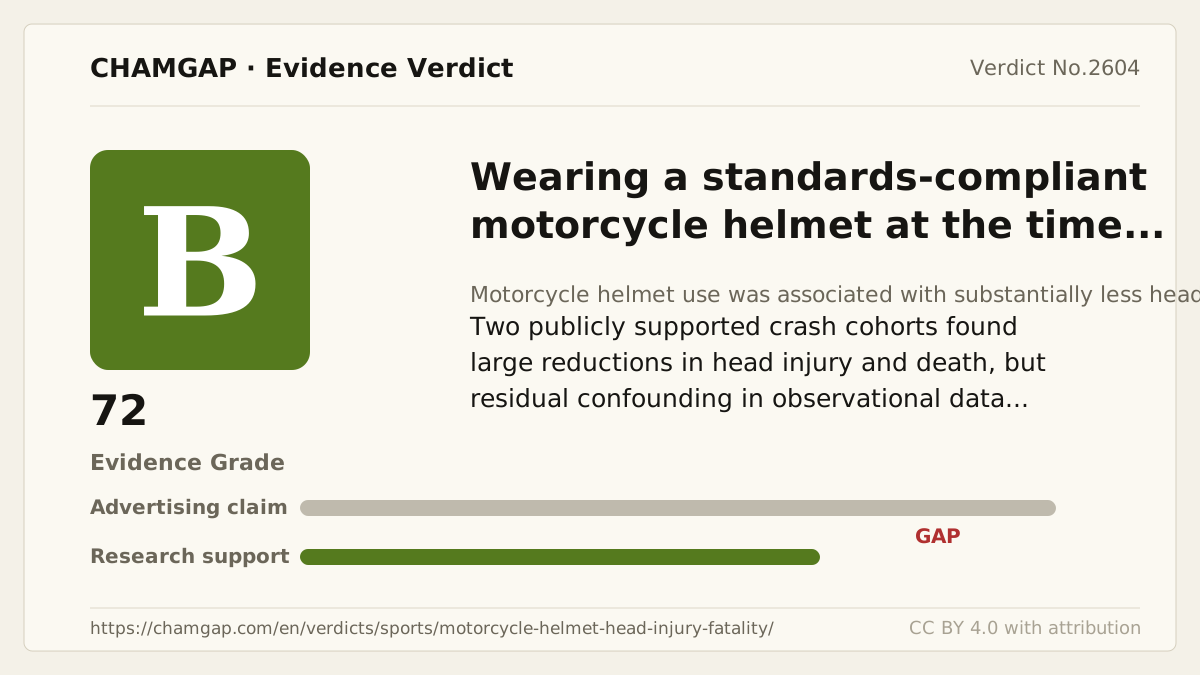
[Chamgap] Motorcycle helmet use x head injury and fatal injury in crashes — Evidence Grade B·72. 2 cited sources checked. Source: https://chamgap.com/en/verdicts/sports/motorcycle-helmet-head-injury-fatality/ · CC BY 4.0CC BY 4.0 — free to use with attribution; do not distort grades, numbers, or verdict meaning.
What this document does and does not do
Chamgap is an information source. It reports what research has and has not confirmed; it does not tell readers what to take or buy. That decision belongs to readers and, when needed, medical or legal professionals. This verdict reflects literature available up to the search date and may change as new research appears. Nothing here is medical advice.