
Menthol mouth rinse,
does it really help with Improved endurance performance in hot environments?
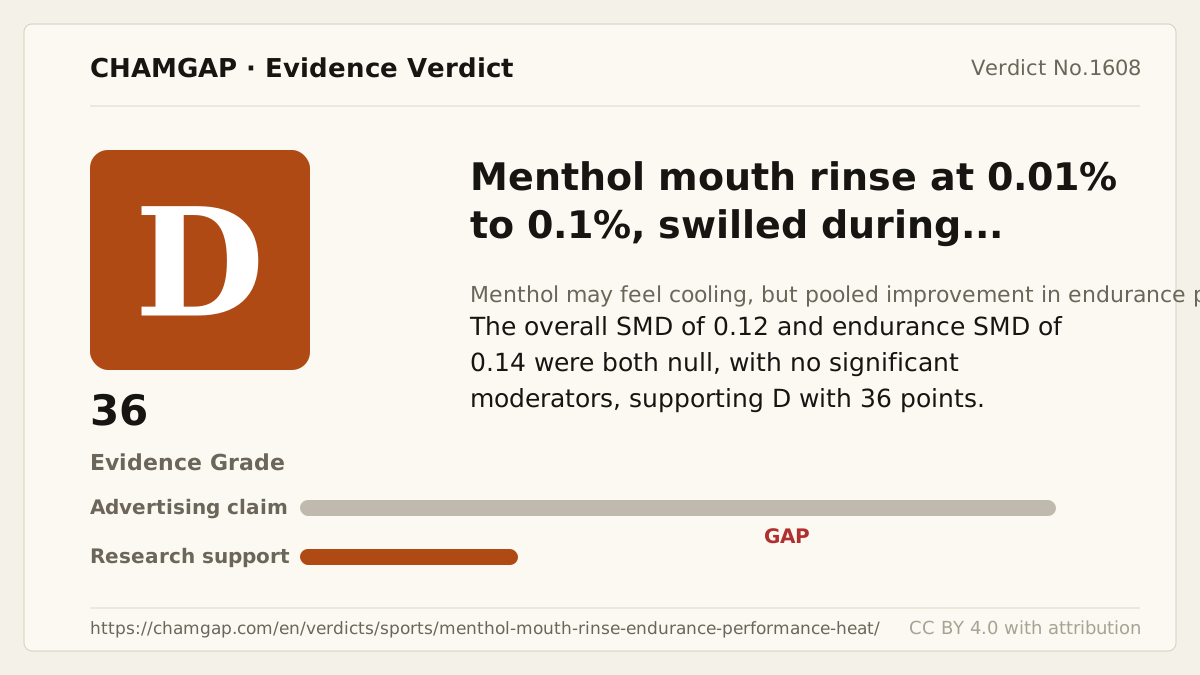
research showsMenthol mouth rinsing is rated D because the direct evidence for improved endurance performance in the heat is null. A 2024 meta-analysis combined 22 outcomes from ten randomized crossover trials involving 153 people and found a null overall performance effect, SMD 0.12 (95% CI -0.08 to 0.31; P=.23). The endurance subgroup was also null, SMD 0.14 (95% CI -0.09 to 0.36), with a confidence interval crossing zero. Exercise type, menthol concentration, and environmental temperature produced no significant moderation. Small positive individual trials and an older analysis mixing administration routes do not overturn the two pooled estimates most direct to the claim. Improved thermal perception is separate from improved performance, supporting D with 36 points.
ads claimMarketing may translate a cool feeling in the mouth into lower core temperature or certain performance gains. Menthol can reduce perceived heat, but it does not reliably lower core temperature or heart rate, and feeling cooler does not mean heat-illness risk has fallen.
Useful facts when choosing a product
- Studies generally used a 0.01% to 0.1% menthol solution, swilled for several seconds before or during exercise and then expectorated rather than swallowed.
- Concentration, swill duration, frequency, and timing varied across trials, so no standardized performance product or established regimen exists.
- Brief rinsing was generally tolerated in research, but higher concentrations can cause oral irritation, coughing, nausea, or discomfort.
- Menthol can blunt heat perception and encourage underestimation of actual heat strain, so it must not replace hydration, rest, environmental control, or heat-illness stopping rules.
Chamgap Semantic Classification Code
Candidate index · review held
X.menthol-mouth-rinse-at-0-01-percent-to-0-1-percent.oromucosal.endurance-performance-in-hot-environments.improve.placeboBehaviors, exposures and policies > Menthol mouth rinse at 0.01% to 0.1% > Oromucosal > endurance performance in hot environments > Improvement claim > Placebo
An automated migration candidate, not an issued permanent code; exact claim scope remains under review. This machine-generated migration candidate helps retrieval but is not a permanent assignment. The original verdict ID and URL remain authoritative.
What the research actually shows
Gavel 2024 used a three-level meta-analysis of 22 outcomes from ten randomized crossover trials comparing menthol mouth rinse with placebo or control in 153 people. The overall performance SMD was a nonsignificant 0.12, the endurance-only estimate was a nonsignificant 0.14, and sensitivity analysis excluding two large effects produced 0.07. Egger testing suggested small-study or publication bias. Exercise type, 0.01% versus 0.1% concentration, swill duration, and environmental temperature were not significant moderators. The 2019 Jeffries meta-analysis was more optimistic, reporting g 0.33 overall and g 0.40 for internal administration, but it combined mouth rinsing with ingestion and topical routes and is less direct for this narrow claim. Some recent small trials improved cycling performance in the heat, while intermittent exercise in football referees and other protocols did not show performance or physiological benefit.
Why this is classified as D (36)
Across ten crossover trials and 153 participants, the overall SMD of 0.12 and endurance SMD of 0.14 both included zero, and exercise type, menthol concentration, and environmental temperature showed no significant moderation. The pooled estimates most direct to the claim are null, while perceived cooling is separate from performance, supporting D with 36 points.
Counterpoint. An athlete may test the same protocol under controlled training conditions, but should not try it for the first time in competition or treat a cool sensation as a safety signal. Heat acclimation, hydration and electrolyte planning, real cooling, and stopping criteria remain the reliable measures.
Rejudgment record. Cross-check applied — The most direct 2024 meta-analysis was null overall at SMD 0.12 and in the endurance subgroup at SMD 0.14, with both confidence intervals crossing zero and no significant moderation by exercise type, menthol concentration, or environmental temperature. Perceived cooling is separate from performance, so the null direct claim receives D
Sub-claim grades by effect
This ingredient is marketed for several effects. A single overall grade blends strong and weak claims together, so each effect is graded separately here. The overall grade reflects the strongest disconfirming or core claim.
| Effect (sub-claim) | Grade | Basis |
|---|---|---|
| Improved endurance performance in hot environments | D | The endurance SMD of 0.14 had a confidence interval crossing zero, with no significant moderation by exercise type, concentration, or temperature. |
| Reduced perceived heat during exercise | D | Some perceptual changes were reported, but protocols were heterogeneous and the outcome is separate from physiological cooling or improved performance. |
| Improved strength or sprint performance | D | The strength or power estimate was null at SMD 0.05 (95% CI -0.34 to 0.35) and included only 19 participants. |
Cross-check — AI research and Codex final gate
Evidence Table
| Study | Design | Sample | Funding | Endpoint | Result | Weight |
|---|---|---|---|---|---|---|
| Gavel EH et al. 2024 | Systematic review and three-level meta-analysis of randomized crossover trials | Ten trials, 153 participants, and 22 performance outcomes | Reported no external funding | Overall exercise performance and capacity with endurance and strength or power subanalyses | The overall effect was null at SMD 0.12 (95% CI -0.08 to 0.31; P=.23), as was endurance at SMD 0.14 (95% CI -0.09 to 0.36). Publication bias was possible. | Most direct key synthesis |
| Jeffries O and Waldron M. 2019 | Meta-analysis of internal and external menthol administration | Thirteen articles for performance and eleven for thermal sensation | No external funding reported | Exercise performance and thermal sensation | Overall performance was g 0.33 (95% CI -0.00 to 0.65; P=.05), internal administration was g 0.40 (95% CI 0.04 to 0.76; P=.03), and thermal sensation was g -0.54. | Positive but indirect evidence combining administration routes |
| Hawke KV et al. 2025 | Randomized crossover controlled trial in hot conditions | Eleven trained adolescent male cyclists | Academic study; not a large manufacturer confirmatory trial | Modified variable cycling performance in the heat | Menthol mouth rinsing improved selected cycling-performance measures, providing a small endurance signal, but the sample was small and the design was crossover. | Recent small positive direct trial |
Receipt — 3 References
All 3 cited sources were verified for existence at the original page (as of 2026-07-24).
Final verification and publication gate: Codex · Evidence date: 2026-07-24 · Corrections: none
Cite this verdict
[Chamgap] Menthol mouth rinse x improved endurance performance in the heat — Evidence Grade D·36. 3 cited sources checked. Source: https://chamgap.com/en/verdicts/sports/menthol-mouth-rinse-endurance-performance-heat/ · CC BY 4.0CC BY 4.0 — free to use with attribution; do not distort grades, numbers, or verdict meaning.
What this document does and does not do
Chamgap is an information source. It reports what research has and has not confirmed; it does not tell readers what to take or buy. That decision belongs to readers and, when needed, medical or legal professionals. This verdict reflects literature available up to the search date and may change as new research appears. Nothing here is medical advice.