
Low-fat chocolate milk,
does it really help with Superior recovery of endurance performance versus other recovery beverages?
research showsThe grade is D with 28 points. In a nine-man crossover trial, time to exhaustion was longer after chocolate milk than after one carbohydrate-recovery drink, but not versus a fluid-electrolyte drink. A later synthesis of six trials and 57 participants found an overall difference of 1.46 minutes (95% CI -0.31 to 3.22), which was not significant. Chocolate milk may be an inexpensive alternative, but consistent superiority is unconfirmed.
ads claimThis verdict concerns a finished sweetened dairy beverage, not an isolated dairy protein or extract. Existing verdicts on isolated whey, milk-derived extracts, bone outcomes, and muscle in older adults address different interventions and indications; this question is superiority for post-exercise endurance recovery.
Useful facts when choosing a product
- Karp's table reports that one chocolate-milk serving averaged 509.1 mL, 70.0 g total carbohydrate, 19.1 g protein, 5.3 g fat, and 381.8 kcal; sugars and added sugars could not be verified, and the serving was given twice.
- Chocolate milk and the carbohydrate-recovery drink matched energy and total carbohydrate, but fat was 5.3 versus 1.5 g. The fluid-electrolyte drink supplied 106.1 kcal and 29.7 g total carbohydrate, so it was not an isocaloric comparison.
- Chocolate milk is a finished milk product with added sugar and flavoring. These values describe the tested product, not every commercial brand.
Chamgap Semantic Classification Code
Candidate index · review held
F.low-fat-chocolate-milk-consumed-immediately-after-exercise-and-again-later.food.superior-recovery-of-endurance-performance.superiority.UNKFoods and beverages > Low-fat chocolate milk consumed immediately after exercise and again later > Food consumption > Superior recovery of endurance performance > Superiority claim > Unknown
An automated migration candidate, not an issued permanent code; exact claim scope remains under review. This machine-generated migration candidate helps retrieval but is not a permanent assignment. The original verdict ID and URL remain authoritative.
What the research actually shows
Karp randomized nine trained male cyclists to receive all three beverages in a single-blind crossover. Investigators were blinded, but distinctive tastes prevented participant blinding. About 509 mL was given immediately after exercise and again two hours later. The Dairy and Nutrition Council partly supported the study. A publicly funded independent meta-analysis reviewed 12 trials and pooled time to exhaustion from six trials with 57 participants; most source studies were very small and measured only acute recovery.
Why this is classified as D (28)
The re-pooling that included the original trial was null for time to exhaustion and perceived exertion, and the decisive evidence remained small and acute, giving D with 28 points.
Counterpoint. D does not mean chocolate milk cannot be used as a recovery beverage; it means superiority over alternatives is unsupported.
Rejudgment record. Cross-check applied — The original table's beverage composition, nine-participant crossover results and funding were checked against the 2018 meta-analysis of overall time to exhaustion and perceived exertion
| Endpoint | P | Symptom or function itself is the target - including patient reports and performance tests |
| Replication | R1 | Single confirmatory trial |
| Independence | I1 | Mixed funding sources |
| Effect size | E0 | Null |
| Precision | C0 | The confidence interval leaves room for benefit |
Stored derived and displayed grades match; this is not a current recalculation or validity check (D).
Sub-claim grades by effect
This ingredient is marketed for several effects. A single overall grade blends strong and weak claims together, so each effect is graded separately here. The overall grade reflects the strongest disconfirming or core claim.
| Effect (sub-claim) | Grade | Basis |
|---|---|---|
| Consistently prolongs time to exhaustion versus other recovery beverages | D | The overall pooled estimate from six trials and 57 participants was null. |
| Superior to a carbohydrate-recovery drink | C | Positive in one nine-man trial, but extremely small and sensitive to comparator composition. |
Cross-check — AI research and Codex final gate
Evidence Table
| Study | Design | Sample | Funding | Endpoint | Result | Weight |
|---|---|---|---|---|---|---|
| Karp JR et al. 2006 | Randomized single-blind three-period crossover trial | Nine trained male cyclists, each completing all three conditions | Partly supported by the Dairy and Nutrition Council | Time to exhaustion and total work at 70% VO2max after four hours of recovery | Time to exhaustion was 40.0 +/- 14.7, 41.3 +/- 15.0, and 26.8 +/- 10.3 minutes; chocolate milk and the fluid-electrolyte drink exceeded the carbohydrate-recovery drink but did not differ from each other | Original direct comparison limited by extremely small size, acute testing, and unblinded participants |
| Amiri M et al. 2019 meta-analysis | Systematic review and random-effects meta-analysis of controlled trials | Twelve trials reviewed; six trials and 57 participants for time to exhaustion, seven and 76 for perceived exertion | Funded by the Shahid Sadoughi University research council; authors declared no conflicts | Time to exhaustion and rating of perceived exertion | Time-to-exhaustion MD 1.46 minutes (95% CI -0.31 to 3.22); perceived-exertion MD -0.04 (-0.52 to 0.44) | Decisive pooled evidence showing no overall superiority |
Receipt — 2 References
All 2 cited sources were verified for existence at the original page (as of 2026-08-03).
Final verification and publication gate: Codex · Evidence date: 2026-08-03 · Corrections: none
Cite this verdict
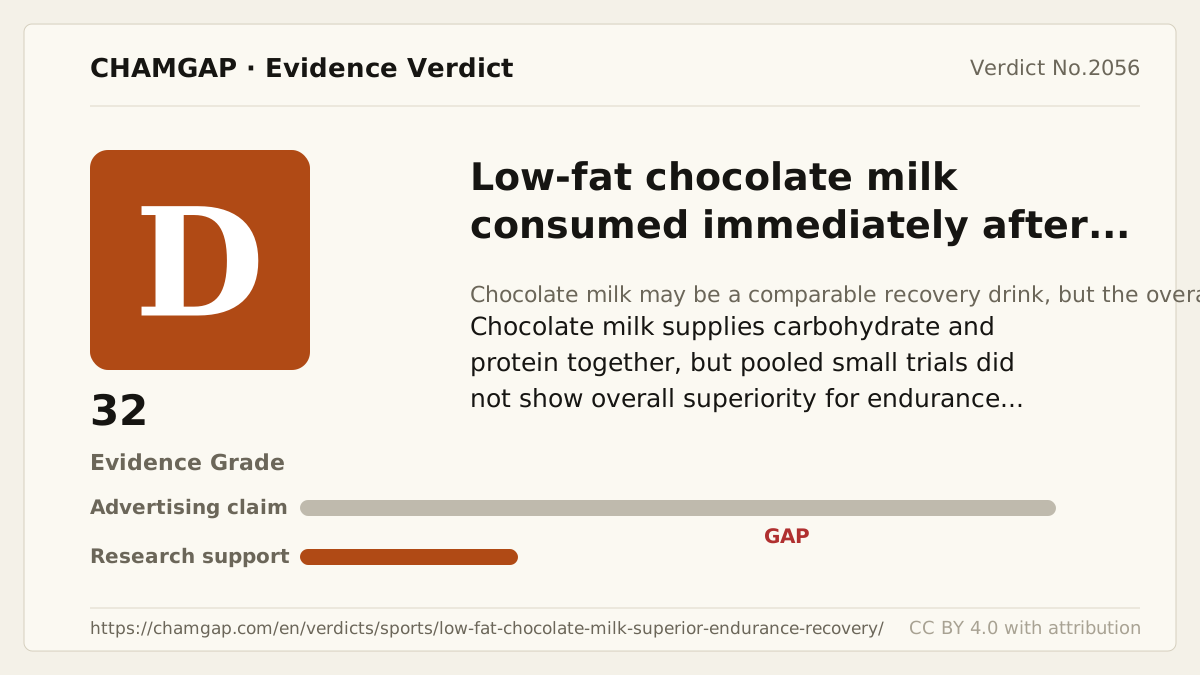
[Chamgap] Low-fat chocolate milk x superior post-exercise endurance recovery — Evidence Grade D·28. 2 cited sources checked. Source: https://chamgap.com/en/verdicts/sports/low-fat-chocolate-milk-superior-endurance-recovery/ · CC BY 4.0CC BY 4.0 — free to use with attribution; do not distort grades, numbers, or verdict meaning.
What this document does and does not do
Chamgap is an information source. It reports what research has and has not confirmed; it does not tell readers what to take or buy. That decision belongs to readers and, when needed, medical or legal professionals. This verdict reflects literature available up to the search date and may change as new research appears. Nothing here is medical advice.