
Lean beef plus resistance training,
does it really help with Additional strength and quadriceps-volume gains beyond resistance training in older women?
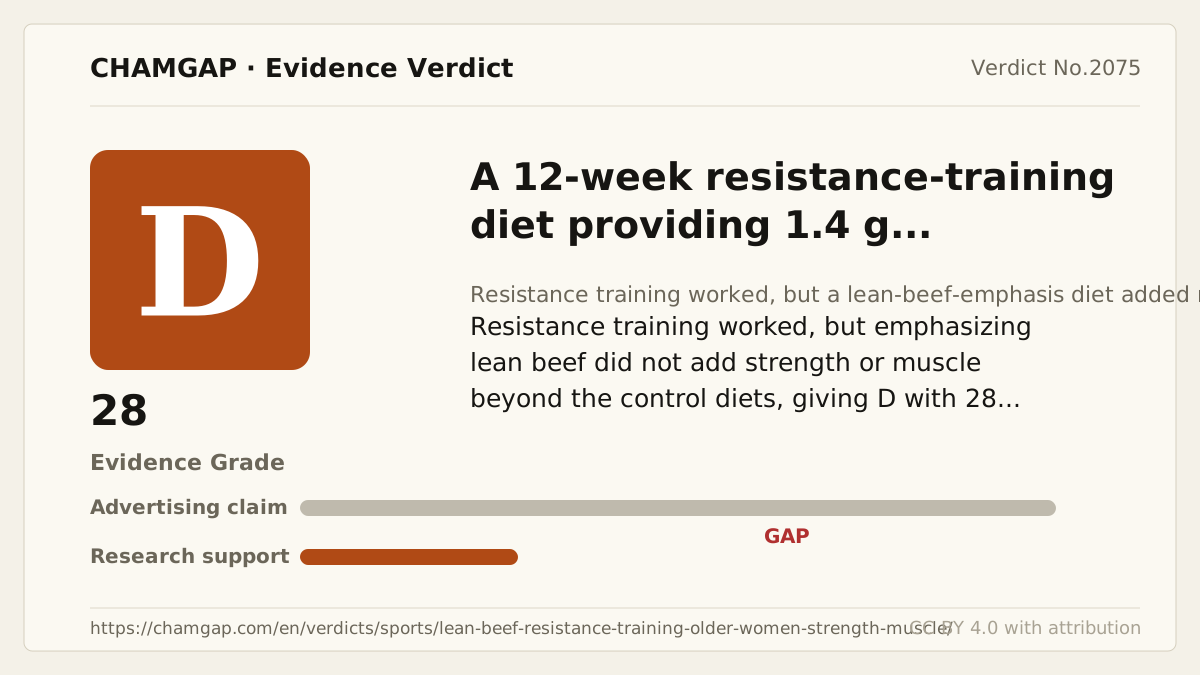
research showsThe grade is D. In a 12-week feeding trial randomizing 49 women as 16, 17, and 16, all three diets improved quadriceps strength and volume with training, but diet added no differential benefit. Only about 34 participants had paired strength or muscle data, and the study was small, had substantial attrition, and included beef-industry funding. A positive older trial prevents repeated-refutation status, but the direct registered trial did not support added benefit, giving D with 28 points.
ads claimBeef provides protein and heme iron, but that fact does not establish more muscle or strength than the same resistance training with a suitable control diet. The trial separated the training effect from beef's incremental effect.
Useful facts when choosing a product
- The beef-emphasis group consumed 1.4 g protein/kg/day and 3 oz, about 85 g, of lean beef daily, 24 oz/week; the high-protein mixed group matched total protein without added red meat.
- The normal-protein control provided 0.8 g/kg/day and 3 oz beef/week. Observed protein intakes were about 0.82, 1.38, and 1.41 g/kg/day.
- The trial used over-90%-lean ground beef and unprocessed round, sirloin, chuck, and tenderloin cuts; saturated fat varies by cut and trimming and was not assigned one fixed value.
- Results were not separated by cooking temperature or doneness.
- Verdict 2058 is D with 28 points for whole eggs versus egg whites during resistance training; this verdict compares a lean-beef high-protein diet with two controls in older women.
Chamgap Semantic Classification Code
Candidate index · review held
D.resistance-training-diet-providing-protein-kg-day-and-emphasizing-of-lean-beef.dietary.additional-strength-and-quadriceps-volume-gains-beyond-resistance-training.assess.UNKDietary patterns and eating practices > resistance-training diet providing protein/kg/day and emphasizing of lean beef > Dietary regimen > Additional strength and quadriceps-volume gains beyond resistance training > Association or change assessment > Unknown
An automated migration candidate, not an issued permanent code; exact claim scope remains under review. This machine-generated migration candidate helps retrieval but is not a permanent assignment. The original verdict ID and URL remain authoritative.
What the research actually shows
The 2024 trial randomized 49 women and had paired main data for 34. The registered NCT04347447 primary outcomes were MRI thigh muscle mass, one-repetition maximum strength, patellar-tendon stiffness, and MRI patellar-tendon size; all were reported and showed no between-diet difference. Patellar-tendon T2* signal, called primary in the paper, was absent from the registered primary and secondary lists and was also null between diets. This is a registration-publication mismatch, not a positive unregistered exploratory outcome after primary failure. Funding combined the NCBA as a Beef Checkoff contractor with Purdue, NIH, and USDA support; the corresponding author disclosed multiple livestock-related grants including Beef Checkoff and Pork Checkoff.
Why this is classified as D (28)
The registered direct strength and muscle outcomes showed no incremental benefit in an analysis of only about 34 participants. Daly used a different comparator and unit and cannot be directly compared, while precision was insufficient to exclude a small benefit, giving D with 28 points.
Counterpoint. D does not mean beef supplies no nutrients or resistance training does not work. It narrowly means an added benefit from emphasizing beef over suitable comparator diets was not established.
Rejudgment record. Cross-check applied — Null registered strength and muscle outcomes, reduced analysis counts, and mixed earlier trials
| Endpoint | P | Symptom or function itself is the target - including patient reports and performance tests |
| Replication | R1 | Single confirmatory trial |
| Independence | I1 | Mixed funding sources |
| Effect size | E0 | Null |
| Precision | CX | No pooled confidence interval could be confirmed |
Stored derived and displayed grades match; this is not a current recalculation or validity check (D).
Sub-claim grades by effect
This ingredient is marketed for several effects. A single overall grade blends strong and weak claims together, so each effect is graded separately here. The overall grade reflects the strongest disconfirming or core claim.
| Effect (sub-claim) | Grade | Basis |
|---|---|---|
| A lean-beef-emphasis diet adds strength gains during resistance training | D | The direct registered trial found no diet difference but could not precisely exclude a small benefit. |
| A lean-beef-emphasis diet adds quadriceps-volume gains | D | MRI volume increased with training but did not differ by diet. |
Cross-check — AI research and Codex final gate
Evidence Table
| Study | Design | Sample | Funding | Endpoint | Result | Weight |
|---|---|---|---|---|---|---|
| Carroll CC et al. 2024 | Three-arm randomized controlled feeding plus resistance-training trial | 49 randomized, 16/17/16; 34 with paired main strength and muscle data, 11/14/9 | Mixed NCBA, Purdue, NIH, and USDA support; corresponding author disclosed grants including Beef and Pork Checkoff | Registered primary MRI thigh muscle mass, 1RM, patellar-tendon stiffness, and MRI tendon size | All registered primary outcomes were reported and null between diets; the paper's primary T2* label mismatched registration and was also null | Pivotal registered direct trial |
| Daly RM et al. 2014 | Retirement-village cluster-randomized resistance-training trial | 100 older women, 53/47 | Mixed funding from Meat & Livestock Australia, NHMRC, and ARC | Percentage change in leg-extension strength | 28% (18 to 39) versus 10% (-1 to 21), adjusted net effect 18 percentage points (3 to 34) | Not directly comparable because comparator and unit differ |
| Daly RM et al. six-month trial | Two-arm randomized multicomponent-exercise dietary trial | 154 older adults, 77/77 | Funding details were not confirmed in the sources reviewed | Leg strength, muscle size, lean mass, and gait | Principal leg strength and muscle size were similar; some lean-mass and gait outcomes favored meat | Supportive trial with mixed outcomes |
Receipt — 3 References
All 3 cited sources were verified for existence at the original page (as of 2026-08-03).
Final verification and publication gate: Codex · Evidence date: 2026-08-03 · Corrections: none
Cite this verdict
[Chamgap] Lean beef plus resistance training x additional strength and muscle gains in older women — Evidence Grade D·28. 3 cited sources checked. Source: https://chamgap.com/en/verdicts/sports/lean-beef-resistance-training-older-women-strength-muscle/ · CC BY 4.0CC BY 4.0 — free to use with attribution; do not distort grades, numbers, or verdict meaning.
What this document does and does not do
Chamgap is an information source. It reports what research has and has not confirmed; it does not tell readers what to take or buy. That decision belongs to readers and, when needed, medical or legal professionals. This verdict reflects literature available up to the search date and may change as new research appears. Nothing here is medical advice.