
Lace-up ankle brace,
does it really help with Prevention of first-time and recurrent acute ankle injuries during basketball and field or court sports?
research showsLace-up ankle braces are rated B because they reduce first-time and recurrent acute ankle injuries during basketball and similar sports. In a randomized trial of 1,460 high-school basketball players, injury rates were 0.47 versus 1.41 per 1,000 exposures, with a hazard ratio of 0.32, and the reduction occurred with and without a previous injury. A randomized trial of 2,081 high-school football players reported a hazard ratio of 0.39, but it shares its first and corresponding author, its institution, and three co-authors with the basketball trial and was funded by the brace manufacturer Don-Joy Global, so it does not count as independent replication. A meta-analysis of six randomized trials reported risk ratios of 0.53 for primary prevention and 0.37 for secondary prevention, but those six trials include both trials above, primary-prevention heterogeneity was substantial, and certainty was low. Neither large trial reduced time-loss severity after an injury, so the grade is B rather than A, with 70 points.
ads claimMarketing can imply that a brace virtually eliminates rolling the ankle and makes any injury milder. The demonstrated benefit is a lower frequency of acute ankle injury; there is no evidence that time loss or severity is reduced once an injury occurs.
Useful facts when choosing a product
- A lace-up ankle brace is a non-drug support that tightens like a shoe and uses straps around the ankle to limit excessive inversion during activity.
- To reproduce the preventive strategy, the brace must fit correctly on both ankles and be worn consistently during practices and competitions.
- A brace does not replace balance and proprioceptive training, calf and ankle strengthening, appropriate footwear, or graded return after injury.
- Pressure, skin chafing, heat, and movement discomfort can occur; numbness, skin injury, or worsening pain calls for stopping use and checking fit and the underlying injury.
Chamgap Semantic Classification Code
Candidate index · review held
P.lace-up-ankle-brace.device.first-time-and-recurrent-acute-ankle-injuries-during-basketball-and-field-or-court-sports.prevent.UNKProcedures, devices and tests > Lace-up ankle brace > Device delivered > first-time and recurrent acute ankle injuries during basketball and field or court sports > Occurrence-prevention claim > Unknown
An automated migration candidate, not an issued permanent code; exact claim scope remains under review. This machine-generated migration candidate helps retrieval but is not a permanent assignment. The original verdict ID and URL remain authoritative.
What the research actually shows
McGuine 2011 randomized 1,460 high-school basketball players to a brace or control group and recorded exposure and trainer-confirmed injuries for one season. Acute ankle injury rates were 0.47 versus 1.41 per 1,000 exposures, with hazard ratios of 0.39 among players with a prior injury and 0.30 among those without one; median time loss was similar at six versus seven days. A 2012 football cluster-randomized trial enrolled 2,081 players and found injury rates of 0.48 versus 1.12 and a hazard ratio of 0.39, but severity was five days in both groups. Both trials share McGuine TA as first and corresponding author, share three co-authors, and were run at the University of Wisconsin-Madison. The 2011 trial was funded by internal UW-Madison funds; the 2012 trial by an unrestricted grant from the brace manufacturer Don-Joy Global LLC. Barelds 2018 synthesized six trials and reported risk ratios of 0.53 for primary prevention and 0.37 for secondary prevention, but those six include McGuine 2011 and 2012, with low certainty and substantial heterogeneity for primary prevention.
Why this is classified as B (70)
The hazard ratio of 0.32 in the 1,460-player basketball trial and 0.39 in the 2,081-player football trial directly demonstrate a brace-specific reduction in injury occurrence. However, the two trials share their first author and institution, so they are not independent replication, and the second was funded by the brace manufacturer. Secondary prevention was also consistent in meta-analysis, but that meta-analysis includes both trials, primary prevention was heterogeneous, and neither large trial reduced injury severity. Large randomized evidence on a direct clinical endpoint, without confirmed independent replication and with manufacturer funding, supports B with 70 points.
Counterpoint. Evidence for preventing recurrence is more stable than evidence for primary prevention, and individual absolute benefit varies with sport, brace design, and adherence.
Rejudgment record. New verdict — A 1,460-player basketball trial and a 2,081-player football trial directly testing lace-up braces showed reductions in acute ankle injury, and a six-trial synthesis supports secondary prevention; however, the two trials share investigators so they are not independent replication and the second was manufacturer-funded, primary-prevention heterogeneity is substantial, and injury severity was null in both, supporting B
| Endpoint | H | Hard endpoint - actual events such as death |
| Replication | R1 | Single confirmatory trial |
| Independence | I1 | Mixed funding sources |
| Effect size | E+ | Meets the clinically important threshold |
Stored derived and displayed grades match; this is not a current recalculation or validity check (B).
Sub-claim grades by effect
This ingredient is marketed for several effects. A single overall grade blends strong and weak claims together, so each effect is graded separately here. The overall grade reflects the strongest disconfirming or core claim.
| Effect (sub-claim) | Grade | Basis |
|---|---|---|
| Prevention of first-time acute ankle injury during sports | B | Large basketball and football trials were positive, but meta-analytic primary-prevention evidence had low certainty and substantial heterogeneity. |
| Prevention of recurrent acute ankle injury in athletes with a previous injury | B | The prior-injury subgroup hazard ratio was 0.39 in the basketball trial, and the six-trial secondary-prevention risk ratio was 0.37. |
| Reduction in severity or time loss after an ankle injury occurs | D | The basketball trial found six versus seven days, and the football trial found five days in both groups, with no significant reduction. |
Cross-check — AI research and Codex final gate
Evidence Table
| Study | Design | Sample | Funding | Endpoint | Result | Weight |
|---|---|---|---|---|---|---|
| McGuine TA et al. 2011 basketball trial | Stratified cluster-randomized controlled trial across 46 high schools | 1,460 male and female basketball players | Funded by the UW-Madison Sports Medicine Classic Research Fund and the UW-Madison Department of Orthopedics. McGuine disclosed speaker honoraria from Mueller Sports Medicine and Brooks disclosed NICHD support under K12HD055894. The brace tested was the McDavid Ultralight 195. | Trainer-confirmed acute ankle injury and days lost | Rates were 0.47 versus 1.41 per 1,000 exposures, with HR 0.32 and benefit regardless of prior injury, but severity was similar at six versus seven days. | Key direct randomized trial of a lace-up brace |
| McGuine TA et al. 2012 football trial | Cluster-randomized controlled trial across 50 high schools | 2,081 football players | Funded by an unrestricted research grant from the brace manufacturer Don-Joy Global LLC to the Department of Orthopedics, and the brace tested was that company's own Don-Joy Ankle Stabilizing Brace. The paper states that data analysis and reporting were performed without Don-Joy involvement. | Acute ankle injury rate and days lost | Rates were 0.48 versus 1.12 per 1,000 exposures, with HR 0.39, but severity was five days in both groups. | Follow-up trial in another sport by the same investigators |
| Barelds I et al. 2018 | Systematic review and meta-analysis of randomized brace-prevention trials | Six randomized trials | The paper states that no sources of funding were used in its preparation, and all three authors declared no relevant conflicts of interest. | Primary and recurrent acute ankle injury | Primary-prevention RR was 0.53 (95% CI 0.32 to 0.88; low certainty; I-squared 77%) and secondary-prevention RR was 0.37 (0.24 to 0.58; moderate certainty). | Scope and heterogeneity assessment; its six trials include both McGuine trials above, so it is not separate evidence |
Receipt — 3 References
All 3 cited sources were verified for existence at the original page (as of 2026-08-08).
Final verification and publication gate: Codex · Evidence date: 2026-08-08 · Corrections: 1
Correction log — 1
Corrections applied to this verdict, in chronological order. Changes are logged, not erased.
- 2026-08-08 · Correction of replication and funding claims — The verdict said the two large randomized trials replicated each other, which was inaccurate. McGuine 2011 and 2012 share McGuine TA as first and corresponding author, share three co-authors, and were both conducted at the University of Wisconsin-Madison, so they are not independent replication. The funding for both was recorded as not stated in the abstract, but both papers state it in full text: the 2011 trial was funded by the UW-Madison Sports Medicine Classic Research Fund and Department of Orthopedics, and the 2012 trial by an unrestricted grant from the brace manufacturer Don-Joy Global LLC, whose own product was the brace tested. The verdict now also notes that the six trials in the Barelds 2018 meta-analysis include both of these trials, so it is not separate evidence. Axis 2 is recorded as R1 and axis 3 as I1, and the score falls from 73 to 70. The grade letter B is unchanged. Found in the 2026-08-08 internal audit (Claude source check with Codex cross-verification). (grade B unchanged)
Cite this verdict
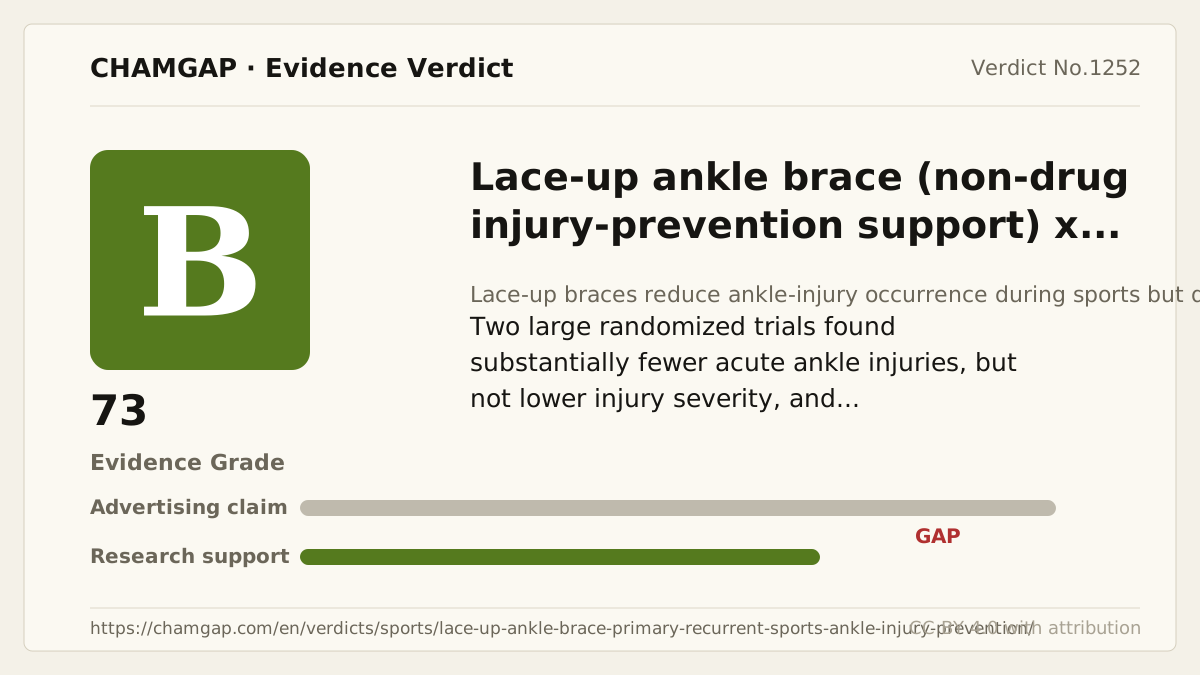
[Chamgap] Lace-up ankle brace x prevention of first-time and recurrent acute ankle injuries during sports — Evidence Grade B·70. 3 cited sources checked. Source: https://chamgap.com/en/verdicts/sports/lace-up-ankle-brace-primary-recurrent-sports-ankle-injury-prevention/ · CC BY 4.0CC BY 4.0 — free to use with attribution; do not distort grades, numbers, or verdict meaning.
What this document does and does not do
Chamgap is an information source. It reports what research has and has not confirmed; it does not tell readers what to take or buy. That decision belongs to readers and, when needed, medical or legal professionals. This verdict reflects literature available up to the search date and may change as new research appears. Nothing here is medical advice.