
Korean red ginseng,
does it really help with Improve maximal oxygen uptake, endurance, and power in healthy adults?
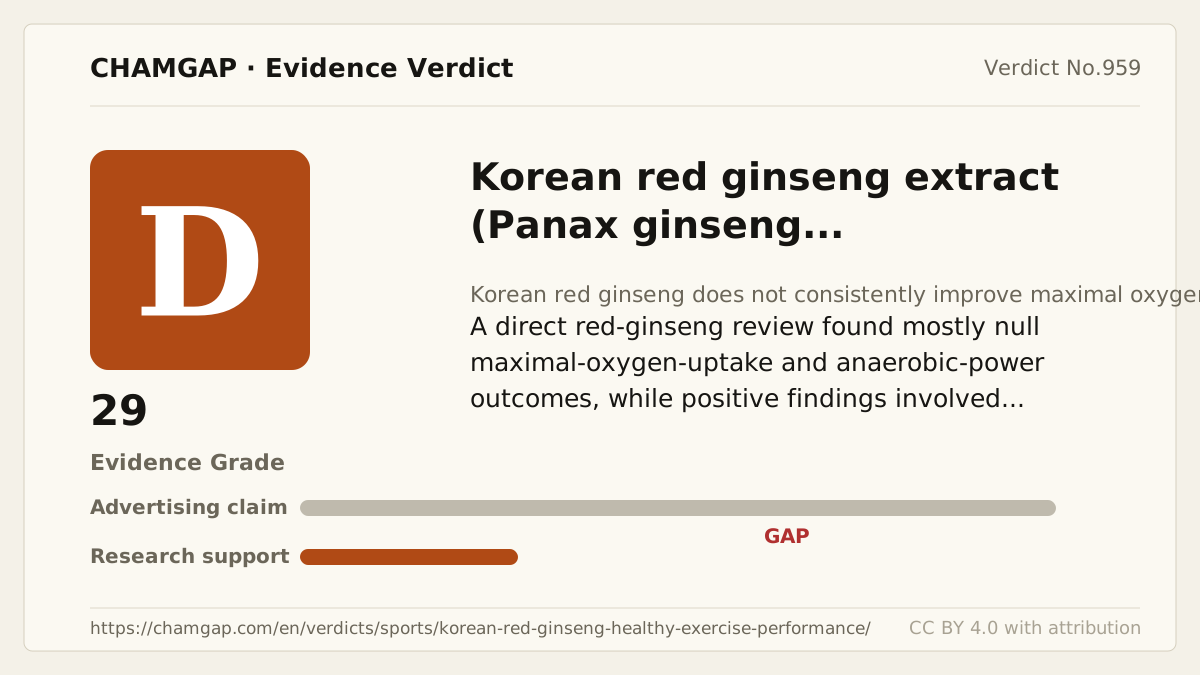
research showsKorean red ginseng is rated D because evidence does not show reliable improvements in maximal oxygen uptake, endurance, or power in healthy adults. In a systematic review of 14 red-ginseng clinical trials, only two of 22 aerobic-capacity outcomes and one of eight anaerobic outcomes were positive, while most maximal oxygen uptake, heart-rate, anaerobic-power, and recovery outcomes were null. A 117-participant UG0712 trial improved maximal oxygen uptake and anaerobic threshold at the high dose but not strength; the intervention was a concentrated ginseng-leaf ginsenoside complex rather than ordinary Korean red-ginseng root extract. Small positive signals cannot establish broad performance enhancement for Korean red ginseng products.
ads claimMarketing treats reduced fatigue or higher ginsenoside content as equivalent to increased maximal oxygen uptake, endurance, and explosive power. Subjective fatigue, lactate, creatine kinase, or antioxidant markers are not the same as improved maximal oxygen uptake, race time, or power, and red-ginseng root, leaf complexes, and isolated ginsenosides are not interchangeable interventions.
Useful facts when choosing a product
- Korean red ginseng is produced by steaming and drying Panax ginseng root, and its ginsenoside profile varies with cultivation, processing, extraction, and standardization.
- A health-functional-food authorization or fatigue claim does not establish strong trials for maximal oxygen uptake, endurance, or power and is not independent evidence for the efficacy grade.
- Short-term use is generally tolerated, but insomnia, headache, or gastrointestinal discomfort can occur, and some people can experience effects relevant to blood-pressure or glucose management.
- Possible interactions with anticoagulants, glucose-lowering medicines, and other prescriptions should be reviewed, and results from a specific standardized material cannot be assumed for a different red-ginseng product.
Chamgap Semantic Classification Code
Candidate index · review held
S.korean-red-ginseng-extract.UNK.improve-maximal-oxygen-uptake-endurance-and-power.improve.placeboSupplements and nutraceuticals > Korean red ginseng extract > Unknown > Improve maximal oxygen uptake, endurance, and power > Improvement claim > Placebo
An automated migration candidate, not an issued permanent code; exact claim scope remains under review. This machine-generated migration candidate helps retrieval but is not a permanent assignment. The original verdict ID and URL remain authoritative.
What the research actually shows
The 2016 direct red-ginseng systematic review included 14 clinical trials, but only two described randomization and only one described double masking; standardization and sample-size planning were also weak. Maximal oxygen uptake, heart rate, anaerobic peak or mean power, and fatigue recovery were mostly null. In Lee 2018, 117 participants received UG0712 or placebo during supervised training: 500 mg improved maximal oxygen uptake and anaerobic threshold relative to placebo training, 100 mg did not improve maximal oxygen uptake, and neither dose improved strength between groups. A 2022 Panax-genus meta-analysis reported positive time to exhaustion across five studies and 90 participants but was not Korean-red-ginseng-specific and had industry funding and author conflicts.
Why this is classified as D (29)
In the direct 14-trial Korean-red-ginseng review, 20 of 22 aerobic outcomes and seven of eight anaerobic outcomes were null, with generally weak methods. Positive findings from high-dose UG0712 and the Panax-genus meta-analysis are limited by a special formulation, mixed species, industry concentration, and small samples. Stable efficacy across maximal oxygen uptake, endurance, and power in healthy adults is absent, supporting D with 29 points.
Counterpoint. Possible improvement in subjective fatigue or selected recovery biomarkers is a separate claim. Such changes do not establish the direct performance endpoints of maximal oxygen uptake, endurance, and power assessed here.
Rejudgment record. New verdict — Centered the rating on the direct 14-trial Korean-red-ginseng review with 20 of 22 aerobic and seven of eight anaerobic outcomes null and weak methods, while accounting for the leaf-derived concentrated UG0712 high-dose signal, null low-dose and strength results, and the Panax-genus meta-analysis limitations of mixed species, industry funding, and only 90 participants; kept claims 004, 442, 927, and 558 separate as different efficacy axes
Sub-claim grades by effect
This ingredient is marketed for several effects. A single overall grade blends strong and weak claims together, so each effect is graded separately here. The overall grade reflects the strongest disconfirming or core claim.
| Effect (sub-claim) | Grade | Basis |
|---|---|---|
| Improved maximal oxygen uptake in healthy adults | D | Most maximal-oxygen-uptake findings in the direct red-ginseng review were null, and the high-dose UG0712 signal was formulation-specific. |
| Improved endurance in healthy adults | D | The positive time-to-exhaustion meta-analysis included only five studies and 90 participants and was indirect because it mixed Panax species and had industry sponsorship. |
| Improved anaerobic power in healthy adults | D | Most peak- and mean-power outcomes in the direct review and the strength outcomes in the UG0712 trial were null. |
Cross-check — AI research and Codex final gate
Evidence Table
| Study | Design | Sample | Funding | Endpoint | Result | Weight |
|---|---|---|---|---|---|---|
| Lee NH et al. 2016 | Systematic review of red-ginseng clinical trials for exercise performance | 14 clinical trials including 12 studies in healthy participants | Detailed funding not stated in the PubMed record; university-affiliated authors | Maximal oxygen uptake, heart rate, time to exhaustion, peak and mean power, and fatigue recovery | Only two of 22 aerobic outcomes and one of eight anaerobic outcomes were positive, and the review concluded that overall efficacy was absent. | Key ingredient- and claim-matched synthesis |
| Lee ES et al. 2018 | Twelve-week randomized double-blind placebo-controlled trial with supervised exercise training | 117 healthy sedentary adults; 39 low dose, 39 high dose, and 39 placebo | Korean government research grant; Unigen supplied UG0712 and placebo | Maximal oxygen uptake, anaerobic threshold, lactate, and knee strength | The high dose improved maximal oxygen uptake and anaerobic threshold, while low-dose maximal oxygen uptake and strength at both doses were null. | Positive conflicting evidence but from a special concentrated leaf-derived material |
| Ikeuchi S et al. 2022 | Systematic review and meta-analysis of Panax-genus plants or ginsenosides for endurance | Five studies and 90 participants, including crossover designs | Funded by Maruzen Pharmaceuticals; four authors were employees and another had an advisory contract | Time to exhaustion | SMD was 0.58 (95% CI 0.22 to 0.95), but species and formulations were mixed and imprecision or publication bias could not be excluded. | Small industry-funded indirect positive evidence |
Receipt — 3 References
All 3 cited sources were verified for existence at the original page (as of 2026-07-21).
Final verification and publication gate: Codex · Evidence date: 2026-07-21 · Corrections: none
Cite this verdict
[Chamgap] Korean red ginseng x improved maximal oxygen uptake, endurance, and power in healthy adults — Evidence Grade D·29. 3 cited sources checked. Source: https://chamgap.com/en/verdicts/sports/korean-red-ginseng-healthy-exercise-performance/ · CC BY 4.0CC BY 4.0 — free to use with attribution; do not distort grades, numbers, or verdict meaning.
What this document does and does not do
Chamgap is an information source. It reports what research has and has not confirmed; it does not tell readers what to take or buy. That decision belongs to readers and, when needed, medical or legal professionals. This verdict reflects literature available up to the search date and may change as new research appears. Nothing here is medical advice.