
Ketone monoester,
does it really help with Improved endurance, exercise performance, and recovery through increased blood ketones?
research showsKetone monoester reliably raises blood beta-hydroxybutyrate, but this is a surrogate. A 2022 meta-analysis of eight randomized studies and 80 participants found a null endurance effect, Hedges g=0.136. Acute performance and recovery considered alone are D-level because results are null or impaired. A 2026 eight-week study in 28 trained men reported better training adaptation and performance, however. Combining the surrogate, acute performance, recovery, and long-term adaptation yields an overall C with 40 points because the evidence is small and conflicting.
ads claimA reliable biochemical rise in blood ketones is presented as though it were the clinical result of faster times and quicker recovery. Ketone concentration is a fuel-use surrogate, not performance itself, and evidence differs between acute preexercise use and repeated postexercise dosing.
Useful facts when choosing a product
- Ketone monoester rapidly raises blood beta-hydroxybutyrate, but the magnitude depends on dose, meals, carbohydrate co-ingestion, and the specific product.
- A single preexercise dose and repeated postexercise plus pre-sleep dosing are distinct strategies. Findings from one strategy cannot be transferred automatically across products, doses, sports, or timing.
- Nausea, abdominal discomfort, diarrhea, and unpleasant taste are common practical problems, and a high dose can interfere with training or competition. People with diabetes, pregnancy, liver or kidney disease, or ketoacidosis risk should consult a clinician.
- Actual content, stereoisomer composition, and contaminants can vary between supplements, and competitive athletes should look for independent third-party contamination testing.
Chamgap Semantic Classification Code
Candidate index · review held
S.ketone-monoester.UNK.endurance-exercise-performance-and-recovery-through-increased-blood-ketones.increase.placeboSupplements and nutraceuticals > Ketone monoester > Unknown > endurance, exercise performance, and recovery through increased blood ketones > Increase claim > Placebo
An automated migration candidate, not an issued permanent code; exact claim scope remains under review. This machine-generated migration candidate helps retrieval but is not a permanent assignment. The original verdict ID and URL remain authoritative.
What the research actually shows
The 2022 meta-analysis included 80 participants across eight randomized studies, 77 of them men, and found a nonsignificant overall endurance effect of Hedges g 0.136 with a 95% confidence interval from -0.195 to 0.467. A 2023 crossover trial in 23 trained cyclists used 0.35 g/kg monoester, raised blood ketones to 2.0 mM, and reduced 20-minute mean power by 2.4%. A 2020 recovery study dosed 20 healthy adults with 360 mg/kg twice daily after eccentric exercise but did not improve strength, jumping, or soreness recovery. A 2026 study gave 25 g after exercise and before sleep during eight weeks of training to 28 trained men and reported improved performance and mitochondrial outcomes, but it remains a small single study.
Why this is classified as C (40)
The 2022 meta-analysis of eight randomized studies and 80 participants found a null endurance effect, Hedges g=0.136. Blood ketone elevation is reliable but is only a surrogate, and acute performance and recovery are D-level when separated because trials are null or impaired. A positive 2026 eight-week trial in 28 men prevents the combined claim from being graded D. Small conflicting evidence across the composite claim gives C with 40 points. Gastrointestinal effects and product variation remain separate.
Counterpoint. A new positive signal applies to trained men following a structured postexercise dosing program. Anyone considering use should also weigh the null or impaired acute pre-race findings, cost, and gastrointestinal tolerability.
Rejudgment record. New verdict — Separated blood ketone elevation as a surrogate and integrated the null 2022 endurance meta-analysis, 2023 acute performance impairment, 2020 null recovery trial, and positive 2026 eight-week postexercise repeated-dosing trial under the conflicting, small, context-dependent evidence standard
Sub-claim grades by effect
This ingredient is marketed for several effects. A single overall grade blends strong and weak claims together, so each effect is graded separately here. The overall grade reflects the strongest disconfirming or core claim.
| Effect (sub-claim) | Grade | Basis |
|---|---|---|
| Elevation of blood ketones | B | Multiple controlled trials consistently show a rapid, substantial direct rise in beta-hydroxybutyrate. |
| Improved acute endurance and exercise performance | D | The meta-analysis was null and some direct trials found impaired time-trial performance. |
| Improved postexercise muscle-function and soreness recovery | D | In a direct recovery trial, blood ketones rose but functional and soreness recovery did not improve. |
| Improved long-term training adaptation with repeated postexercise dosing | C | A 2026 randomized trial in 28 participants was positive but remains a single small male study. |
Cross-check — AI research and Codex final gate
Evidence Table
| Study | Design | Sample | Funding | Endpoint | Result | Weight |
|---|---|---|---|---|---|---|
| Brooks E et al. 2022 | Systematic review and meta-analysis of randomized trials | Eight trials with 80 participants; 77 men and three women | Not reported in the abstract; see the full-text funding statement | Endurance time trial and time to exhaustion | The overall performance effect was nonsignificant, Hedges g 0.136 with 95% CI -0.195 to 0.467. | Key synthesis of acute endurance evidence |
| McCarthy DG et al. 2023 | Randomized triple-blind placebo-controlled crossover trial | 23 trained cyclists | Not reported in the abstract; see the full-text funding and conflict statements | Mean power in a 20-minute cycling time trial | Blood ketones rose to about 2.0 mM, but mean power was 2.4% lower than placebo. | Direct performance-impairment trial |
| Martin-Arrowsmith PW et al. 2020 | Randomized double-blind energy-matched parallel-group trial | 20 healthy active adults | Not reported in the abstract; see the full-text funding statement | Forty-eight-hour recovery of strength, jump performance, soreness, and muscle-damage markers | Blood ketones rose to 4.4 mM, but muscle-function and soreness recovery were no better than control. | Direct null recovery trial |
| Robberechts R et al. 2026 | Eight-week supervised exercise-training randomized controlled trial | 28 trained men; 14 per group | Public support from Research Foundation Flanders; the authors reported no competing interests | Thirty-minute time trial, peak oxygen uptake, and mitochondrial adaptation | Postexercise and pre-sleep ketone dosing improved performance and mitochondrial adaptation. | Recent small longer-term positive trial |
Receipt — 4 References
All 4 cited sources were verified for existence at the original page (as of 2026-07-20).
Final verification and publication gate: Codex · Evidence date: 2026-07-20 · Corrections: none
Cite this verdict
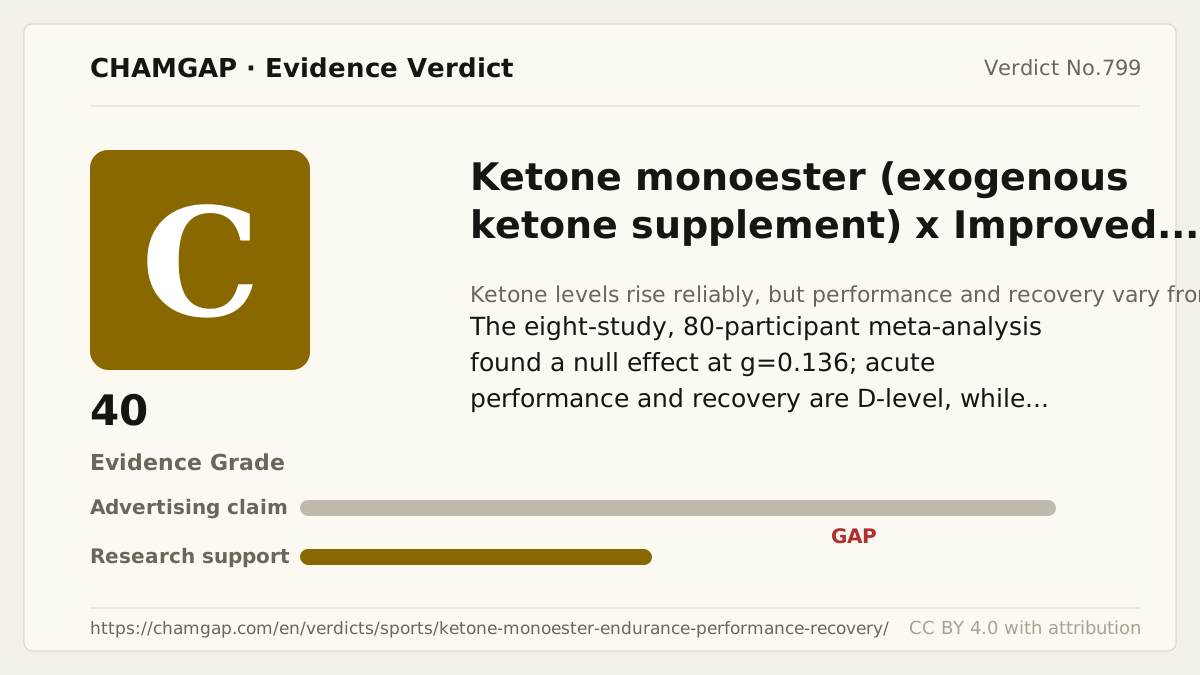
[Chamgap] Ketone monoester x improved endurance, exercise performance, and recovery — Evidence Grade C·40. 4 cited sources checked. Source: https://chamgap.com/en/verdicts/sports/ketone-monoester-endurance-performance-recovery/ · CC BY 4.0CC BY 4.0 — free to use with attribution; do not distort grades, numbers, or verdict meaning.
What this document does and does not do
Chamgap is an information source. It reports what research has and has not confirmed; it does not tell readers what to take or buy. That decision belongs to readers and, when needed, medical or legal professionals. This verdict reflects literature available up to the search date and may change as new research appears. Nothing here is medical advice.