
Ibuprofen,
does it really help with Prevention of delayed-onset muscle soreness and faster strength or power recovery when taken around exercise?
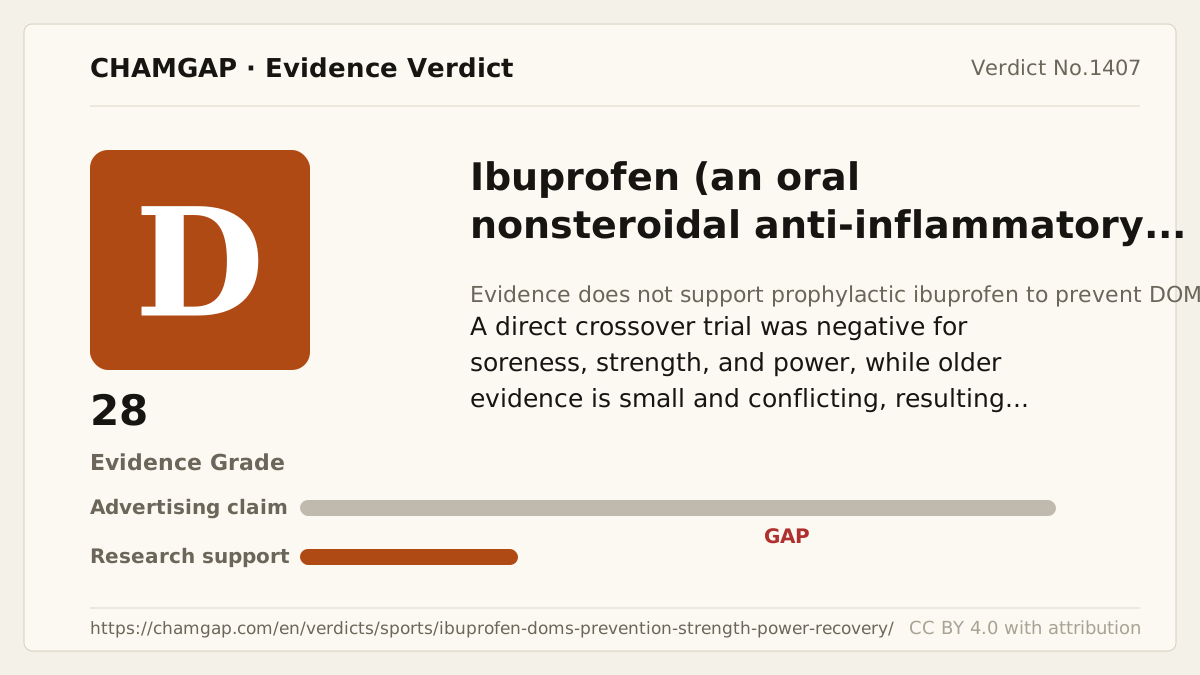
research showsIbuprofen is rated D for prophylactic use around exercise to prevent DOMS and performance loss. In a 2024 randomized double-blind crossover trial, 800 mg taken two hours before exercise did not prevent muscle soreness or decrements in maximal voluntary contraction or vertical jump compared with placebo. An older very small study reported positive signals, but the evidence is inconsistent and too small to support routine prophylactic use.
ads claimGeneral analgesia must not be converted into prevention of muscle damage, faster tissue recovery, or guaranteed power at the next workout. Masking pain and accelerating recovery are different outcomes.
Useful facts when choosing a product
- Ibuprofen is an NSAID indicated for pain and fever; it is not approved as a DOMS-prevention or sports-recovery drug.
- Prophylactic dosing around exercise may add renal and gastrointestinal risk, particularly during dehydration or prolonged endurance exercise.
- Gastrointestinal bleeding or ulceration, kidney injury, fluid retention, increased blood pressure, and cardiovascular risk can occur; it should not be duplicated with another NSAID.
- Interference with training adaptation and muscle-repair signaling is biologically plausible, but clinically important long-term effects in humans remain uncertain and may depend on dose and duration.
Chamgap Semantic Classification Code
Candidate index · review held
M.ibuprofen.oral.delayed-onset-muscle-soreness-and-faster-strength-or-power-recovery-when-taken-around-exercise.prevent.placeboMedicinal interventions > Ibuprofen > Oral > delayed-onset muscle soreness and faster strength or power recovery when taken around exercise > Occurrence-prevention claim > Placebo
An automated migration candidate, not an issued permanent code; exact claim scope remains under review. This machine-generated migration candidate helps retrieval but is not a permanent assignment. The original verdict ID and URL remain authoritative.
What the research actually shows
Roberts and colleagues had 12 healthy adults complete four plyometric exercise sessions in a crossover design after ibuprofen 800 mg, celecoxib, flurbiprofen, or placebo two hours before exercise. Ibuprofen showed no placebo advantage for soreness, vertical jump, or maximal voluntary contraction at four or 24 hours. A 1993 preliminary trial by Hasson and colleagues divided 20 participants among four groups and reported pain and torque signals with prophylactic or therapeutic ibuprofen, but only five participants were assigned to each group. Unlike verdict 857, which concerns established analgesia for primary dysmenorrhea, this verdict concerns sports recovery.
Why this is classified as D (28)
The most direct 2024 double-blind crossover trial was negative for DOMS, strength, and power and enrolled only 12 people. The older positive preliminary trial had five participants per arm and lacks precision and replication. The null-and-tiny-pilot rule yields D with 28 points.
Counterpoint. Short-term analgesic use for pain that impairs daily function is a separate decision requiring assessment of individual contraindications and risks.
Rejudgment record. New verdict — Applied the null-and-small-pilot rule because a direct randomized double-blind crossover trial of 800 mg before exercise found no benefit for DOMS, strength, or power, while the older positive study had only five participants per group
Sub-claim grades by effect
This ingredient is marketed for several effects. A single overall grade blends strong and weak claims together, so each effect is graded separately here. The overall grade reflects the strongest disconfirming or core claim.
| Effect (sub-claim) | Grade | Basis |
|---|---|---|
| Prevention of DOMS by dosing around exercise | D | The most direct crossover trial found no soreness benefit, and older evidence is tiny and conflicting. |
| Accelerated strength recovery | D | A dose of 800 mg did not prevent the decline in maximal voluntary contraction. |
| Accelerated power recovery | D | No advantage over placebo was found for vertical-jump performance. |
Cross-check — AI research and Codex final gate
Evidence Table
| Study | Design | Sample | Funding | Endpoint | Result | Weight |
|---|---|---|---|---|---|---|
| Roberts BM et al. 2024 | Randomized double-blind counterbalanced crossover placebo-controlled trial | 12 healthy adults | Conducted by a United States Army research institute; no conflicts declared | Muscle soreness, maximal voluntary contraction, vertical jump, and exercise performance | Ibuprofen 800 mg did not improve soreness or vertical jump versus placebo and did not prevent loss of contraction force. | Most direct null randomized evidence, but small |
| Hasson SM et al. 1993 | Randomized preliminary comparative trial | 20 participants; five in each of four groups | Inadequately reported | Soreness, creatine kinase, knee-extension torque, and electromyography | The prophylactic group had less soreness and torque decline on selected measures, but muscle-damage markers did not differ. | Unstable positive preliminary evidence with five per group |
Receipt — 2 References
All 2 cited sources were verified for existence at the original page (as of 2026-07-23).
Final verification and publication gate: Codex · Evidence date: 2026-07-23 · Corrections: none
Cite this verdict
[Chamgap] Ibuprofen x prevention of DOMS and faster strength or power recovery — Evidence Grade D·28. 2 cited sources checked. Source: https://chamgap.com/en/verdicts/sports/ibuprofen-doms-prevention-strength-power-recovery/ · CC BY 4.0CC BY 4.0 — free to use with attribution; do not distort grades, numbers, or verdict meaning.
What this document does and does not do
Chamgap is an information source. It reports what research has and has not confirmed; it does not tell readers what to take or buy. That decision belongs to readers and, when needed, medical or legal professionals. This verdict reflects literature available up to the search date and may change as new research appears. Nothing here is medical advice.