
HIIT,
does it really help with Greater improvement in peak oxygen uptake than moderate-intensity continuous training?
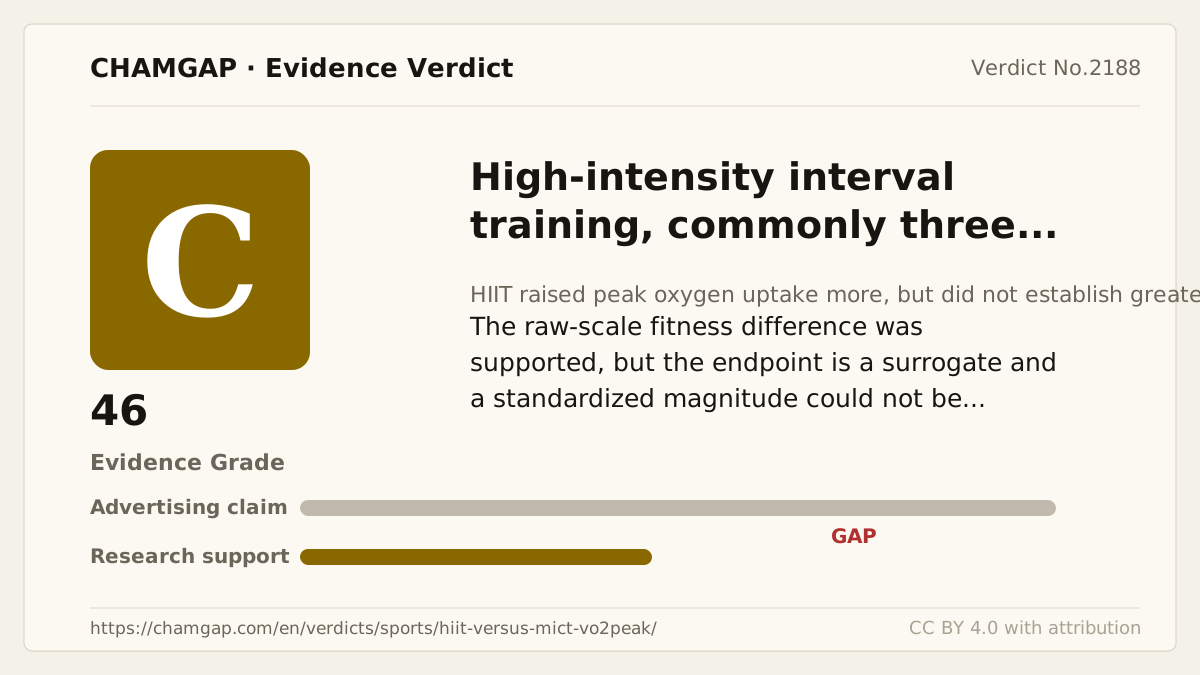
research showsThe grade is C with 46 points. Ten trials in 273 cardiometabolic patients found a raw-scale between-group difference of 3.03 mL/kg/min (95% CI 2.00 to 4.07), with low heterogeneity of 9%. Trial-level standard deviations and weights could not be verified, so conversion to a standardized magnitude was not reproducible. Six trials came from the same Norwegian research network, and total exercise time and work varied across trials.
ads claimA larger absolute gain is different from a larger gain per minute. The former was supported; the latter and hard clinical outcomes were not directly tested.
Useful facts when choosing a product
- The raw-scale pooled difference was 3.03 mL/kg/min (2.00 to 4.07), with heterogeneity of 9%.
- Trial-level standard deviations and weights could not be verified, so a standardized magnitude could not be calculated.
- A common prescription used four 4-minute intervals at 85% to 95% maximal heart rate, three times weekly.
Chamgap Semantic Classification Code
Candidate index · review held
X.high-intensity-interval-training.oral.greater-improvement-in-peak-oxygen-uptake-than-moderate-intensity-continuous-training.improve.UNKBehaviors, exposures and policies > High-intensity interval training > Oral > Greater improvement in peak oxygen uptake than moderate-intensity continuous training > Improvement claim > Unknown
An automated migration candidate, not an issued permanent code; exact claim scope remains under review. This machine-generated migration candidate helps retrieval but is not a permanent assignment. The original verdict ID and URL remain authoritative.
What the research actually shows
Weston et al. pooled ten comparisons in coronary disease, heart failure, hypertension, metabolic syndrome, and obesity. A common protocol used four 4-minute intervals at 85% to 95% maximal heart rate, three times weekly, but interval structure, total time, and total work varied, so this was not an equal-work comparison. Pooled attrition was not reported consistently. Six studies came from the same Norwegian research network, and funding independence for every included trial could not be confirmed.
Why this is classified as C (46)
A positive raw-scale surrogate result is limited by unreproducible standardization, investigator concentration, small short trials, and unequal time and work, giving C with 46 points.
Counterpoint. Hard cardiovascular events were not tested.
Rejudgment record. Cross-check applied — The raw-scale difference and low heterogeneity were retained, while missing trial-level standard deviations and weights prevented standardization and surrogate status, one-network concentration, unequal work, and short duration were applied
| Endpoint | S | Surrogate marker - laboratory or imaging measures |
| Replication | R1 | Single confirmatory trial |
| Independence | I1 | Mixed funding sources |
| Effect size | EX | The clinical size of the effect could not be judged |
Stored derived and displayed grades match; this is not a current recalculation or validity check (C).
Sub-claim grades by effect
This ingredient is marketed for several effects. A single overall grade blends strong and weak claims together, so each effect is graded separately here. The overall grade reflects the strongest disconfirming or core claim.
| Effect (sub-claim) | Grade | Basis |
|---|---|---|
| HIIT improves peak oxygen uptake more than MICT | C | The raw-scale pooled difference was 3.03 mL/kg/min, but standardized conversion was not reproducible. |
| HIIT is twice as efficient per minute | ? | Total time and work were not uniformly matched across trials. |
Cross-check — AI research and Codex final gate
Evidence Table
| Study | Design | Sample | Funding | Endpoint | Result | Weight |
|---|---|---|---|---|---|---|
| Weston et al. 2014 | Systematic review and meta-analysis of randomized and controlled exercise trials | Ten trials; 273 pooled participants | Review funding not confirmed; included-trial funding mixed or incompletely reported | Change in peak oxygen uptake | Raw-scale between-group difference 3.03 mL/kg/min (2.00 to 4.07), heterogeneity 9%; standardized conversion unavailable | Core pooled surrogate evidence |
Receipt — 2 References
All 2 cited sources were verified for existence at the original page (as of 2026-08-04).
Final verification and publication gate: Codex · Evidence date: 2026-08-04 · Corrections: none
Cite this verdict
[Chamgap] HIIT x additional peak oxygen uptake versus MICT — Evidence Grade C·46. 2 cited sources checked. Source: https://chamgap.com/en/verdicts/sports/hiit-versus-mict-vo2peak/ · CC BY 4.0CC BY 4.0 — free to use with attribution; do not distort grades, numbers, or verdict meaning.
What this document does and does not do
Chamgap is an information source. It reports what research has and has not confirmed; it does not tell readers what to take or buy. That decision belongs to readers and, when needed, medical or legal professionals. This verdict reflects literature available up to the search date and may change as new research appears. Nothing here is medical advice.