
Highly branched cyclic dextrin,
does it really help with Superior endurance, recovery, and gastrointestinal comfort versus ordinary carbohydrates?
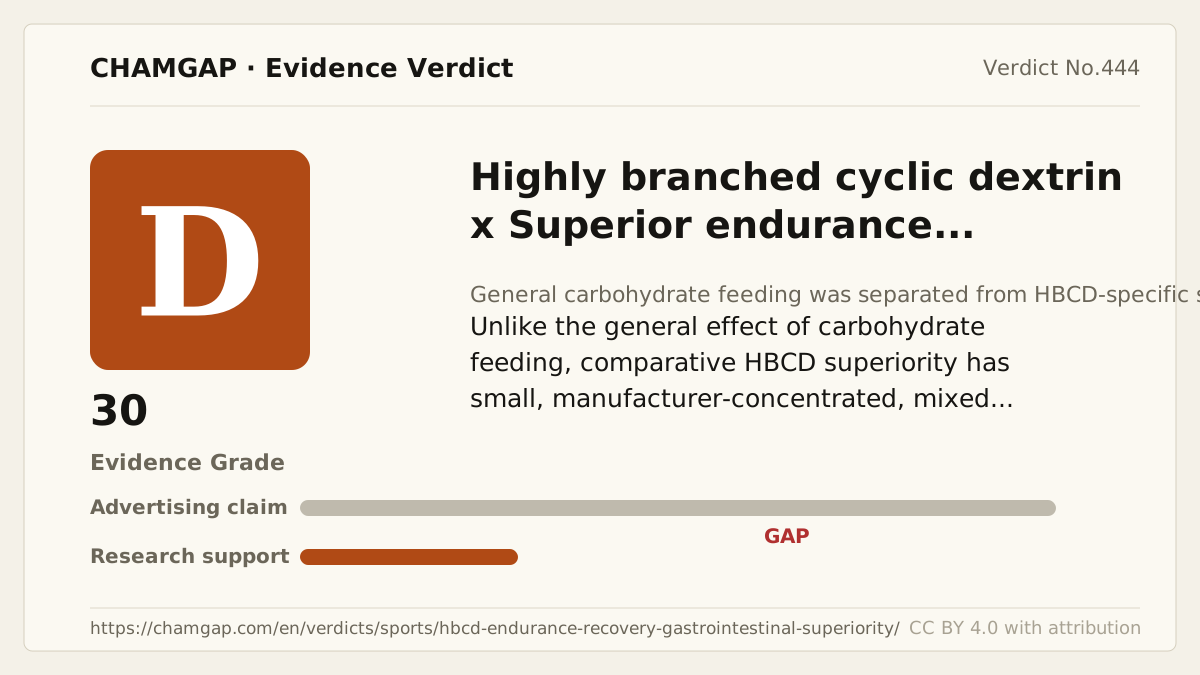
research showsCarbohydrate delivery during exercise can be useful, but HBCD has not shown consistent superiority over maltodextrin or glucose. A seven-swimmer trial and small manufacturer-linked studies reported endurance, exertion, or gastrointestinal signals, while a 30 g CrossFit trial was null for performance and fatigue. In a recent 45 g resistance trial, repetition velocity improved only in men, with no change in fatigue or gastrointestinal discomfort. Direct recovery-superiority evidence was not identified, so the grade is D.
ads claimClaims of the fastest carbohydrate, complete superiority over maltodextrin for absorption, endurance, and recovery, or no gastrointestinal discomfort overstate the evidence. Gastric emptying and osmolality, carbohydrate delivery, actual performance, and next-day recovery are different outcomes.
Useful facts when choosing a product
- Sports powders sold in Korea and abroad use HBCD or Cluster Dextrin as a standalone carbohydrate or in combinations with electrolytes and amino acids.
- Human trials used very different acute doses, including 15 g, 30 g, 45 g, or 1.5 g/kg.
- Comparisons that do not match carbohydrate grams, calories, concentration, and pre-exercise glycogen cannot establish ingredient superiority.
- It is a carbohydrate; people managing diabetes or glucose should count total carbohydrate, and high doses may cause individual gastrointestinal symptoms.
Chamgap Semantic Classification Code
Candidate index · review held
UNK.highly-branched-cyclic-dextrin.UNK.superior-endurance-recovery-and-gastrointestinal-comfort.superiority.placeboUnknown > Highly branched cyclic dextrin > Unknown > Superior endurance, recovery, and gastrointestinal comfort > Superiority claim > Placebo
An automated migration candidate, not an issued permanent code; exact claim scope remains under review. This machine-generated migration candidate helps retrieval but is not a permanent assignment. The original verdict ID and URL remain authoritative.
What the research actually shows
Takii 2004 used a crossover design in seven untrained men to compare drinks containing HBCD, DE16 dextrin, glucose, or water and reported gastric-emptying and selected subjective gastrointestinal signals. Furuyashiki 2014 compared 15 g HBCD with maltodextrin and found lower exertion at 30 and 60 minutes, but Ezaki Glico researchers participated. Shiraki 2015 randomized the order of 1.5 g/kg HBCD, glucose, and water in seven elite swimmers and reported 70% longer time to fatigue; the sample was extremely small and Glico researchers participated. The Grijota 2024 CrossFit trial found no difference in repetitions, heart rate, or exertion between 30 g HBCD and placebo. A 2025 resistance crossover trial in 30 participants found faster repetitions only in men after 45 g HBCD, with null findings in women, perceived fatigue, and gastrointestinal discomfort. These studies do not establish superior recovery.
Why this is classified as D (30)
General carbohydrate feeding is B, but the target claim is superiority over other carbohydrates. Superiority is D because small positive and null findings are mixed; recovery superiority is unknown. The overall verdict is D with 30 points.
Counterpoint. Adequately powered, isocaloric and carbohydrate-matched comparisons with maltodextrin or glucose should replicate actual race performance, gastrointestinal symptoms, and 24-48-hour glycogen and performance recovery as prespecified primary outcomes.
Rejudgment record. New verdict — Separated general carbohydrate-feeding effects from HBCD superiority over maltodextrin or glucose and incorporated small positive, null, sex-inconsistent, and absent direct recovery evidence
Sub-claim grades by effect
This ingredient is marketed for several effects. A single overall grade blends strong and weak claims together, so each effect is graded separately here. The overall grade reflects the strongest disconfirming or core claim.
| Effect (sub-claim) | Grade | Basis |
|---|---|---|
| General effect of carbohydrate feeding during exercise | B | Carbohydrate delivery itself has a separate evidence base in appropriate prolonged-exercise settings |
| Endurance and gastrointestinal superiority over maltodextrin or glucose | D | Tiny positive studies are mixed with null performance and sex-inconsistent findings, so repeated superiority is unestablished |
| Superior recovery | ? | No adequate human efficacy literature directly comparing 24-48-hour recovery with another carbohydrate was identified |
Cross-check — AI research and Codex final gate
Evidence Table
| Study | Design | Sample | Funding | Endpoint | Result | Weight |
|---|---|---|---|---|---|---|
| Takii et al. (2004) | Acute crossover trial | 7 | Ezaki Glico researchers | Gastric emptying, subjective gastrointestinal symptoms, and fatigue | Positive gastric-emptying and selected gastrointestinal signals versus glucose | Limited |
| Furuyashiki et al. (2014) | Double-blind crossover trial | 24 | Ezaki Glico and Glico Nutrition researchers | Perceived exertion, glucose, and energy metabolism | Fifteen grams of HBCD lowered exertion at 30 and 60 minutes versus maltodextrin | Limited |
| Shiraki et al. (2015) | Random-order three-condition crossover trial | 7 | Ezaki Glico researchers | Swimming time to fatigue and glucose | Time to fatigue was about 70% longer with HBCD | Limited |
| Grijota et al. (2024) | Randomized placebo-controlled crossover trial | Reported no external funding | Workout repetitions, heart rate, exertion, and glucose | No performance or fatigue difference between 30 g HBCD and placebo | Key | |
| Morenas-Aguilar et al. (2025) | Randomized double-blind placebo-controlled crossover trial | 30 | Several authors advised a sports-supplement brand | Repetition velocity, lactate, fatigue, and gastrointestinal discomfort | Positive velocity only in men; null in women, fatigue, and gastrointestinal discomfort | Key |
Receipt — 5 References
All 5 cited sources were verified for existence at the original page (as of 2026-07-17).
Final verification and publication gate: Codex · Evidence date: 2026-07-17 · Corrections: none
Cite this verdict
[Chamgap] Highly branched cyclic dextrin x superiority for endurance, recovery, and gastrointestinal comfort — Evidence Grade D·30. 5 cited sources checked. Source: https://chamgap.com/en/verdicts/sports/hbcd-endurance-recovery-gastrointestinal-superiority/ · CC BY 4.0CC BY 4.0 — free to use with attribution; do not distort grades, numbers, or verdict meaning.
What this document does and does not do
Chamgap is an information source. It reports what research has and has not confirmed; it does not tell readers what to take or buy. That decision belongs to readers and, when needed, medical or legal professionals. This verdict reflects literature available up to the search date and may change as new research appears. Nothing here is medical advice.