
Habitual exercise in polluted areas,
does it really help with Preserved association with lower natural-cause mortality in high-pollution areas?
research showsThe grade is C with 56 points. In a Taiwanese cohort of 384,130 adults followed for a median 13.4 years, within PM2.5 of at least 26.0 micrograms/m3, HRs versus inactivity were 0.84 (95% CI 0.78 to 0.90) for moderate and 0.67 (0.62 to 0.72) for high exercise. Exercise was a self-reported prior-month questionnaire, while pollution was a modeled value assigned to an address or examination location rather than personal exposure.
ads claimPersistence of benefit under a long-term residential average is not a guarantee that vigorous outdoor exercise is safe during today's acute pollution peak. Personal concentration, indoor versus outdoor location, and exercise ventilation were not measured.
Useful facts when choosing a product
- The overall PM2.5 IQR was 21.6 to 27.8 micrograms per cubic meter, and the high category began at 26.0.
- Exercise was questionnaire-based for the prior month rather than device-measured.
- Pollution was a two-year satellite-spatiotemporal estimate assigned to an address or examination location, not a personal monitor.
- Verdict 2181 is B with 72 points for 10,000 steps and mortality, while verdict 2185 is C with 56 points for strength exercise and mortality; this verdict concerns the joint relation of long-term pollution, habitual exercise, and natural-cause death.
Chamgap Semantic Classification Code
Candidate index · review held
X.habitual-exercise-while-living-under-long-term-fine-particle-pollution.environmental.preserved-association-with-lower-natural-cause-mortality-in-high-pollution-areas.reduce.UNKBehaviors, exposures and policies > Habitual exercise while living under long-term fine-particle pollution > Environmental exposure > Preserved association with lower natural-cause mortality in high-pollution areas > Reduction claim > Unknown
An automated migration candidate, not an issued permanent code; exact claim scope remains under review. This machine-generated migration candidate helps retrieval but is not a permanent assignment. The original verdict ID and URL remain authoritative.
What the research actually shows
The Taiwan MJ Health cohort followed 384,130 people for a median 13.4 years and recorded 12,375 natural-cause deaths. A self-administered questionnaire captured prior-month exercise. A satellite spatiotemporal model assigned a two-year PM2.5 average to examination or home locations; personal and indoor concentrations were not measured, and updating for address changes was not verified. Within high pollution, HRs were 0.84 (0.78 to 0.90) for moderate and 0.67 (0.62 to 0.72) for high exercise. Among high exercisers, HR 1.34 (1.22 to 1.47) was the category comparison of at least 26.0 versus below 22.4 micrograms/m3. Models adjusted for many factors, but several were self-reported and residual income, occupation-type, population-density, and healthy-exerciser confounding remained. Funding came from the Hong Kong Research Grants Council General Research Fund and the Chinese University of Hong Kong Environmental Health Research Fund. The authors declared no conflicts of interest.
Why this is classified as C (56)
A very large cohort and objective deaths are strengths, but absent personal and indoor exposure, unverified moves, self-reported exercise and covariates, and residual confounding give C with 56 points.
Counterpoint. C is not an instruction to exercise outdoors at any pollution level. It grades habitual exercise under long-term area-average exposure.
Rejudgment record. Cross-check applied — Accepted high-pollution-stratum mortality associations while accounting for absent personal and indoor exposure, unverified moves, self-reported exercise and covariates, and residual income, occupation, and density confounding
| Endpoint | H | Hard endpoint - actual events such as death |
| Replication | R1 | Single confirmatory trial |
| Independence | I2 | Decisive evidence is publicly or non-profit funded |
| Effect size | E+ | Meets the clinically important threshold |
Stored derived and displayed grades match; this is not a current recalculation or validity check (C).
Sub-claim grades by effect
This ingredient is marketed for several effects. A single overall grade blends strong and weak claims together, so each effect is graded separately here. The overall grade reflects the strongest disconfirming or core claim.
| Effect (sub-claim) | Grade | Basis |
|---|---|---|
| Preserved mortality association of habitual exercise in high-pollution areas | B | Both moderate- and high-exercise HRs excluded 1 within high pollution. |
| Guaranteed safety of outdoor exercise during acute pollution peaks | ? | Exercise location and personal concentration during activity were not measured. |
Cross-check — AI research and Codex final gate
Evidence Table
| Study | Design | Sample | Funding | Endpoint | Result | Weight |
|---|---|---|---|---|---|---|
| Guo C et al. 2021 Taiwan MJ cohort | Longitudinal cohort with repeated questionnaires and address-modeled exposure | 384,130 participants, 842,394 examinations, median 13.4 years, and 12,375 natural deaths | Hong Kong Research Grants Council General Research Fund and Chinese University of Hong Kong Environmental Health Research Fund; no conflicts declared | Death from natural causes | Within high pollution, HR versus inactivity was 0.84 (0.78 to 0.90) for moderate and 0.67 (0.62 to 0.72) for high exercise. | Principal large hard-outcome cohort |
Receipt — 2 References
All 2 cited sources were verified for existence at the original page (as of 2026-08-04).
Final verification and publication gate: Codex · Evidence date: 2026-08-04 · Corrections: none
Cite this verdict
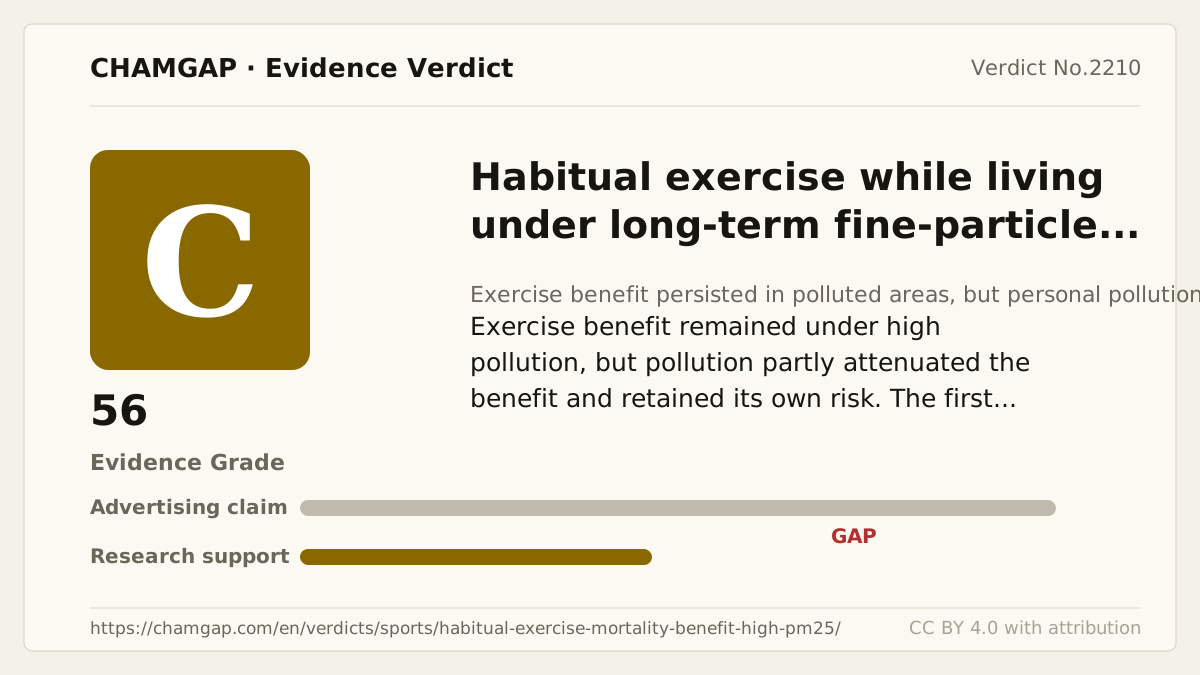
[Chamgap] Habitual exercise in polluted areas x lower natural-cause mortality — Evidence Grade C·56. 2 cited sources checked. Source: https://chamgap.com/en/verdicts/sports/habitual-exercise-mortality-benefit-high-pm25/ · CC BY 4.0CC BY 4.0 — free to use with attribution; do not distort grades, numbers, or verdict meaning.
What this document does and does not do
Chamgap is an information source. It reports what research has and has not confirmed; it does not tell readers what to take or buy. That decision belongs to readers and, when needed, medical or legal professionals. This verdict reflects literature available up to the search date and may change as new research appears. Nothing here is medical advice.