
Graduated compression garments,
does it really help with Faster recovery of strength and power and less delayed-onset muscle soreness when worn during or after exercise?
research showsThe exercise-recovery claim for graduated compression garments is rated C. A 2022 meta-analysis of 19 randomized trials and 350 participants found no strength-recovery benefit at any interval from immediately after exercise through 96 hours or later. A larger 2025 synthesis of 27 studies, however, reported small but statistically significant attenuation of strength and power loss, with Hedges g values of -0.21 and -0.23, and earlier syntheses found small signals for perceptual outcomes such as muscle soreness. Because the latest positive human synthesis cannot be ignored, the grade is raised from D to a low C. Results point in opposite directions across meta-analyses, effect sizes are small, participants, exercises, wear timing, pressure, and products are heterogeneous, and blinding is difficult. Product-specific pressure and discomfort or circulatory risk remain separate from efficacy.
ads claimMarketing turns claims of clearing lactate, fully restoring next-day strength, or preventing soreness from small average effects and a feeling of support. Evidence varies substantially by garment pressure, body area, exercise type, and recovery interval, and compression sensation does not guarantee restored performance.
Useful facts when choosing a product
- Sports compression garments differ from medical compression stockings in purpose, pressure specification, and quality control, and products with the same labeled size can deliver different skin pressure and gradients.
- Trials used garments during exercise, for several hours after exercise, or for 24 hours or longer, so no product-independent optimal pressure and wear duration has been established.
- They are generally safe for healthy adults, but tightness, heat, skin irritation, numbness, or pain means the garment should be removed.
- People with peripheral arterial disease, impaired sensation, skin injury, severe swelling, or possible thrombosis should not self-apply strong compression and should seek clinical advice.
Chamgap Semantic Classification Code
Candidate index · review held
M.graduated-compression-garments.UNK.faster-recovery-of-strength-and-power-and-less-delayed-onset-muscle-soreness-when-worn-during-or-after-exercise.reduce.UNKMedicinal interventions > Graduated compression garments > Unknown > Faster recovery of strength and power and less delayed-onset muscle soreness when worn during or after exercise > Reduction claim > Unknown
An automated migration candidate, not an issued permanent code; exact claim scope remains under review. This machine-generated migration candidate helps retrieval but is not a permanent assignment. The original verdict ID and URL remain authoritative.
What the research actually shows
Négyesi and colleagues pooled 19 randomized crossover or parallel trials involving 350 healthy participants to test whether garments worn during or after exercise reduced subsequent strength loss. Overall effects were nonsignificant from immediately after exercise through 96 hours and beyond, with only a weak signal after plyometric exercise. Li and colleagues used a three-level model across 27 studies in 2025 and reported small positive strength and power effects, g -0.21 and -0.23. Many trials did not report actual pressure, participants were predominantly male, and interventions were unblinded. The 2016 Marqués-Jiménez synthesis found SMD -0.43 across 15 studies for perceptual measures but warned of high heterogeneity and discordant blood and functional outcomes. Overall, a small recovery signal exists but its magnitude and conditions are not stable.
Why this is classified as C (43)
The rigorous 2022 synthesis of 19 randomized trials found no strength-recovery benefit at any interval, but a 2025 meta-analysis of 27 studies reported small significant strength and power benefits, and earlier syntheses reported positive DOMS and perceptual signals. Positive current human evidence gives C rather than D, while direct conflict between meta-analyses, small effects, lack of blinding, and pressure, product, and exercise heterogeneity limit the grade to C with 43 points. Discomfort and circulatory precautions remain separate safety issues.
Counterpoint. Sleep, adequate energy, protein and fluids, appropriate training load, and time are the foundation of recovery. Anyone trying a garment can record next-day performance and soreness after comparable sessions and stop paying for it if it causes discomfort or no reproducible difference.
Rejudgment record. New verdict — Retained the null strength-recovery result at every interval in the 2022 synthesis of 19 randomized trials and 350 participants as a major limitation, but applied the C boundary for trustworthy positive human evidence because the 2025 synthesis of 27 studies found small significant strength and power effects and earlier syntheses found positive DOMS or perceptual signals; capped this at a low C for meta-analytic conflict, lack of blinding, and pressure and product heterogeneity
Sub-claim grades by effect
This ingredient is marketed for several effects. A single overall grade blends strong and weak claims together, so each effect is graded separately here. The overall grade reflects the strongest disconfirming or core claim.
| Effect (sub-claim) | Grade | Basis |
|---|---|---|
| Faster recovery of strength after exercise | C | The 2022 synthesis of 19 randomized trials was null at every interval, while the 2025 synthesis of 27 studies found a small positive effect of g -0.21. |
| Faster recovery of power after exercise | C | The latest meta-analysis found a positive g -0.23 signal, but the effect was small and data were uneven across conditions. |
| Reduction of delayed-onset muscle soreness | C | Meta-analysis of perceptual outcomes found a small improvement, but blinding is difficult and heterogeneity is high, limiting confidence beyond a subjective signal. |
Cross-check — AI research and Codex final gate
Evidence Table
| Study | Design | Sample | Funding | Endpoint | Result | Weight |
|---|---|---|---|---|---|---|
| Négyesi J et al. 2022 | Systematic review and meta-analysis of randomized trials | Nineteen randomized trials and 350 healthy participants | The first author was supported by JSPS KAKENHI 21K17600; authors declared no conflicts of interest | Strength-related recovery across postexercise time intervals | SMD was -0.02 from immediately to 24 hours, 0.00 from 24 to 48 hours, and -0.03 from 48 to 72 hours, with later intervals also nonsignificant. | Rigorous pivotal null synthesis |
| Li X et al. 2025 | Systematic review and three-level random-effects meta-analysis | Twenty-seven studies; participants were predominantly male and individual studies were small | China National Key R&D Program and Ministry of Education Humanities and Social Science Fund | Decline in strength and power after exercise-induced fatigue | Compression garments produced small but significant recovery effects for strength, Hedges g -0.21, and power, -0.23. | Latest positive contrary evidence with small effects, lack of blinding, and pressure heterogeneity |
| Marqués-Jiménez D et al. 2016 | Systematic review and meta-analysis of recovery from exercise-induced muscle damage | Fifteen studies for perceptual measures, eight for strength, and five for power | Academic meta-analysis with heterogeneous funding and products across included studies | Perceptual measures including DOMS, strength, power, and muscle-damage biomarkers | Perceptual measures improved with SMD -0.43 and functional signals were positive, but heterogeneity was high and creatine kinase was unchanged. | Supportive positive DOMS signal with high heterogeneity |
Receipt — 3 References
All 3 cited sources were verified for existence at the original page (as of 2026-07-22).
Final verification and publication gate: Codex · Evidence date: 2026-07-22 · Corrections: none
Cite this verdict
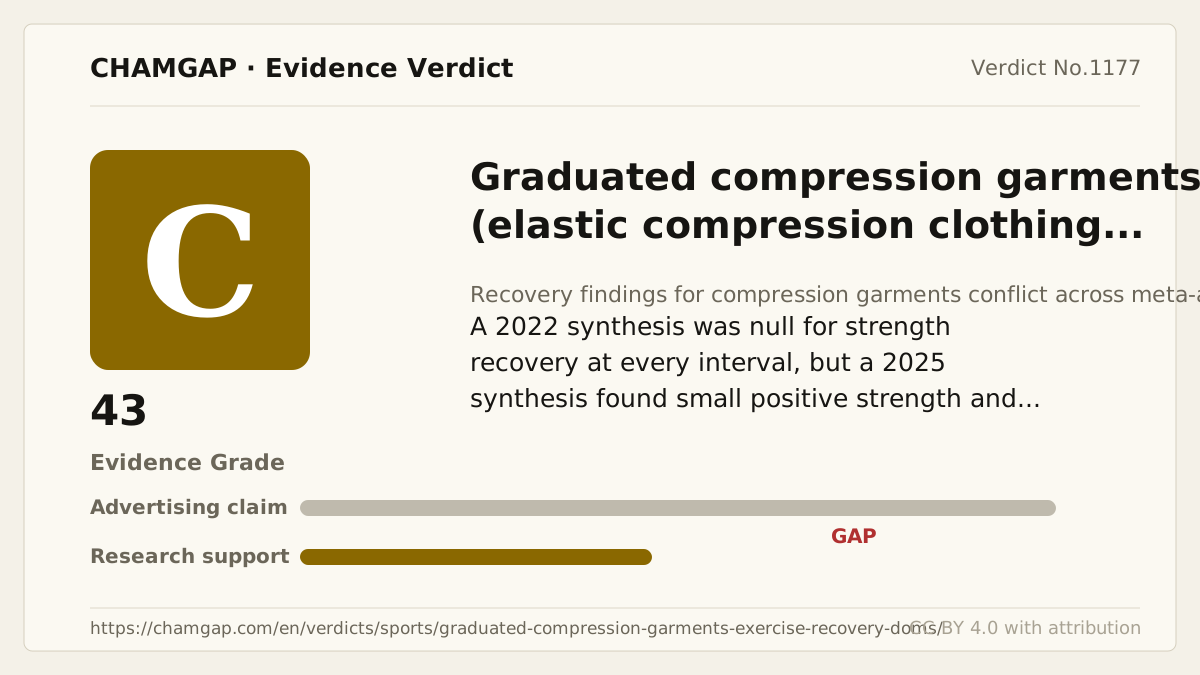
[Chamgap] Graduated compression garments x faster recovery of strength and power and less delayed-onset muscle soreness — Evidence Grade C·43. 3 cited sources checked. Source: https://chamgap.com/en/verdicts/sports/graduated-compression-garments-exercise-recovery-doms/ · CC BY 4.0CC BY 4.0 — free to use with attribution; do not distort grades, numbers, or verdict meaning.
What this document does and does not do
Chamgap is an information source. It reports what research has and has not confirmed; it does not tell readers what to take or buy. That decision belongs to readers and, when needed, medical or legal professionals. This verdict reflects literature available up to the search date and may change as new research appears. Nothing here is medical advice.