
Foam rolling,
does it really help with Reduction of delayed-onset muscle soreness and short-term functional recovery after exercise?
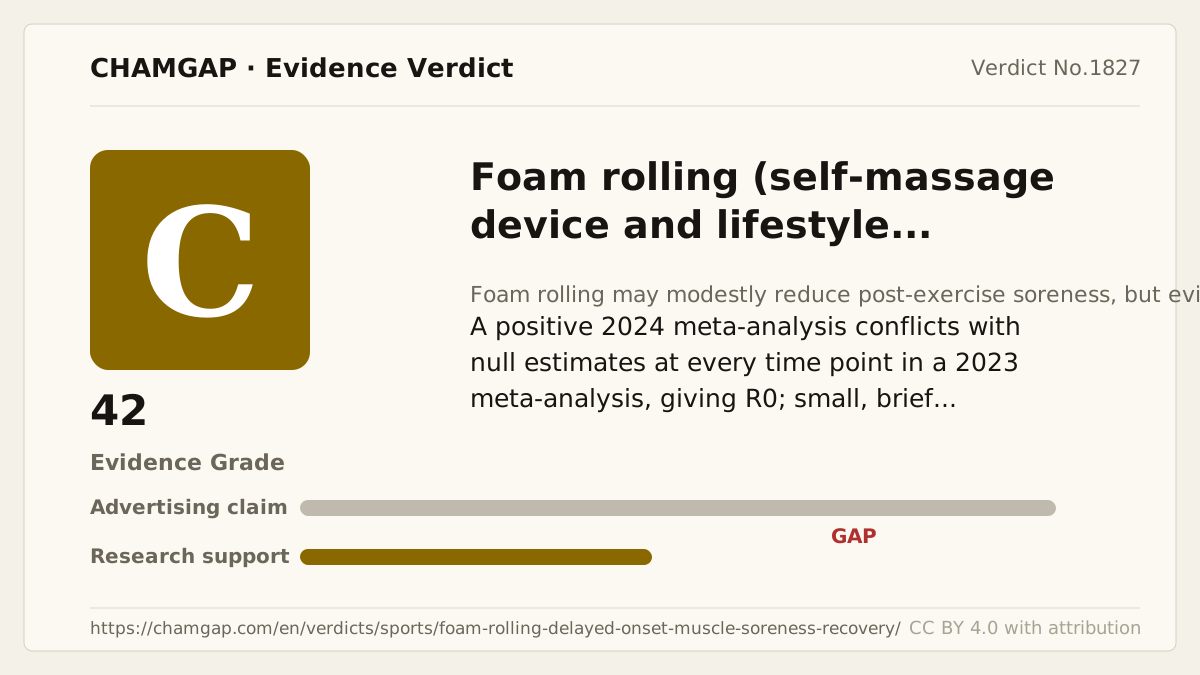
research showsFoam rolling may reduce subjective soreness 24 to 72 hours after exercise, but pooled results conflict, yielding C. The 37-person Arbiza 2024 randomized crossover trial used passive recovery rather than sham rolling and favored rolling at 24, 48, and 72 hours. Zhou 2024 pooled 16 trials and 515 participants and found positive VAS estimates from immediately after treatment through 72 hours. Medeiros 2023, however, pooled five trials and 151 participants and found confidence intervals crossing zero immediately and at 24, 48, 72, and 96 hours. Replication is therefore R0 rather than R2.
ads claimTransient reduction in pain perception is expanded into faster repair of muscle damage and full restoration of performance.
Useful facts when choosing a product
- A foam roller uses body weight to apply pressure and shear to soft tissue; roller firmness, pressure, duration, and muscle groups varied across trials.
- The key DOMS controls were passive recovery or no treatment, not sham rolling, so participants were not blinded.
- For comparison, verdict 1186, which is C with 49 points, concerns percussion massage guns; verdict 1306, which is C with 48 points, concerns curcumin; verdict 1407, which is D with 28 points, concerns ibuprofen. Evidence from these different DOMS interventions was not transferred to foam rolling.
Chamgap Semantic Classification Code
Candidate index · review held
P.foam-rolling.device.delayed-onset-muscle-soreness-and-short-term-functional-recovery-after-exercise.reduce.shamProcedures, devices and tests > Foam rolling > Device delivered > delayed-onset muscle soreness and short-term functional recovery after exercise > Reduction claim > Sham procedure or device
An automated migration candidate, not an issued permanent code; exact claim scope remains under review. This machine-generated migration candidate helps retrieval but is not a permanent assignment. The original verdict ID and URL remain authoritative.
What the research actually shows
Arbiza and colleagues randomized 37 participants to foam rolling and passive recovery in a crossover trial and assessed 24, 48, and 72 hours. Against passive recovery rather than sham rolling, soreness was 22.8%, 39.2%, and 59.7% lower. Zhou 2024 pooled 16 studies and 515 participants: VAS SMD was minus 0.38 (minus 0.61 to minus 0.15) immediately, minus 0.53 (minus 0.82 to minus 0.25) at 24 hours, minus 0.77 (minus 1.12 to minus 0.42) at 48 hours, and minus 0.67 (minus 1.09 to minus 0.24) at 72 hours. Medeiros 2023 pooled five trials and 151 participants; estimates were null immediately and at 24, 48, 72, and 96 hours because every confidence interval crossed zero.
Why this is classified as C (54)
The profile is P, R0, I2, E+, and B2. The positive 2024 synthesis conflicts with the null 2023 time-point synthesis, and multiple design flaws remain, yielding C with 54 points.
Counterpoint. Because cost and risk are low, people who feel soreness relief may use it as an adjunct, but it should not replace sleep, nutrition, or progressive training.
Rejudgment record. Cross-check applied — Applied R0 for conflict between the positive 2024 synthesis and null 2023 time-point synthesis, plus B2 for small, brief, unblinded controls
| Endpoint | P | Symptom or function itself is the target - including patient reports and performance tests |
| Replication | R0 | Trials conflict in direction |
| Independence | I2 | Decisive evidence is publicly or non-profit funded |
| Effect size | E+ | Meets the clinically important threshold |
Stored derived and displayed grades match; this is not a current recalculation or validity check (C).
Sub-claim grades by effect
This ingredient is marketed for several effects. A single overall grade blends strong and weak claims together, so each effect is graded separately here. The overall grade reflects the strongest disconfirming or core claim.
| Effect (sub-claim) | Grade | Basis |
|---|---|---|
| Reduction of delayed-onset muscle soreness at 24 to 72 hours | C | Pooled results are positive, but studies are small, brief, and lack sham controls. |
| Faster post-exercise strength recovery | C | Results are less consistent than for soreness. |
| Faster recovery of jump and explosive performance | C | Direct functional outcomes come from small trials and are heterogeneous. |
Cross-check — AI research and Codex final gate
Evidence Table
| Study | Design | Sample | Funding | Endpoint | Result | Weight |
|---|---|---|---|---|---|---|
| Arbiza BCC et al. 2024 | Randomized crossover trial of foam rolling versus passive recovery | 37 randomized and 37 analyzed | No external study funding reported in the article | Pain, strength, and jump outcomes at 24, 48, and 72 hours; no clear single prespecified primary endpoint | Pain was 22.8%, 39.2%, and 59.7% lower than passive recovery, P<0.001; success of a single primary endpoint cannot be assigned. | Recent direct trial |
| Zhou J et al. 2024 | Systematic review and meta-analysis of randomized trials | 16 studies and 515 participants | Funding source not reported in the abstract or indexing record | Post-exercise VAS and pressure-pain threshold | VAS SMDs were minus 0.38 (minus 0.61 to minus 0.15) immediately, minus 0.53 (minus 0.82 to minus 0.25) at 24 hours, minus 0.77 (minus 1.12 to minus 0.42) at 48 hours, and minus 0.67 (minus 1.09 to minus 0.24) at 72 hours. | Positive synthesis |
| Medeiros F et al. 2023 | Systematic review and meta-analysis of randomized trials | Five trials and 151 participants | Funding source not confirmed in the public abstract or indexing record | Soreness immediately through 96 hours after exercise-induced muscle damage | Immediately 0.26 (minus 0.14 to 0.65), 24 hours minus 0.64 (minus 1.34 to 0.07), 48 hours minus 0.35 (minus 0.85 to 0.15), 72 hours minus 0.40 (minus 0.92 to 0.12), and 96 hours 0.05 (minus 0.40 to 0.50); every interval crossed zero. | Null synthesis |
Receipt — 3 References
All 3 cited sources were verified for existence at the original page (as of 2026-07-24).
Final verification and publication gate: Codex · Evidence date: 2026-07-24 · Corrections: none
Cite this verdict
[Chamgap] Foam rolling x post-exercise muscle soreness and recovery — Evidence Grade C·54. 3 cited sources checked. Source: https://chamgap.com/en/verdicts/sports/foam-rolling-delayed-onset-muscle-soreness-recovery/ · CC BY 4.0CC BY 4.0 — free to use with attribution; do not distort grades, numbers, or verdict meaning.
What this document does and does not do
Chamgap is an information source. It reports what research has and has not confirmed; it does not tell readers what to take or buy. That decision belongs to readers and, when needed, medical or legal professionals. This verdict reflects literature available up to the search date and may change as new research appears. Nothing here is medical advice.