
FIFA 11+,
does it really help with Prevention of lower-extremity and severe sports injuries in youth and amateur football players?
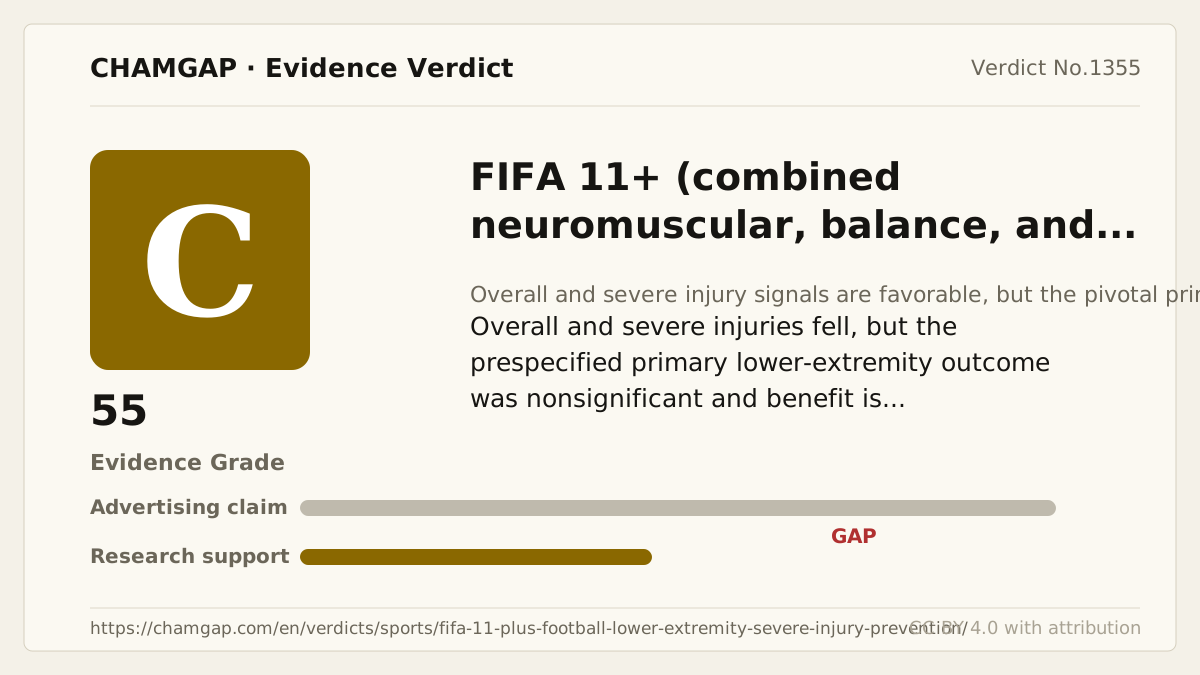
research showsFIFA 11+ is rated C because it may reduce overall and severe injuries in youth and amateur football, but the adjusted primary lower-extremity injury outcome in the pivotal cluster-randomized trial was not statistically significant. Among 1,892 players in the Soligard trial, the lower-extremity injury rate ratio was 0.71 (95% CI 0.49 to 1.03), while overall injury RR 0.68 and severe injury RR 0.55 were significant. Later literature generally supports prevention, but adherence and variation across teams, sexes, and playing levels matter.
ads claimThe FIFA name and convenient warm-up format do not guarantee prevention of every lower-extremity injury. Coach education, regular performance, correct technique, load management, surface, equipment, and rehabilitation still matter.
Useful facts when choosing a product
- FIFA 11+ is an approximately 20-minute nonpharmacologic warm-up combining running, core and lower-limb strength, balance, jumping and landing, and agility exercises in progressive levels.
- Regular performance close to at least twice weekly and coaching of knee and hip alignment and landing technique are important for expected benefit.
- Serious harm from the exercise itself is uncommon, but existing acute injury or pain calls for modification or stopping and sports-medicine assessment.
- This verdict concerns injury prevention through a structured pre-training or pre-match warm-up, not post-exercise compression or recovery.
Chamgap Semantic Classification Code
Candidate index · review held
X.fifa-11-plus.behavioral.lower-extremity-and-severe-sports-injuries-in-youth-and-amateur-football-players.prevent.UNKBehaviors, exposures and policies > FIFA 11+ > Behavioral delivery > lower-extremity and severe sports injuries in youth and amateur football players > Occurrence-prevention claim > Unknown
An automated migration candidate, not an issued permanent code; exact claim scope remains under review. This machine-generated migration candidate helps retrieval but is not a permanent assignment. The original verdict ID and URL remain authoritative.
What the research actually shows
Soligard and colleagues randomized 125 Norwegian football clubs containing 1,892 girls aged 13–17 by team to FIFA 11+ or usual warm-up for one season. The primary lower-extremity outcome involved 121 versus 143 injured players, RR 0.71 (0.49 to 1.03), and was nonsignificant, while overall, overuse, and severe injuries fell significantly. An adherence analysis of the same trial found 35% lower overall injury risk with high versus intermediate adherence, showing that execution frequency matters. Systematic reviews report benefit across several populations, but program fidelity and study design vary.
Why this is classified as C (55)
The cluster trial's adjusted primary lower-extremity injury RR of 0.71 was nonsignificant because its confidence interval included one. Positive overall and severe secondary outcomes and later synthesis support a signal, but adherence dependence and population heterogeneity support C with 55 points. Exercise safety is a separate consideration.
Counterpoint. Low cost and low risk can still justify team implementation; grade C means certainty for the claimed primary lower-extremity outcome is limited, not that the program has no effect.
Rejudgment record. Cross-check applied — The Soligard cluster trial found significant overall and severe secondary injury reductions, but the prespecified adjusted primary lower-extremity injury RR of 0.71 had a 95% CI of 0.49 to 1.03, and effects depend on adherence and population. At cross-check the score was lowered to 55 (grade C retained) to weight the nonsignificant prespecified primary lower-extremity endpoint more heavily.
Sub-claim grades by effect
This ingredient is marketed for several effects. A single overall grade blends strong and weak claims together, so each effect is graded separately here. The overall grade reflects the strongest disconfirming or core claim.
| Effect (sub-claim) | Grade | Basis |
|---|---|---|
| Reduced overall sports injuries in youth and amateur football players | C | The pivotal trial's secondary result was significant at RR 0.68, but it was not the primary endpoint and depended on adherence. |
| Reduced severe sports injuries in youth and amateur football players | C | The pivotal trial's secondary RR of 0.55 was positive, but event count and generalizability are limited. |
| Reduced lower-extremity injuries in youth and amateur football players | C | The adjusted primary result was RR 0.71 (95% CI 0.49 to 1.03), p=0.072, and was not statistically significant. |
Cross-check — AI research and Codex final gate
Evidence Table
| Study | Design | Sample | Funding | Endpoint | Result | Weight |
|---|---|---|---|---|---|---|
| Soligard T et al. 2008 | Club-level cluster-randomized controlled trial | 1,892 female players aged 13–17 in 125 Norwegian clubs | Supported by FIFA and Norwegian sports organizations; no competing interests declared | Primary lower-extremity injury; overall, overuse, and severe injuries | Lower-extremity injury RR 0.71 (95% CI 0.49 to 1.03) was nonsignificant; overall RR 0.68, overuse RR 0.47, and severe RR 0.55 were significant. | Key direct cluster randomized trial |
| Soligard T et al. 2010 adherence analysis | Prospective adherence cohort analysis nested in the cluster trial | 1,055 players from 65 teams in the original trial | Supported by FIFA and Norwegian sports organizations | Program adherence and overall injury risk | Players with high adherence had 35% lower overall injury risk than those with intermediate adherence, RR 0.65 (95% CI 0.46 to 0.91). | Adherence-dependence evidence |
| Barengo NC et al. 2014 | Systematic review of FIFA 11+ | Synthesis of studies across football players of different ages and sexes | Academic review | Overall and lower-extremity injury and program implementation | Evidence generally supported injury reduction, but studies, populations, and adherence varied substantially. | Supporting synthesis |
Receipt — 3 References
All 3 cited sources were verified for existence at the original page (as of 2026-07-23).
Final verification and publication gate: Codex · Evidence date: 2026-07-23 · Corrections: none
Cite this verdict
[Chamgap] FIFA 11+ x prevention of lower-extremity and severe sports injuries in youth and amateur football players — Evidence Grade C·55. 3 cited sources checked. Source: https://chamgap.com/en/verdicts/sports/fifa-11-plus-football-lower-extremity-severe-injury-prevention/ · CC BY 4.0CC BY 4.0 — free to use with attribution; do not distort grades, numbers, or verdict meaning.
What this document does and does not do
Chamgap is an information source. It reports what research has and has not confirmed; it does not tell readers what to take or buy. That decision belongs to readers and, when needed, medical or legal professionals. This verdict reflects literature available up to the search date and may change as new research appears. Nothing here is medical advice.