
Family screen restriction,
does it really help with Increased leisure nonsedentary physical activity in children?
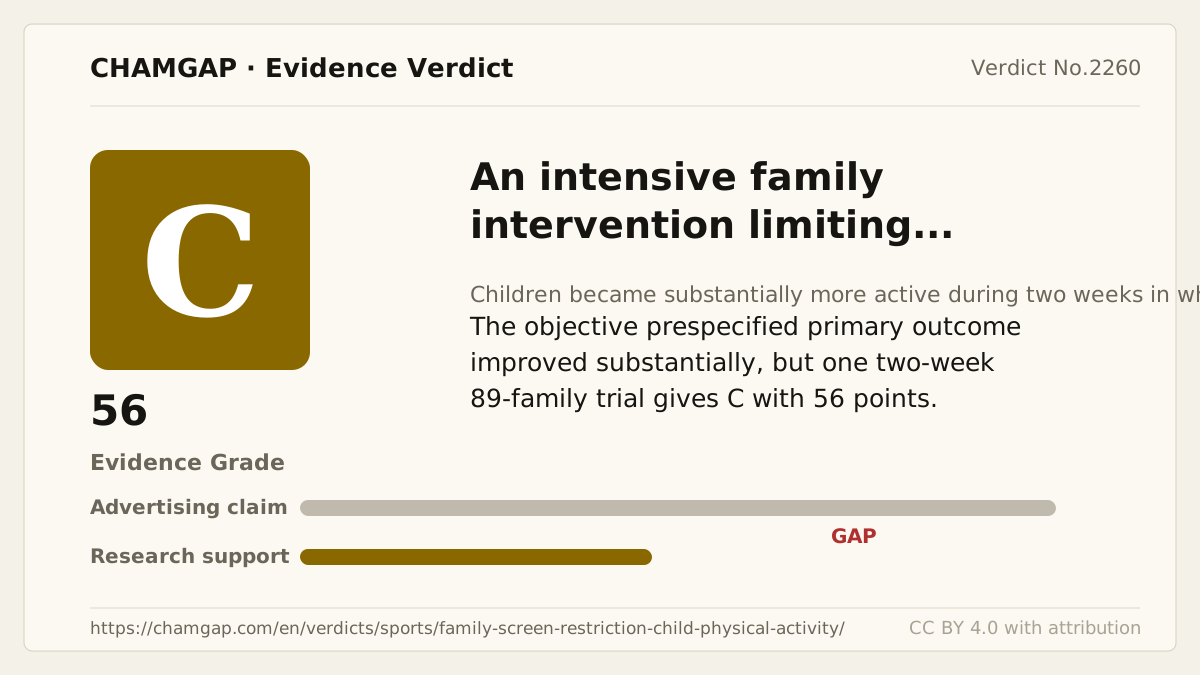
research showsThe grade is C. In a two-week family-cluster trial of 89 families and 181 children, leisure nonsedentary activity increased 45.8 minutes per day more than usual use, 95% CI 27.9-63.6. Activity came from waist and thigh accelerometers, not parent report, and analysis accounted for family clustering. This was still an intensive device-surrender intervention lasting only two weeks in fewer than 200 children.
ads claimChildren averaged 35.9 hours per week of recreational screens at baseline. The exact mean between-group reduction was not reported, but 83 of 86 intervention children stayed at or below seven hours per week, confirmed by tracking apps and TV monitors. This cannot be expanded into proven long-term weight loss or health improvement.
Useful facts when choosing a product
- Intervention families surrendered smartphones and tablets, received basic phones, and targeted no more than three recreational screen hours per person per week.
- Baseline child recreational use averaged 35.9 hours per week; 83/86 intervention children met the seven-hour adherence threshold, but an exact mean between-group reduction was not reported.
- Apps tracked phones, tablets, and computers, a current monitor tracked television, and waist and thigh accelerometers measured activity.
Chamgap Semantic Classification Code
Candidate index · review held
UNK.intensive-family-intervention-limiting-recreational-screen-use-to-per-person.UNK.leisure-nonsedentary-physical-activity.increase.UNKUnknown > intensive family intervention limiting recreational screen use to per person > Unknown > leisure nonsedentary physical activity > Increase claim > Unknown
An automated migration candidate, not an issued permanent code; exact claim scope remains under review. This machine-generated migration candidate helps retrieval but is not a permanent assignment. The original verdict ID and URL remain authoritative.
What the research actually shows
The intervention included 45 families and 86 children; usual-use control included 44 families and 95 children. The primary endpoint was two-week leisure nonsedentary time from combined waist and thigh accelerometry. Change was +44.8±63.5 versus +1.0±55.1 minutes per day; adjusted intention-to-treat difference was +45.8, 95% CI 27.9-63.6, using family random intercepts plus baseline and age adjustment. Recruitment began June 6, 2019, while NCT04098913 was first submitted September 19, making registration retrospective.
Why this is classified as C (54)
Family-cluster assignment, objective exposure and activity measurement, a prespecified primary endpoint, and public funding are strengths, but 181 participants and two weeks give C with 54 points.
Counterpoint. This efficacy package combined device surrender, basic-phone loans, household signs, and reimbursement. Ordinary parental advice may not reproduce its adherence or effect.
Rejudgment record. Cross-check applied — Verified family-cluster assignment, random-intercept and baseline-age adjustment, accelerometer outcome, objective adherence, and retrospective registration, while incorporating the two-week and 181-participant limitations
| Endpoint | P | Symptom or function itself is the target - including patient reports and performance tests |
| Replication | R1 | Single confirmatory trial |
| Independence | I2 | Decisive evidence is publicly or non-profit funded |
| Effect size | E+ | Meets the clinically important threshold |
Stored derived and displayed grades match; this is not a current recalculation or validity check (C).
Sub-claim grades by effect
This ingredient is marketed for several effects. A single overall grade blends strong and weak claims together, so each effect is graded separately here. The overall grade reflects the strongest disconfirming or core claim.
| Effect (sub-claim) | Grade | Basis |
|---|---|---|
| Increased leisure nonsedentary activity at two weeks | C | The difference was +45.8 minutes/day, 95% CI 27.9-63.6. |
| Increased moderate-to-vigorous activity | C | A post hoc total-MVPA analysis found +8.8 minutes/day. |
| Long-term health or weight improvement | ? | Long-term outcomes beyond two weeks were not measured. |
Cross-check — AI research and Codex final gate
Evidence Table
| Study | Design | Sample | Funding | Endpoint | Result | Weight |
|---|---|---|---|---|---|---|
| Pedersen et al. 2022 SCREENS | Family cluster-randomized clinical trial | 89 families and 181 randomized children; 181 in intention-to-treat analysis | Public funding from the European Research Council, UK MRC, and NIHR | Leisure nonsedentary time at two weeks | Adjusted intention-to-treat +45.8 minutes/day, 95% CI 27.9-63.6 | Objective prespecified primary outcome |
Receipt — 2 References
All 2 cited sources were verified for existence at the original page (as of 2026-08-05).
Final verification and publication gate: Codex · Evidence date: 2026-08-05 · Corrections: none
Cite this verdict
[Chamgap] Family screen restriction x child physical activity — Evidence Grade C·54. 2 cited sources checked. Source: https://chamgap.com/en/verdicts/sports/family-screen-restriction-child-physical-activity/ · CC BY 4.0CC BY 4.0 — free to use with attribution; do not distort grades, numbers, or verdict meaning.
What this document does and does not do
Chamgap is an information source. It reports what research has and has not confirmed; it does not tell readers what to take or buy. That decision belongs to readers and, when needed, medical or legal professionals. This verdict reflects literature available up to the search date and may change as new research appears. Nothing here is medical advice.