
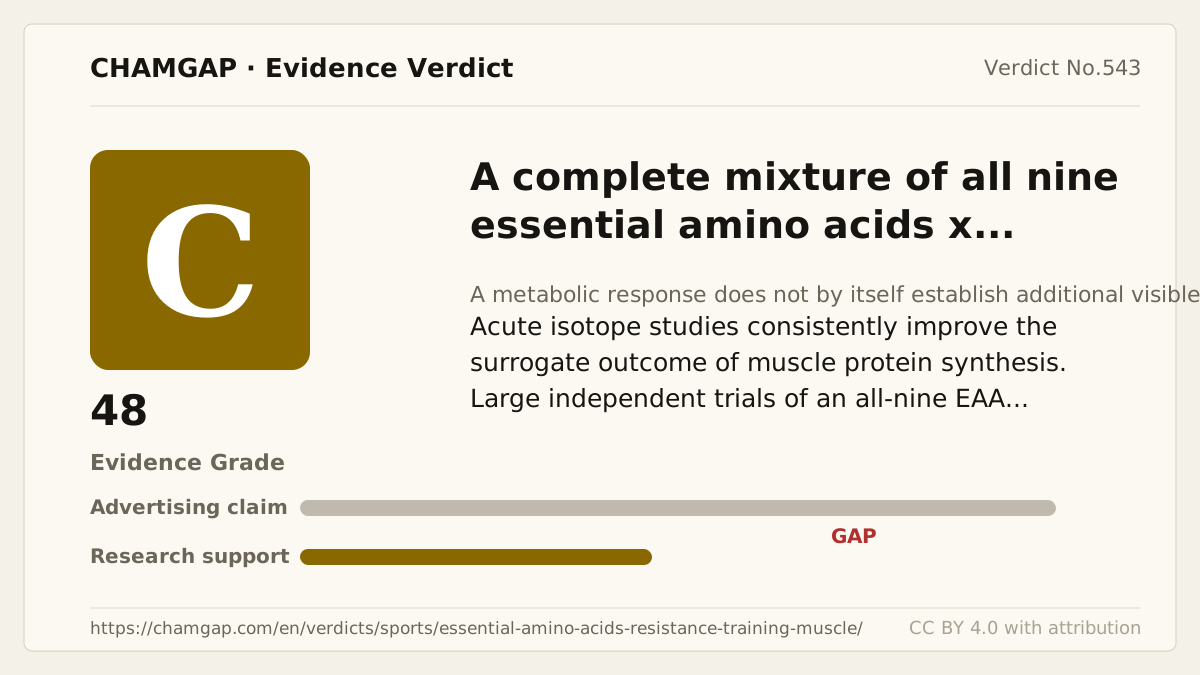
A complete mixture of all nine essential amino acids,
does it really help with Increased muscle mass and strength during resistance training?
research showsEssential amino acids increase muscle protein synthesis for several hours around exercise, but it is uncertain whether long-term supplementation adds muscle mass or strength when total protein intake is already adequate.
ads claimClaims that merely crossing a leucine threshold guarantees muscle gain, or that EAA replaces protein-containing meals, are overstated. Leucine provides a signal, but the remaining essential amino acids, energy intake, training stimulus, and recovery are also required.
Useful facts when choosing a product
- All-nine EAA powders and stick packs are sold in South Korea as sports nutrition foods, commonly providing roughly 6 to 15 g per serving.
- Total EAA, leucine content, sweeteners, and serving sizes vary, so retail formulas are not automatically equivalent to research preparations.
- EAA mixtures are a different ingredient category from whey protein or hydrolyzed whey and should not inherit those product-specific findings.
Chamgap Semantic Classification Code
Candidate index · review held
S.complete-mixture-of-all-nine-essential-amino-acids.UNK.muscle-mass-and-strength-during-resistance-training.increase.factorialSupplements and nutraceuticals > complete mixture of all nine essential amino acids > Unknown > muscle mass and strength during resistance training > Increase claim > Defined factorial contrast
An automated migration candidate, not an issued permanent code; exact claim scope remains under review. This machine-generated migration candidate helps retrieval but is not a permanent assignment. The original verdict ID and URL remain authoritative.
What the research actually shows
Acute studies giving roughly 6 to 15 g of EAA before or after resistance exercise improve muscle net protein balance. Long-term studies are sparse and small, and gains in body composition or strength are less consistent than the synthesis response.
Why this is classified as C (48)
A positive surrogate was not treated as proof of long-term muscle mass or strength. EAA-specific long-duration evidence on direct outcomes is limited, capping the verdict at C.
Counterpoint. Convenient amino acid delivery for someone who cannot meet protein needs is a separate issue from added hypertrophy in someone already consuming enough protein.
Rejudgment record. New verdict — Separate assessment of acute muscle protein synthesis surrogates and long-term mass and strength outcomes
Sub-claim grades by effect
This ingredient is marketed for several effects. A single overall grade blends strong and weak claims together, so each effect is graded separately here. The overall grade reflects the strongest disconfirming or core claim.
| Effect (sub-claim) | Grade | Basis |
|---|---|---|
| Acute increase in muscle protein synthesis around resistance exercise | C | Repeated isotope studies support the effect, but it is a short-term physiological surrogate. |
| Additional long-term gains in muscle mass and strength | C | Long-term EAA-specific trials are scarce, and added benefit is limited when total protein intake is sufficient. |
Cross-check — AI research and Codex final gate
Evidence Table
| Study | Design | Sample | Funding | Endpoint | Result | Weight |
|---|---|---|---|---|---|---|
| Rasmussen et al. 2000 | Acute stable-isotope metabolic study after resistance exercise | 6 | Supported by Shriners Hospitals and the NIH | Muscle protein synthesis, breakdown, and net amino acid balance | EAA plus carbohydrate shifted muscle net protein balance from negative to positive. | Strong for mechanism and the surrogate, but low for long-term efficacy because of sample size and duration |
| Jeong et al. 2024 | Four-week randomized factorial trial of resistance exercise and EAA | 34 | Academic grant support; no commercial funding reported | Lean mass, strength, muscle quality, and myokines | Some body-composition and muscle-function measures improved in the combined resistance-exercise and EAA group, but four groups divided a very small sample and follow-up lasted four weeks. | Low weight despite direct outcomes because the study was very small and brief |
| Markofski et al. 2019 | Twenty-four-week randomized factorial trial of EAA and aerobic training | 45 | Supported by the NIH and academic institutions | Lean mass, strength, and acute muscle protein synthesis | EAA increased acute muscle protein synthesis but did not increase total or regional lean mass; strength benefit was limited to selected measures in the combined group. | Supporting evidence for a surrogate-outcome gap, although this was not a resistance-training trial |
| Morton et al. 2018 | Systematic review and meta-regression of protein-supplement randomized trials during resistance training | 1,863 | Primarily academic support; funding varied across individual trials | Fat-free mass, muscle-fiber area, and one-repetition maximum strength | Protein supplementation produced small average added gains, but fat-free mass benefit did not increase beyond total protein intake of about 1.62 g/kg/day. | High-quality contextual evidence for diminishing added benefit at adequate protein intake, but not specific to EAA mixtures |
Receipt — 4 References
All 4 cited sources were verified for existence at the original page (as of 2026-07-18).
Final verification and publication gate: Codex · Evidence date: 2026-07-18 · Corrections: none
Cite this verdict
[Chamgap] Do all-nine EAA supplements add muscle mass and strength to resistance training? — Evidence Grade C·48. 4 cited sources checked. Source: https://chamgap.com/en/verdicts/sports/essential-amino-acids-resistance-training-muscle/ · CC BY 4.0CC BY 4.0 — free to use with attribution; do not distort grades, numbers, or verdict meaning.
What this document does and does not do
Chamgap is an information source. It reports what research has and has not confirmed; it does not tell readers what to take or buy. That decision belongs to readers and, when needed, medical or legal professionals. This verdict reflects literature available up to the search date and may change as new research appears. Nothing here is medical advice.