
Elevation training mask,
does it really help with Additional improvement in VO2max, endurance, and lung function by simulating hypoxic altitude training?
research showsElevation training masks are rated D for the core claim. In a randomized trial of 24 participants, both the mask and control groups improved VO2max and peak power after six weeks of high-intensity cycling, but the magnitude of improvement did not differ between groups. Lung function, maximal inspiratory pressure, hemoglobin, and hematocrit also showed no additional benefit. Several ventilatory-threshold and respiratory-compensation measures improved from baseline only in the mask group, but these were partial outcomes in a small study and did not establish better endurance performance. The device resembles respiratory resistance rather than altitude exposure that lowers inspired oxygen partial pressure.
ads claimMarketing describes valve resistance as thin air at thousands of meters and treats difficult breathing as proof of higher red-cell production, larger lungs, and additional VO2max gains. In practice, the device increases respiratory load without lowering ambient oxygen concentration.
Useful facts when choosing a product
- The valves resist airflow but do not lower surrounding oxygen concentration or atmospheric pressure as real altitude does.
- Because both groups improved in the 24-person trial, the effects of high-intensity training must be separated from any added effect of the mask.
- Breathlessness, chest tightness, dizziness, headache, or anxiety may occur during exercise; the device should be removed and exercise stopped if symptoms develop.
- People with asthma, chronic obstructive pulmonary disease, cardiovascular disease, or a history of fainting should not combine respiratory resistance with high-intensity exercise without clinical assessment.
Chamgap Semantic Classification Code
Candidate index · review held
P.elevation-training-mask.device.vo2max-endurance-and-lung-function-by-simulating-hypoxic-altitude-training.improve.UNKProcedures, devices and tests > Elevation training mask > Device delivered > VO2max, endurance, and lung function by simulating hypoxic altitude training > Improvement claim > Unknown
An automated migration candidate, not an issued permanent code; exact claim scope remains under review. This machine-generated migration candidate helps retrieval but is not a permanent assignment. The original verdict ID and URL remain authoritative.
What the research actually shows
Porcari et al. 2016 randomized 24 moderately trained participants to mask and control groups of 12 for six weeks of high-intensity cycle training. Both groups improved VO2max and peak power, but the magnitude did not differ, and lung function, maximal inspiratory pressure, and hematologic measures showed no additional improvement. Ventilatory threshold, power at threshold, and respiratory compensation measures improved from baseline only in the mask group, but these were multiple partial outcomes in a small sample. Ott et al. compared the mask with a true hypoxicator during high-intensity exercise and reported that the mask did not produce altitude-like acute changes in pulmonary function, metabolism, heart rate, or oxygen saturation.
Why this is classified as D (30)
A small randomized trial found favorable partial ventilatory-threshold changes, but no additional effect on the magnitude of VO2max improvement, endurance performance, lung function, or hematologic altitude adaptation. Null core outcomes with only partial markers meet rule ② and yield D with 30 points.
Counterpoint. The device may help someone acclimate to the sensation of respiratory resistance for a narrow training goal. It should not be treated as equivalent to validated hypoxic exposure or real altitude training.
Rejudgment record. New verdict — Accepted within-group changes in several ventilatory-threshold measures, but applied rule ② for null core outcomes and partial markers because between-group VO2max and peak-power gains, pulmonary function, maximal inspiratory pressure, and hematologic altitude adaptation were not improved and the device did not reproduce true altitude
Sub-claim grades by effect
This ingredient is marketed for several effects. A single overall grade blends strong and weak claims together, so each effect is graded separately here. The overall grade reflects the strongest disconfirming or core claim.
| Effect (sub-claim) | Grade | Basis |
|---|---|---|
| Additional improvement in VO2max | D | Both groups improved in the six-week randomized trial, but the magnitude did not differ between mask and control. |
| Additional improvement in endurance | D | Some ventilatory-threshold measures were favorable, but additional real-world endurance performance was not established. |
| Improved lung function and simulation of altitude adaptation | D | Pulmonary function, hemoglobin, and hematocrit were null, and the device primarily imposes respiratory resistance. |
Cross-check — AI research and Codex final gate
Evidence Table
| Study | Design | Sample | Funding | Endpoint | Result | Weight |
|---|---|---|---|---|---|---|
| Porcari JP et al. 2016 | Six-week randomized controlled training trial | 24 moderately trained participants; 12 mask and 12 control | Inadequately reported; university research | VO2max, peak power, ventilatory thresholds, pulmonary function, maximal inspiratory pressure, hemoglobin, and hematocrit | Both groups improved VO2max and peak power without a between-group difference in magnitude. Pulmonary, inspiratory-pressure, and blood measures were null, while only several within-mask-group ventilatory thresholds improved. | Key direct randomized trial |
| Ott T et al. 2021 | Acute randomized crossover physiologic study | Eight healthy men | Inadequately reported | Pulmonary function, metabolism, hormones, heart rate, and oxygen saturation | The mask did not alter acute pulmonary function, metabolism, heart rate, or oxygen saturation and did not reproduce the hypoxic environment generated by a hypoxicator. | Mechanistic evidence against altitude simulation |
Receipt — 2 References
All 2 cited sources were verified for existence at the original page (as of 2026-07-23).
Final verification and publication gate: Codex · Evidence date: 2026-07-23 · Corrections: none
Cite this verdict
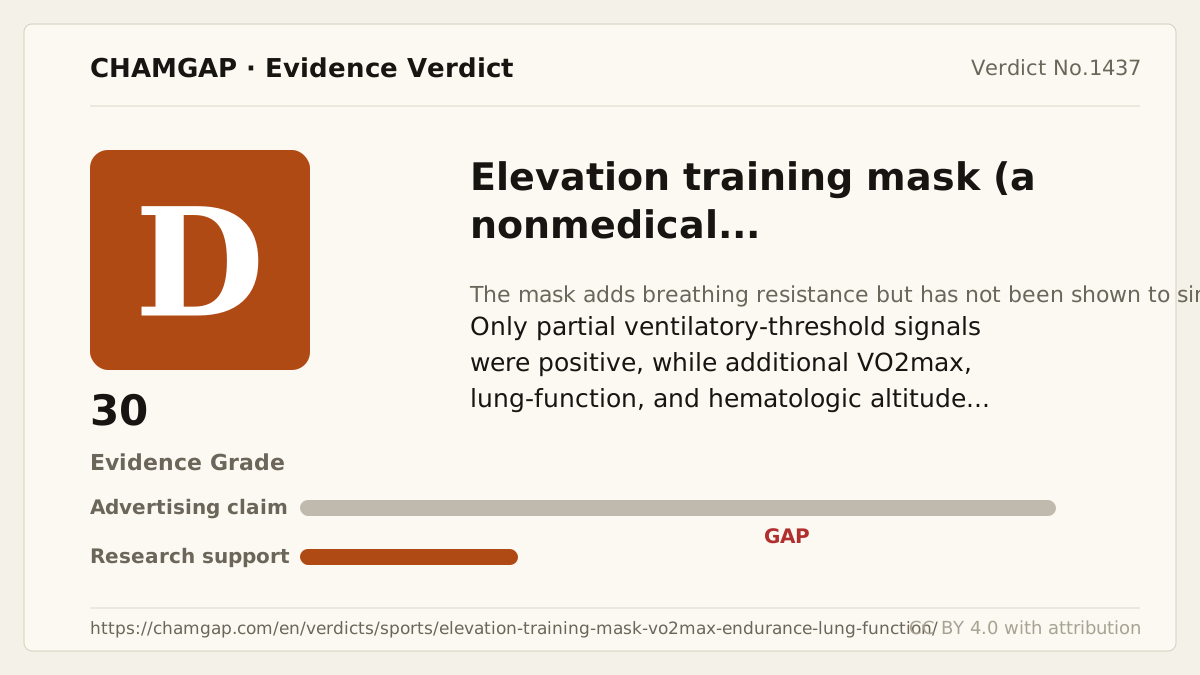
[Chamgap] Elevation training mask x additional improvement in VO2max, endurance, and lung function — Evidence Grade D·30. 2 cited sources checked. Source: https://chamgap.com/en/verdicts/sports/elevation-training-mask-vo2max-endurance-lung-function/ · CC BY 4.0CC BY 4.0 — free to use with attribution; do not distort grades, numbers, or verdict meaning.
What this document does and does not do
Chamgap is an information source. It reports what research has and has not confirmed; it does not tell readers what to take or buy. That decision belongs to readers and, when needed, medical or legal professionals. This verdict reflects literature available up to the search date and may change as new research appears. Nothing here is medical advice.