
D-ribose,
does it really help with Improved high-intensity exercise performance and recovery through ATP replenishment?
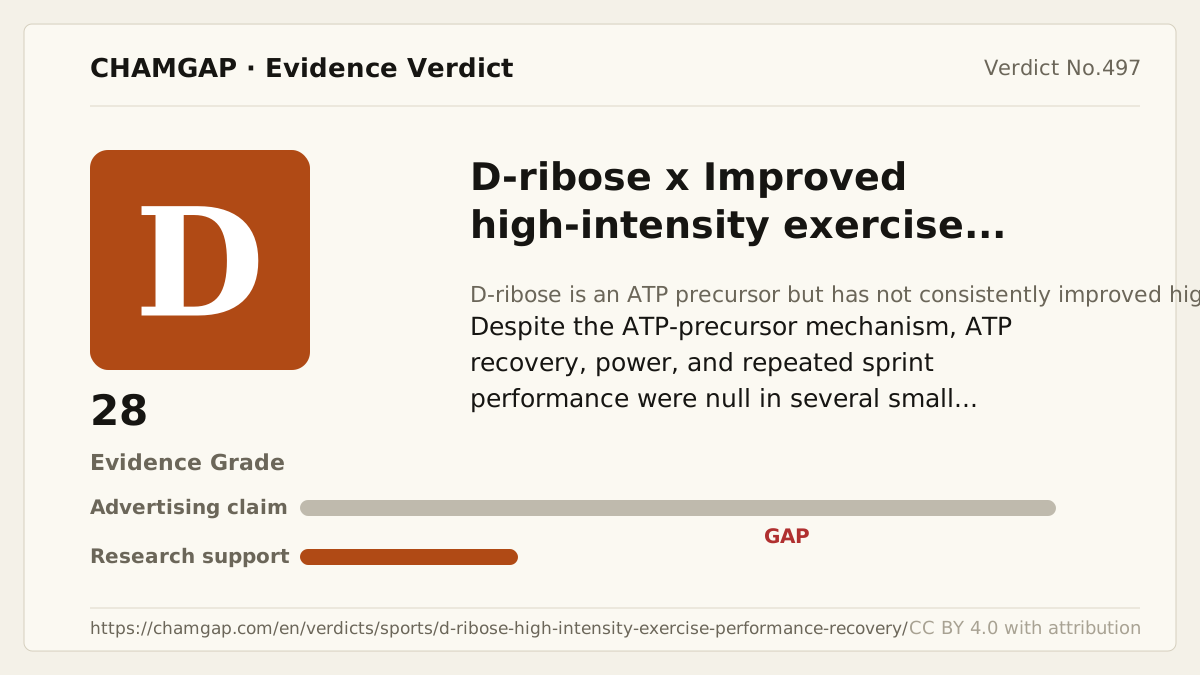
research showsD-ribose is a precursor in ATP synthesis, but that does not mean oral supplementation improves athletic performance in healthy people. Double-blind trials using 10 to 16 g/day generally found no benefit for muscle ATP recovery, repeated maximal exercise, Wingate power, or metabolic markers, and a trial at the recommended 625-mg dose was also null. A small signal in a low-fitness subgroup prevents an F rating, but direct performance trials are broadly null, supporting D.
ads claimMarketing says that supplying ATP substrate directly boosts explosive power and recovery. Oral absorption and biochemical plausibility do not establish a sufficient concentration in exercising muscle, faster ATP restoration, or improved competitive performance.
Useful facts when choosing a product
- Korean consumers can purchase D-ribose powders providing 5 g per serving or 850-mg capsules through Korean-language cross-border retailers.
- Exercise studies ranged from an acute 625-mg dose and 3 g to 10 g/day, 16 g/day, and 32 g over 36 hours without consistent performance benefit.
- The European Food Safety Authority set a safe intake level for the general population at 36 mg/kg body weight per day, about 2.5 g/day for a 70-kg adult and below many sports products and trial doses.
- Transient hypoglycemia, gastrointestinal symptoms, and higher uric acid have been reported at high doses, warranting caution with glucose-lowering drugs and in people prone to hypoglycemia or gout.
Chamgap Semantic Classification Code
Candidate index · review held
UNK.d-ribose.UNK.high-intensity-exercise-performance-and-recovery-through-atp-replenishment.improve.placeboUnknown > D-ribose > Unknown > high-intensity exercise performance and recovery through ATP replenishment > Improvement claim > Placebo
An automated migration candidate, not an issued permanent code; exact claim scope remains under review. This machine-generated migration candidate helps retrieval but is not a permanent assignment. The original verdict ID and URL remain authoritative.
What the research actually shows
Op 't Eijnde 2001 assigned 19 participants to ribose 16 g/day or placebo and used repeated maximal knee extensions and muscle biopsy. ATP and total adenine nucleotides fell after exercise, but 24-hour recovery and power did not differ. Kreider 2003 found no effect of 10 g/day for five days on Wingate performance or most metabolic markers in 19 trained men. Dunne 2006 reported no benefit from an acute 3-g dose, and Kerksick 2006 found no benefit at the marketed 625-mg dose. Berardi 2003 found a signal in one selected sprint after 32 g over 36 hours, but it was not reproduced across all six sprints. Seifert 2017 was positive only in the lower-VO2max stratum of 26 participants, while performance and recovery markers were null in the higher-VO2max stratum.
Why this is classified as D (28)
Multiple direct placebo-controlled exercise trials generally failed to improve ATP recovery, repeated maximal exercise, Wingate performance, or rowing performance. Because the trials were small and one low-fitness subgroup signal remains, the evidence supports D with 28 points rather than F based on regulatory rejection or large repeated refutation.
Counterpoint. A limited hypothesis remains for recovery across consecutive high-intensity sessions in untrained or low-fitness people. Independent adequately powered trials with prespecified fitness strata and actual performance outcomes are needed for an upgrade.
Rejudgment record. New verdict — Separated ATP-precursor plausibility from athletic performance and prioritized repeated null placebo-controlled exercise trials at marketed and higher doses
Sub-claim grades by effect
This ingredient is marketed for several effects. A single overall grade blends strong and weak claims together, so each effect is graded separately here. The overall grade reflects the strongest disconfirming or core claim.
| Effect (sub-claim) | Grade | Basis |
|---|---|---|
| Faster postexercise muscle ATP recovery | D | A direct biopsy trial using 16 g/day found no faster ATP resynthesis than placebo at 24 hours. |
| Improved high-intensity power, repeated sprints, and endurance performance | D | Several small placebo-controlled trials found no consistent improvement, and a rowing trial improved more with dextrose. |
| Improved exercise recovery and reduced fatigue | C | Perceived-exertion and creatine-kinase signals appeared in a low-fitness subgroup, but this was a stratified result from 26 people and was null in the higher-fitness group. |
Cross-check — AI research and Codex final gate
Evidence Table
| Study | Design | Sample | Funding | Endpoint | Result | Weight |
|---|---|---|---|---|---|---|
| Op 't Eijnde B et al. 2001 | Double-blind placebo-controlled trial with a muscle-biopsy substudy | 8 | Academic research | Repeated maximal knee-extension power, muscle ATP, and total adenine nucleotides | Sixteen grams per day did not improve postexercise ATP recovery, strength, or power versus placebo. | Direct mechanistic contradiction |
| Kreider RB et al. 2003 | Randomized double-blind placebo-controlled trial | 5 | Unknown | Two Wingate tests, total work, peak power, and metabolic markers | At 10 g/day, anaerobic performance and metabolic markers did not improve apart from one post hoc total-work contrast. | Key null evidence |
| Berardi JM, Ziegenfuss TN. 2003; Kerksick CM et al. 2006 | Randomized placebo-controlled crossover repeated-sprint trials | Unknown | Repeated cycle sprints, peak power, and mean power | A signal in one sprint after 32 g over 36 hours did not reproduce across six sprints, and the marketed 625-mg dose was entirely null. | Repeated null evidence | |
| Seifert JG et al. 2017 | Double-blind crossover trial | 26 | No competing interests declared; one coauthor had a company affiliation | Two-minute power, perceived exertion, creatine kinase, and metabolic markers | Selected outcomes were positive in the lower-VO2max stratum, while all main performance and recovery markers were null in the higher-VO2max stratum. | Limited counterevidence |
Receipt — 6 References
All 6 cited sources were verified for existence at the original page (as of 2026-07-18).
Final verification and publication gate: Codex · Evidence date: 2026-07-18 · Corrections: none
Cite this verdict
[Chamgap] D-ribose x high-intensity exercise performance and recovery — Evidence Grade D·28. 6 cited sources checked. Source: https://chamgap.com/en/verdicts/sports/d-ribose-high-intensity-exercise-performance-recovery/ · CC BY 4.0CC BY 4.0 — free to use with attribution; do not distort grades, numbers, or verdict meaning.
What this document does and does not do
Chamgap is an information source. It reports what research has and has not confirmed; it does not tell readers what to take or buy. That decision belongs to readers and, when needed, medical or legal professionals. This verdict reflects literature available up to the search date and may change as new research appears. Nothing here is medical advice.