
Curcumin,
does it really help with Reduced delayed-onset muscle soreness and accelerated recovery of muscle function when taken around exercise?
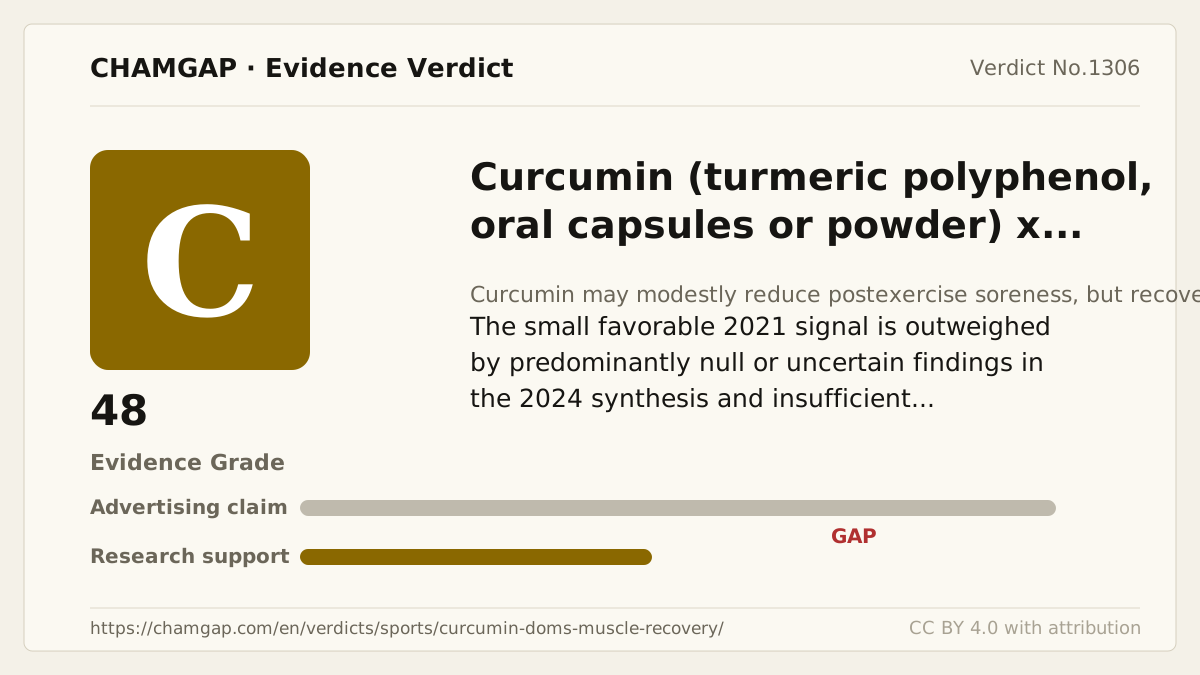
research showsCurcumin is rated C because it may modestly reduce postexercise muscle soreness. The double-blind crossover trial by Nicol in 2015 involved only 17 men and signaled reductions of about 1.0 to 1.9 points in pain VAS ratings and 22% to 29% in creatine kinase at 24 to 48 hours, but the sample was extremely small and subjective pain was central. A 2021 meta-analysis also reported a soreness-index WMD of -0.476 and a creatine-kinase WMD of -48.54 IU/L, but formulations, doses, exercise protocols, and assessment times differed substantially. A stricter 2024 synthesis of 16 papers found insufficient functional-strength data for quantitative synthesis, while DOMS and creatine-kinase findings were unstable across time points. The small pain signal is therefore accepted without extending it to performance or training recovery.
ads claimMarketing expands pain and creatine-kinase signals into claims that curcumin switches off inflammation, accelerates recovery, and guarantees next-session performance. Bioavailability differs by formulation, and research has not established that less pain produces better strength or real-world performance.
Useful facts when choosing a product
- Research doses have ranged from several hundred milligrams to 5 g per day depending on formulation, and plain turmeric powder, standard curcumin, and absorption-enhanced products cannot be converted dose for dose.
- Oral curcumin has low bioavailability, so piperine, phospholipid, and micellar formulations are used; results from one formulation cannot automatically be applied to another capsule or powder.
- Short courses are generally tolerated, but nausea, diarrhea, abdominal discomfort, and headache can occur, and exercise-recovery safety data for high doses or prolonged use are limited.
- People taking anticoagulant or antiplatelet drugs, those with gallbladder or biliary disease, anyone awaiting surgery, and pregnant or breastfeeding individuals should consult a clinician before supplementation.
Chamgap Semantic Classification Code
Candidate index · review held
S.curcumin.oral.delayed-onset-muscle-soreness-and-accelerated-recovery-of-muscle-function-when-taken-around-exercise.reduce.placeboSupplements and nutraceuticals > Curcumin > Oral > delayed-onset muscle soreness and accelerated recovery of muscle function when taken around exercise > Reduction claim > Placebo
An automated migration candidate, not an issued permanent code; exact claim scope remains under review. This machine-generated migration candidate helps retrieval but is not a permanent assignment. The original verdict ID and URL remain authoritative.
What the research actually shows
Nicol 2015 was a double-blind randomized crossover trial in 17 men who received curcumin 2.5 g twice daily from two days before through three days after exercise. Pain VAS ratings during several movements and creatine kinase were lower at 24 to 48 hours, but the trial used magnitude-based inference with 90% confidence limits, had an extremely small sample, and tested multiple outcomes. Fang 2021 pooled adult randomized trials and found small average reductions in creatine kinase and muscle soreness, with substantial differences among the underlying studies. Oxley and Peart 2024 reassessed 16 papers but found too little functional-strength evidence for quantitative synthesis, while creatine-kinase and DOMS effects were predominantly null or uncertain across time points. The most defensible claim is therefore possible short-term relief of DOMS pain.
Why this is classified as C (48)
DOMS pain and creatine kinase show a small positive signal, so the evidence is not completely null. Reliance on subjective pain and blood creatine kinase, small studies, heterogeneity in formulation, dose, exercise, and timing, predominantly null or uncertain 2024 findings, and insufficient functional-strength data for quantitative synthesis yield lower-range C with 48 points.
Counterpoint. A brief trial of a defined standardized formulation may be reasonable for someone with troublesome postexercise soreness, but it does not replace sleep, protein intake, training-load management, or active recovery. Severe pain accompanied by marked swelling, weakness, or dark urine should not be assumed to be DOMS and warrants medical evaluation.
Rejudgment record. Cross-check applied — Accepted the small positive signals in DOMS pain and creatine kinase but applied lower-range C because of extremely small samples, subjective and surrogate outcomes, heterogeneity in formulation, dose, exercise, and timing, predominantly null or uncertain findings in the 2024 synthesis, and insufficient functional-strength data for quantitative synthesis
Sub-claim grades by effect
This ingredient is marketed for several effects. A single overall grade blends strong and weak claims together, so each effect is graded separately here. The overall grade reflects the strongest disconfirming or core claim.
| Effect (sub-claim) | Grade | Basis |
|---|---|---|
| Reduced postexercise DOMS pain | C | Tiny randomized trials and meta-analyses show a small positive signal, but subjective pain and heterogeneity limit it to C. |
| Accelerated recovery of muscle function after exercise | D | The latest synthesis found insufficient functional-strength evidence for quantitative meta-analysis. |
| Improved next-session performance or training outcomes | D | No direct trial shows that soreness or creatine-kinase signals improve real performance or long-term training adaptation. |
Cross-check — AI research and Codex final gate
Evidence Table
| Study | Design | Sample | Funding | Endpoint | Result | Weight |
|---|---|---|---|---|---|---|
| Nicol LM et al. 2015 | Double-blind randomized placebo-controlled crossover trial | 17 men | Indexed as non-government research support; the abstract does not detail a product-company role | Pain VAS, creatine kinase, swelling, and single-leg jump at 0, 24, and 48 hours after exercise | Pain during several movements fell by about 1.0 to 1.9 points and creatine kinase by 22% to 29% at 24 to 48 hours, with a 15% jump-performance signal. | Direct positive signal with an extremely small sample and multiple subjective outcomes |
| Fang W and Nasir Y. 2021 | Systematic review and meta-analysis of randomized trials | Synthesis of adult randomized trials; total participant count not stated in the abstract | Academic meta-analysis with mixed funding across source trials | Creatine kinase and muscle-soreness index | Reported small favorable effects for creatine kinase, WMD -48.54 IU/L (95% CI -80.67 to -16.42), and soreness, WMD -0.476 (95% CI -0.750 to -0.202). | Positive synthesis limited by surrogate and subjective outcomes and heterogeneity |
| Oxley RA and Peart DJ. 2024 | Systematic review and meta-analysis | 16 papers | Academic review with mixed funding across source studies | Functional strength, DOMS, creatine kinase, and inflammatory markers | Functional-strength evidence was insufficient for quantitative synthesis, while DOMS and creatine-kinase findings were predominantly null or uncertain across time points. | Current assessment of limitations and inconsistency |
Receipt — 3 References
All 3 cited sources were verified for existence at the original page (as of 2026-07-24).
Final verification and publication gate: Codex · Evidence date: 2026-07-24 · Corrections: none
Cite this verdict
[Chamgap] Curcumin x reduced delayed-onset muscle soreness and accelerated muscle-function recovery — Evidence Grade C·48. 3 cited sources checked. Source: https://chamgap.com/en/verdicts/sports/curcumin-doms-muscle-recovery/ · CC BY 4.0CC BY 4.0 — free to use with attribution; do not distort grades, numbers, or verdict meaning.
What this document does and does not do
Chamgap is an information source. It reports what research has and has not confirmed; it does not tell readers what to take or buy. That decision belongs to readers and, when needed, medical or legal professionals. This verdict reflects literature available up to the search date and may change as new research appears. Nothing here is medical advice.