
Cold-water immersion,
does it really help with Improved delayed-onset muscle soreness and subjective recovery 24 to 96 hours after high-intensity exercise?
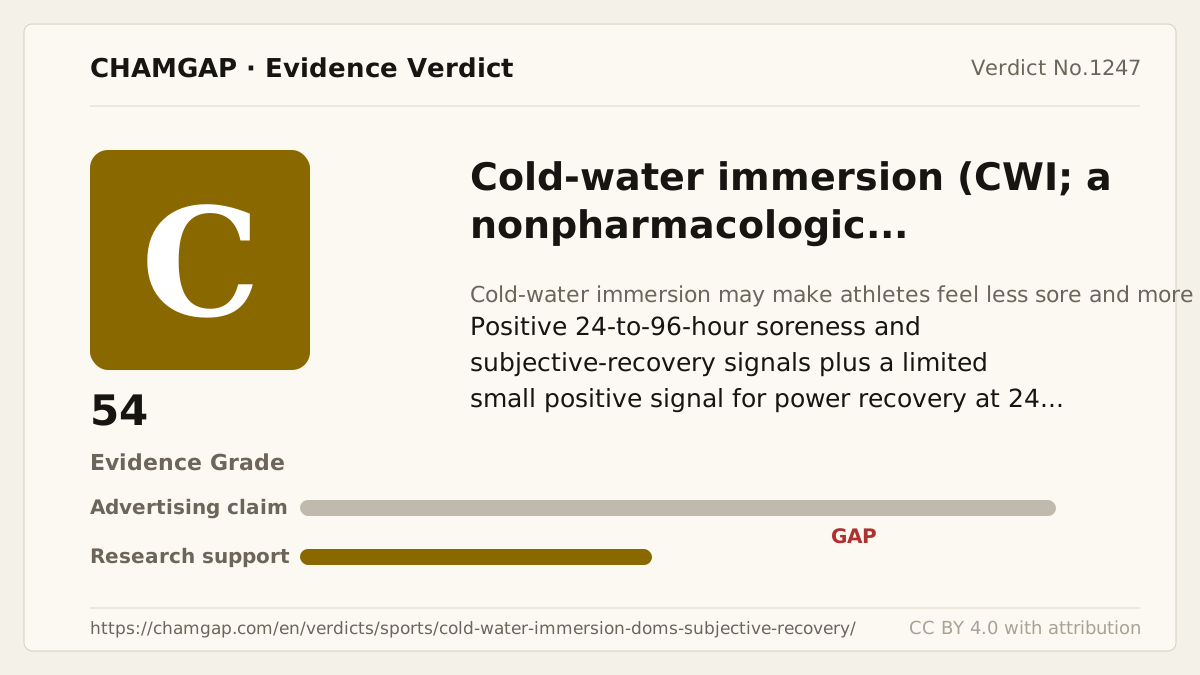
research showsCold-water immersion immediately after high-intensity exercise is rated C because it can reduce delayed-onset muscle soreness over 24 to 96 hours and may improve some subjective recovery ratings versus passive recovery. A Cochrane review of 17 small trials and 366 participants favored immersion for soreness at 24, 48, 72, and 96 hours, but study quality was low and temperature, duration, and exercise protocols varied substantially. A meta-analysis of 27 articles likewise found a 24-to-96-hour DOMS signal, while objective recovery outcomes such as strength, power, and blood markers did not improve significantly. Blinding is difficult and subjective outcomes dominate, so the positive small signal receives C rather than B.
ads claimMarketing can convert less soreness into removing inflammation, repairing muscle immediately, or fully restoring next-day performance. The most direct evidence concerns subjective soreness versus passive recovery, and equal effects are not established across every sport, water temperature, or immersion duration.
Useful facts when choosing a product
- Research protocols usually applied immersion within one hour after exercise in water of roughly 5 to 15°C for 5 to 24 minutes, but an optimal temperature, duration, and immersion depth are not established.
- A reduction in perceived soreness is not equivalent to faster objective recovery of strength, power, jumping, sprinting, or muscle damage.
- Sudden cold exposure can trigger gasping, hyperventilation, higher blood pressure and heart rate, arrhythmia, and hypothermia, so immersion should not be performed alone or in open water.
- People with cardiovascular disease, uncontrolled hypertension, Raynaud phenomenon, cold hypersensitivity, sensory impairment, or alcohol use should seek medical advice or avoid the practice.
Chamgap Semantic Classification Code
Candidate index · review held
X.cold-water-immersion.behavioral.delayed-onset-muscle-soreness-and-subjective-recovery-after-high-intensity-exercise.reduce.UNKBehaviors, exposures and policies > Cold-water immersion > Behavioral delivery > delayed-onset muscle soreness and subjective recovery after high-intensity exercise > Reduction claim > Unknown
An automated migration candidate, not an issued permanent code; exact claim scope remains under review. This machine-generated migration candidate helps retrieval but is not a permanent assignment. The original verdict ID and URL remain authoritative.
What the research actually shows
Bleakley and colleagues reviewed 17 randomized or quasi-randomized trials with 366 participants using heterogeneous protocols of roughly 5 to 15°C for 5 to 24 minutes. Soreness favored immersion over passive recovery at 24 through 96 hours, but only 19% of participants were women, study quality was low, and adverse-event surveillance was inadequate. Hohenauer and colleagues synthesized 27 articles that applied external cooling within one hour of exercise and compared it with passive recovery. DOMS improved at 24, 48, and 96 hours, while the 72-hour result varied by analysis; perceived exertion favored cooling only at 24 hours. Creatine kinase, lactate, IL-6, CRP, and performance-related objective outcomes did not show consistent significant benefit.
Why this is classified as C (54)
The Cochrane review of 17 trials and 366 participants and a meta-analysis of 27 articles provide positive signals for DOMS and some subjective recovery from 24 to 96 hours versus passive recovery. Trials were small and low quality, blinding was difficult, and protocols were heterogeneous. A limited small positive signal exists for power recovery at 24 hours, but strength and blood recovery outcomes did not improve consistently, so the rule ① subjective-outcome ceiling and positive-small-signal standard give C with 54 points.
Counterpoint. Reducing soreness and fatigue perception can still be practically useful when another competition follows quickly. Repeated immediate cooling may have separate implications when long-term training adaptation or muscle growth is the priority; this verdict is limited to recovery over 24 to 96 hours after a single high-intensity bout.
Rejudgment record. Cross-check applied — Accepted positive signals for DOMS and some subjective recovery over 24 to 96 hours versus passive recovery in a Cochrane review of 17 small trials and 366 participants and a 27-article meta-analysis, but applied the rule ① ceiling of C because study quality was low, blinding was infeasible, protocols were heterogeneous, and objective strength, power, and blood recovery evidence was limited
Sub-claim grades by effect
This ingredient is marketed for several effects. A single overall grade blends strong and weak claims together, so each effect is graded separately here. The overall grade reflects the strongest disconfirming or core claim.
| Effect (sub-claim) | Grade | Basis |
|---|---|---|
| Reduced delayed-onset muscle soreness over 24 to 96 hours | C | Meta-analytic signals versus passive recovery are positive but rely on small, low-quality, heterogeneous trials and a subjective outcome. |
| Improved subjective recovery over 24 to 96 hours | C | Some fatigue and recovery-rating signals exist, but time-specific data are sparse and blinding is infeasible. |
| Improved objective performance recovery | C | A small positive effect on power recovery at 24 hours has been observed in some analyses, but strength results are inconsistent and uncertainty is substantial, supporting a limited small effect (C). |
Cross-check — AI research and Codex final gate
Evidence Table
| Study | Design | Sample | Funding | Endpoint | Result | Weight |
|---|---|---|---|---|---|---|
| Bleakley C et al. 2012 | Cochrane systematic review of randomized and quasi-randomized trials | 17 small trials with 366 participants | Academic Cochrane review; funding of included trials was inadequately reported | Muscle soreness at 24, 48, 72, and 96 hours, fatigue, subjective physical recovery, and adverse events | Soreness improved over 24 to 96 hours versus passive recovery, but study quality was low, protocols were heterogeneous, and safety surveillance was inadequate. | Key positive synthesis with low quality |
| Hohenauer E et al. 2015 | Systematic review and meta-analysis of randomized and quasi-randomized post-exercise cooling trials | 27 articles | The authors reported receiving no specific funding | DOMS and perceived exertion plus objective performance, muscle-damage, and inflammatory variables | Cooling, especially immersion, reduced DOMS over 24 to 96 hours, but no objective recovery variable improved significantly during 96 hours. | Key evidence showing positive subjective and null objective recovery |
Receipt — 2 References
All 2 cited sources were verified for existence at the original page (as of 2026-07-24).
Final verification and publication gate: Codex · Evidence date: 2026-07-24 · Corrections: none
Cite this verdict
[Chamgap] Cold-water immersion x improved post-exercise muscle soreness and subjective recovery — Evidence Grade C·54. 2 cited sources checked. Source: https://chamgap.com/en/verdicts/sports/cold-water-immersion-doms-subjective-recovery/ · CC BY 4.0CC BY 4.0 — free to use with attribution; do not distort grades, numbers, or verdict meaning.
What this document does and does not do
Chamgap is an information source. It reports what research has and has not confirmed; it does not tell readers what to take or buy. That decision belongs to readers and, when needed, medical or legal professionals. This verdict reflects literature available up to the search date and may change as new research appears. Nothing here is medical advice.