
Carbohydrate-electrolyte sports drink,
does it really help with Improved performance and hydration during endurance exercise lasting at least one hour?
research showsCarbohydrate-electrolyte sports drinks are rated B when used in the appropriate context of endurance exercise lasting at least one hour. Ramos-Campo synthesized 136 studies of carbohydrate intake rather than electrolyte drinks as a whole, and the Rowlands plasma-volume outcome is a hydration surrogate. A direct 2026 meta-analysis of carbohydrate-electrolyte supplementation found no significant overall performance effect, SMD 0.16 with p=0.06, while time to exhaustion alone was positive, SMD 0.60 with p=0.006. Formulation, environment, training status, and endpoint heterogeneity preclude A and give B with 70 points.
ads claimMarketing generalizes a prolonged, demanding exercise benefit to every gym session and routine thirst.
Useful facts when choosing a product
- Sports drinks such as Pocari Sweat and Gatorade combine water, carbohydrate, and electrolytes such as sodium.
- Effects vary with exercise duration, intensity, heat, sweat loss, and osmolality, so all ion drinks are not equivalent.
- Oral rehydration solution in verdict 450 treats diarrhea or vomiting dehydration and has a different purpose and glucose-sodium composition.
- Frequent use increases sugar, calorie, and acid exposure and can add weight, caries, and dental-erosion burden.
Chamgap Semantic Classification Code
Candidate index · review held
F.carbohydrate-electrolyte-sports-drink.food.performance-and-hydration-during-endurance-exercise-lasting-at-least.improve.UNKFoods and beverages > Carbohydrate-electrolyte sports drink > Food consumption > performance and hydration during endurance exercise lasting at least > Improvement claim > Unknown
An automated migration candidate, not an issued permanent code; exact claim scope remains under review. This machine-generated migration candidate helps retrieval but is not a permanent assignment. The original verdict ID and URL remain authoritative.
What the research actually shows
The Ramos-Campo meta-analysis found endurance-performance benefit across 136 carbohydrate-feeding studies, but this is the carbohydrate axis rather than sports drinks as a whole. The Rowlands hydration analysis included 28 studies and 68 drink effects; hypotonic drinks reduced plasma-volume loss by about 1.1 percentage points versus water, but plasma volume is a surrogate and isotonic drinks were not superior to water. A direct 2026 meta-analysis of 26 carbohydrate-electrolyte studies found no overall performance effect, SMD 0.16 (95% CI -0.01 to 0.33, p=0.06); time to exhaustion was positive, SMD 0.60 (95% CI 0.17 to 1.02, p=0.006), while time to finish was null.
Why this is classified as B (70)
Prolonged-exercise carbohydrate evidence, a plasma-volume surrogate for hypotonic drinks, and a positive time-to-exhaustion subgroup in the direct carbohydrate-electrolyte meta-analysis support B. However, the 136-study synthesis concerns carbohydrate, plasma volume is a surrogate, and overall performance in the 2026 direct meta-analysis was not significant at SMD 0.16 with p=0.06. Context, formulation, and endpoint heterogeneity give B with 70 points.
Counterpoint. Water usually suffices for ordinary exercise under one hour, and overdrinking can contribute to hyponatremia, so intake should follow thirst and individual sweat loss.
Rejudgment record. New verdict — Accepted prolonged-exercise carbohydrate performance evidence, the plasma-volume hydration surrogate, and the positive time-to-exhaustion finding in the 2026 direct carbohydrate-electrolyte meta-analysis while accounting for null overall performance and contextual, formulation, and endpoint heterogeneity
Sub-claim grades by effect
This ingredient is marketed for several effects. A single overall grade blends strong and weak claims together, so each effect is graded separately here. The overall grade reflects the strongest disconfirming or core claim.
| Effect (sub-claim) | Grade | Basis |
|---|---|---|
| Performance and hydration in endurance exercise lasting at least one hour | B | Prolonged-exercise carbohydrate evidence and a positive time-to-exhaustion subgroup support the claim, although overall direct performance was null. |
| Superiority to water for sub-hour routine exercise | D | Most evidence finds little difference and generalization is poorly supported. |
| Equivalent effects of all ion drinks | ? | Composition and osmolality differences prevent generalization. |
Cross-check — AI research and Codex final gate
Evidence Table
| Study | Design | Sample | Funding | Endpoint | Result | Weight |
|---|---|---|---|---|---|---|
| Ramos-Campo DJ et al. 2024 | Systematic review, meta-analysis, and meta-regression | 136 endurance-exercise studies | Academic research | Direct performance including time trial and time to exhaustion | Carbohydrate improved performance, with larger effects in longer exercise. | Performance synthesis for the carbohydrate axis |
| Rowlands DS et al. 2022 | Systematic review and meta-analysis of hydration | 28 studies and 68 drink effects | Academic research | Change in plasma volume during exercise | Hypotonic carbohydrate-electrolyte drinks preserved hydration better than water. | Hydration-surrogate synthesis |
| Bravo-Sánchez A et al. 2026 | Systematic review and meta-analysis of carbohydrate-electrolyte supplementation | 26 studies; 922 participants in the overall performance analysis | University grant co-funded by the European Social Fund | Overall performance, time to exhaustion, and time to finish | Overall performance was null at SMD 0.16 (p=0.06), time to exhaustion was positive at SMD 0.60 (p=0.006), and time to finish was null. | Latest direct carbohydrate-electrolyte synthesis |
Receipt — 4 References
All 4 cited sources were verified for existence at the original page (as of 2026-07-19).
Final verification and publication gate: Codex · Evidence date: 2026-07-19 · Corrections: none
Cite this verdict
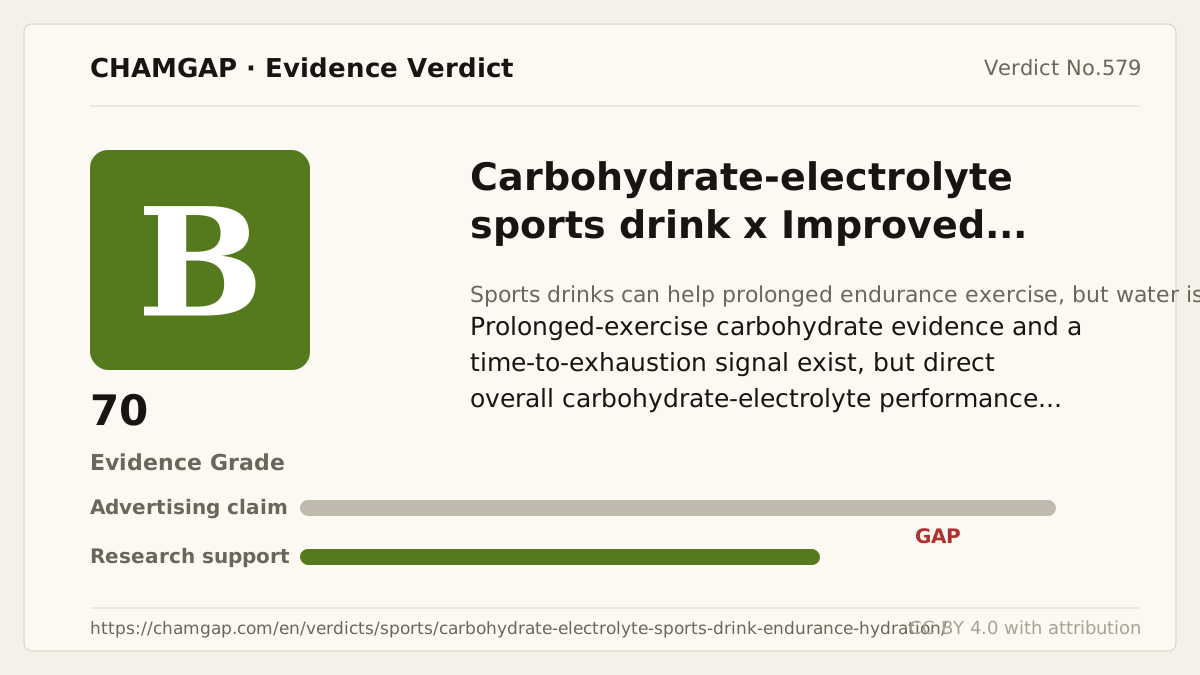
[Chamgap] Carbohydrate-electrolyte sports drink x improved performance and hydration during endurance exercise lasting at least one hour — Evidence Grade B·70. 4 cited sources checked. Source: https://chamgap.com/en/verdicts/sports/carbohydrate-electrolyte-sports-drink-endurance-hydration/ · CC BY 4.0CC BY 4.0 — free to use with attribution; do not distort grades, numbers, or verdict meaning.
What this document does and does not do
Chamgap is an information source. It reports what research has and has not confirmed; it does not tell readers what to take or buy. That decision belongs to readers and, when needed, medical or legal professionals. This verdict reflects literature available up to the search date and may change as new research appears. Nothing here is medical advice.