
Blood flow restriction training,
does it really help with High-load-level gains in muscle size and strength from low-load resistance exercise?
research showsLow-load BFR is graded C because credible human syntheses show greater strength and muscle cross-sectional-area gains than the same low-load exercise without restriction. A meta-analysis of 53 randomized trials favored BFR over nonocclusive low-load training, but high-load training produced greater maximal-strength gains and equivalence for hypertrophy varied by protocol. Trials were generally small and heterogeneous in cuff pressure, site, and training dose, and measured exercise surrogates rather than hard outcomes.
ads claimMarketing reduces a protocol-dependent intervention to a promise that light weights always reproduce heavy-weight results. Outcomes depend on cuff pressure, limb occlusion pressure, exercise dose, population, and supervision.
Useful facts when choosing a product
- BFR places a cuff near the top of an arm or leg to partly maintain arterial inflow while limiting venous outflow during usually low-load exercise.
- Cuff width, position, pressure, and individual limb occlusion pressure affect both the stimulus and discomfort; arbitrary tight wrapping does not reproduce studied protocols.
- The evidence mainly covers weeks to months of strength, torque, and ultrasound or magnetic-resonance muscle-size surrogates, not injury prevention or longevity.
- Pressure pain, numbness, and bruising can occur. A history of thrombosis, severe vascular disease, uncontrolled hypertension, or pregnancy warrants professional assessment before use.
Chamgap Semantic Classification Code
Candidate index · review held
UNK.blood-flow-restriction-training.UNK.high-load-level-gains-in-muscle-size-and-strength-from-low-load-resistance-exercise.assess.UNKUnknown > Blood flow restriction training > Unknown > High-load-level gains in muscle size and strength from low-load resistance exercise > Association or change assessment > Unknown
An automated migration candidate, not an issued permanent code; exact claim scope remains under review. This machine-generated migration candidate helps retrieval but is not a permanent assignment. The original verdict ID and URL remain authoritative.
What the research actually shows
Perera and colleagues found that low-load BFR improved torque over comparable low-load exercise and increased cross-sectional area over nonocclusive training, while high-load training was superior for one-repetition maximum and torque. Chang and colleagues found no overall difference in muscle-mass gain versus high-load training but smaller overall strength gains. Safety reviews support supervised use in selected people while noting discomfort, rare thrombosis or rhabdomyolysis reports, and incomplete adverse-event reporting.
Why this is classified as C (54)
A synthesis of 53 randomized trials supports strength and hypertrophy benefits over low-load exercise, but lower maximal strength than high-load training, heterogeneous protocols, and surrogate-only outcomes yield C with 54 points.
Counterpoint. It can be a practical adjunct when heavy loading is unsuitable, provided pressure is individualized and contraindications are screened.
Rejudgment record. New verdict — Accepted positive strength and hypertrophy findings versus low-load exercise in the 53-trial meta-analysis, while applying rule ① for lower maximal strength versus high loads, small and heterogeneous pressure protocols, and exercise surrogates only
Sub-claim grades by effect
This ingredient is marketed for several effects. A single overall grade blends strong and weak claims together, so each effect is graded separately here. The overall grade reflects the strongest disconfirming or core claim.
| Effect (sub-claim) | Grade | Basis |
|---|---|---|
| Increased hypertrophy from low-load BFR | C | Cross-sectional-area gains are consistent versus nonocclusive low loads, but outcomes are surrogate and heterogeneous. |
| Increased strength from low-load BFR | C | It outperforms comparable low loads, while high loads produce greater maximal strength on average. |
| Long-term strength and hypertrophy equivalent to high-load training | C | Hypertrophy may be similar, but strength findings conflict and long-term hard outcomes are absent. |
Cross-check — AI research and Codex final gate
Evidence Table
| Study | Design | Sample | Funding | Endpoint | Result | Weight |
|---|---|---|---|---|---|---|
| Perera E et al. 2022 | Systematic review and meta-analysis | 53 randomized trials; 31 in meta-analyses | Academic review; source-trial conflicts varied | One-repetition maximum, torque, cross-sectional area, and endurance | Torque and cross-sectional area favored BFR over comparable low loads, but one-repetition maximum and torque were lower than with high loads. | Key synthesis |
| Chang H et al. 2024 | Systematic review and meta-analysis versus high-load training | Comparative trials in untrained men | Academic research | Strength and muscle mass | Muscle-mass gain did not differ, but overall strength gain was smaller than with high-load training. | Limits high-load equivalence |
Receipt — 3 References
All 3 cited sources were verified for existence at the original page (as of 2026-07-23).
Final verification and publication gate: Codex · Evidence date: 2026-07-23 · Corrections: none
Cite this verdict
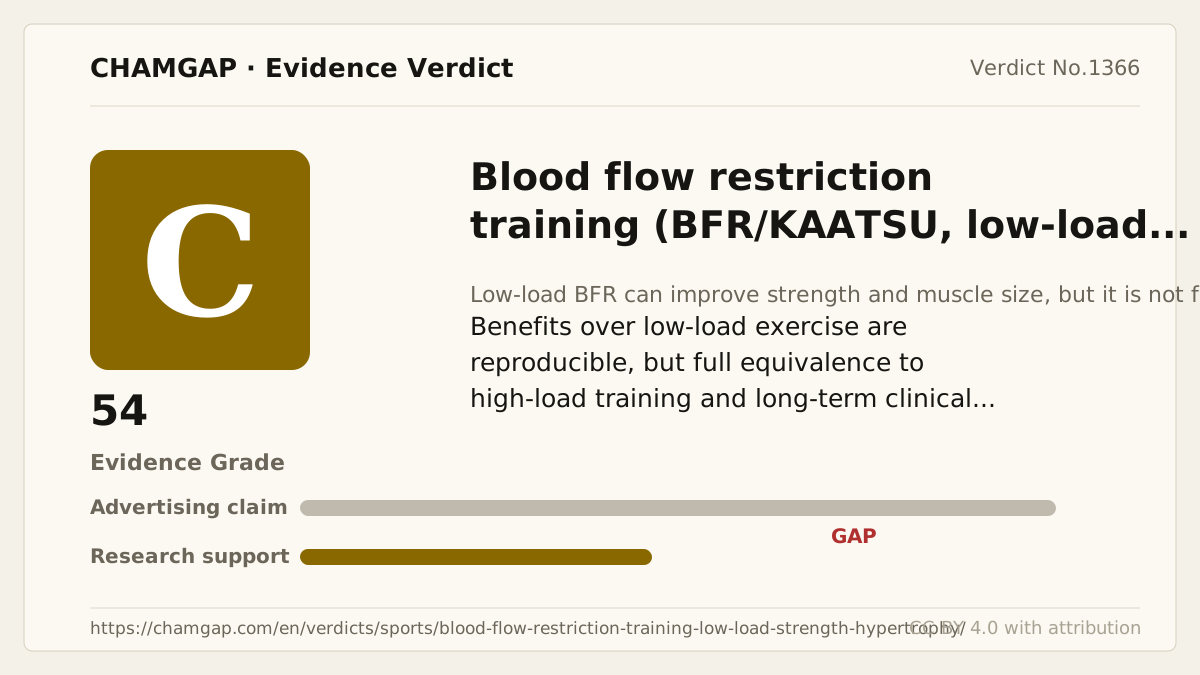
[Chamgap] Blood flow restriction training x muscle size and strength gains with low loads — Evidence Grade C·54. 3 cited sources checked. Source: https://chamgap.com/en/verdicts/sports/blood-flow-restriction-training-low-load-strength-hypertrophy/ · CC BY 4.0CC BY 4.0 — free to use with attribution; do not distort grades, numbers, or verdict meaning.
What this document does and does not do
Chamgap is an information source. It reports what research has and has not confirmed; it does not tell readers what to take or buy. That decision belongs to readers and, when needed, medical or legal professionals. This verdict reflects literature available up to the search date and may change as new research appears. Nothing here is medical advice.