
Bicycle helmet use,
does it really help with Prevention of head injury and serious head injury during a crash or fall?
research showsThe grade is C with 54 points. Observational studies restricted to injured patients reaching trauma care found fewer head and serious head injuries among helmeted cyclists. In the Norwegian registry study, any head injury occurred in 380/678 (56%) versus 445/578 (77%), and serious head injury in 150/678 (22%) versus 222/578 (38%); the limited-adjustment odds ratios were 0.38 (95% CI 0.30-0.49) and 0.29 (0.22-0.39), respectively. Helmet users may differ in alcohol use, speed, riding environment, age, and risk behavior, and these were not randomized incidence comparisons.
ads claimAn association among selected trauma patients should not be converted into an incidence reduction for all cyclists or an exact personal risk reduction. A case-control odds ratio is not a risk ratio; the two pivotal studies here were retrospective trauma-registry cohorts, not case-control studies.
Useful facts when choosing a product
- The English authors were Nick Dodds, Rowena Johnson, Benjamin Walton, Omar Bouamra, David Yates, Fiona Elizabeth Lecky, and Julian Thompson. The Norwegian authors were Ingar Naess, Mats Doving, Pal Galteland, Nils Oddvar Skaga, Torsten Eken, Eirik Helseth, and Jon Ramm-Pettersen. No name overlaps.
- Both registries included only patients who crossed hospital or major-trauma entry thresholds, not every cyclist who crashed. If a helmet prevents an isolated head injury from reaching that threshold, the person disappears from the registry, so within-registry proportions are not population crash incidence. The registry threshold and retrospective reconstruction of helmet use were treated as unavoidable data-structure limitations rather than separate avoidable defects.
- Avoidable adjustment differed. The English report gave no multivariable relative estimate for head injury and did not analyze crash mechanism in the main comparison. The Norwegian report adjusted for age, sex, and pre-injury status and stratified crash type, but omitted night riding, alcohol, speed, riding setting, and risk behavior from its main model.
- Bicycle helmets are widely sold in Korea, where applicable products can be checked for KC safety confirmation. Seoul Bike communicates helmet use in its safety rules, and its family pass requires agreement to child helmet use. Seoul bicycle training provides training bicycles, helmets, and protective equipment and teaches correct fitting.
- Korean helmet law and official safety recommendations provide local context only. The C grade with 58 points comes from the design and results of human trauma-registry studies, not from law or guidance.
- Verdict 2249 is C with 56 points for cycle commuting and cancer incidence. It concerns a long-term commuting exposure and registry-confirmed cancer, whereas this verdict concerns protective equipment worn during a crash and immediate head trauma. Its exposure and endpoint cannot substitute for this evidence.
Chamgap Semantic Classification Code
Candidate index · review held
UNK.wearing-a-bicycle-helmet.UNK.head-injury-and-serious-head-injury-during-a-crash-or-fall.prevent.UNKUnknown > Wearing a bicycle helmet > Unknown > head injury and serious head injury during a crash or fall > Occurrence-prevention claim > Unknown
An automated migration candidate, not an issued permanent code; exact claim scope remains under review. This machine-generated migration candidate helps retrieval but is not a permanent assignment. The original verdict ID and URL remain authoritative.
What the research actually shows
Dodds used a retrospective cohort analysis of the English TARN major-trauma registry from 2012 to 2017. Helmet status was available for 6,621 of 11,192 injured cyclists: 4,075 helmeted and 2,546 unhelmeted. Serious TBI occurred in 780/4,075 (19.1%) versus 1,211/2,546 (47.6%), and 30-day death in 72/4,075 (1.8%) versus 143/2,546 (5.6%). A composite count for any head injury was not reported. Head-injury results were unadjusted proportions with no adjusted relative estimate. Mortality used observed-minus-expected W scores, 2.4 (1.3-3.6) versus 1.1 (-0.1 to 2.2), not an adjusted risk ratio or odds ratio. Crash mechanism was not reviewed in the main analysis. Næss likewise used a retrospective cohort from the Oslo University Hospital Trauma Registry, 2005 to 2016. Of 1,543 admissions, 1,256 had helmet information. Models adjusted for age, sex, and pre-injury ASA physical status. Any head injury occurred in 380/678 (56%) versus 445/578 (77%), serious head injury in 150/678 (22%) versus 222/578 (38%), and 30-day death in 10/678 (1.5%) versus 17/578 (2.9%). The adjusted mortality OR, 0.50 (0.22-1.11), was null. Both used unhelmeted injured cyclists as the exposure reference, but neither labeled serious head injury as a single primary endpoint. The full author lists have no overlap. The English paper said its authors had not declared a specific grant from any public, commercial, or nonprofit sector. The Norwegian paper separately listed University of Oslo open-access funding and an unrestricted Norwegian Safety Forum research grant to one author; it did not identify that grant as study funding. Distinct independent study funders therefore were not established. The English study used crude proportions and a mortality W score, whereas the Norwegian study used adjusted odds ratios, so their main estimands were not the same. Amoros et al. 2012, an independent French road-trauma-registry case-control study with a separate author team (PMID 21606469; DOI 10.1136/ip.2011.031815), is an independent counterexample in the same protective direction. Repetition using the same estimand and data source was not identified.
Why this is classified as C (54)
Hard head-injury events and large associations are strengths, but repetition with the same estimand and data source was not identified, while major confounding and multiple testing remain, giving C with 54 points.
Counterpoint. Crude mortality was lower in England but lacked an adjusted relative estimate; in Norway, the adjusted mortality OR was 0.50 (0.22-1.11) and not significant. Evidence for preventing death is weaker than the head-injury association.
Rejudgment record. Cross-check applied — Hard head-injury events and large trauma-registry associations balanced against inadequate confounding control, registry selection, multiplicity, and nonmatching primary estimands
| Endpoint | H | Hard endpoint - actual events such as death |
| Replication | R1 | Single confirmatory trial |
| Independence | I1 | Mixed funding sources |
| Effect size | E+ | Meets the clinically important threshold |
Stored derived and displayed grades match; this is not a current recalculation or validity check (C).
Sub-claim grades by effect
This ingredient is marketed for several effects. A single overall grade blends strong and weak claims together, so each effect is graded separately here. The overall grade reflects the strongest disconfirming or core claim.
| Effect (sub-claim) | Grade | Basis |
|---|---|---|
| Lower odds of any head injury among injured cyclists | C | The Norwegian aOR was 0.38, with residual confounding and registry selection. |
| Lower odds of serious head injury among injured cyclists | C | The Norwegian aOR was 0.29 and English proportions pointed the same way, but the estimand was not directly replicated. |
| Prevention of 30-day mortality | D | England reported no adjusted relative estimate, and the Norwegian aOR 0.50 (0.22-1.11) was not significant. |
Cross-check — AI research and Codex final gate
Evidence Table
| Study | Design | Sample | Funding | Endpoint | Result | Weight |
|---|---|---|---|---|---|---|
| Dodds N et al. 2019 NHS England TARN | Retrospective cohort analysis of a major-trauma registry | 11,192 registered; 6,621 with helmet information analyzed (4,075/2,546) | Paper states that no specific public, commercial, or nonprofit grant was declared | Serious traumatic brain injury and 30-day mortality; no single primary endpoint label | Serious TBI 780/4,075 (19.1%) versus 1,211/2,546 (47.6%), no adjusted relative estimate; death 72/4,075 (1.8%) versus 143/2,546 (5.6%), W scores 2.4 versus 1.1 | Large hard-event association with selection and unadjusted head-injury comparisons |
| Naess I et al. 2024 Oslo University Hospital Trauma Registry | Retrospective cohort analysis of a single level-1 trauma-center registry | 1,543 admissions; 1,256 with helmet information analyzed (678/578) | University of Oslo open-access funding; one author's unrestricted Norwegian Safety Forum grant was not identified as funding this study | Any head injury, serious head injury, cranial neurosurgery, and 30-day mortality; no single primary endpoint label | Any head injury 380/678 (56%) versus 445/578 (77%), aOR 0.38 (0.30-0.49); serious injury 150/678 (22%) versus 222/578 (38%), aOR 0.29 (0.22-0.39); death 10/678 (1.5%) versus 17/578 (2.9%), aOR 0.50 (0.22-1.11) | Adjusted head-injury association with limited confounding control |
Receipt — 5 References
All 5 cited sources were verified for existence at the original page (as of 2026-08-07).
Final verification and publication gate: Codex · Evidence date: 2026-08-07 · Corrections: none
Cite this verdict
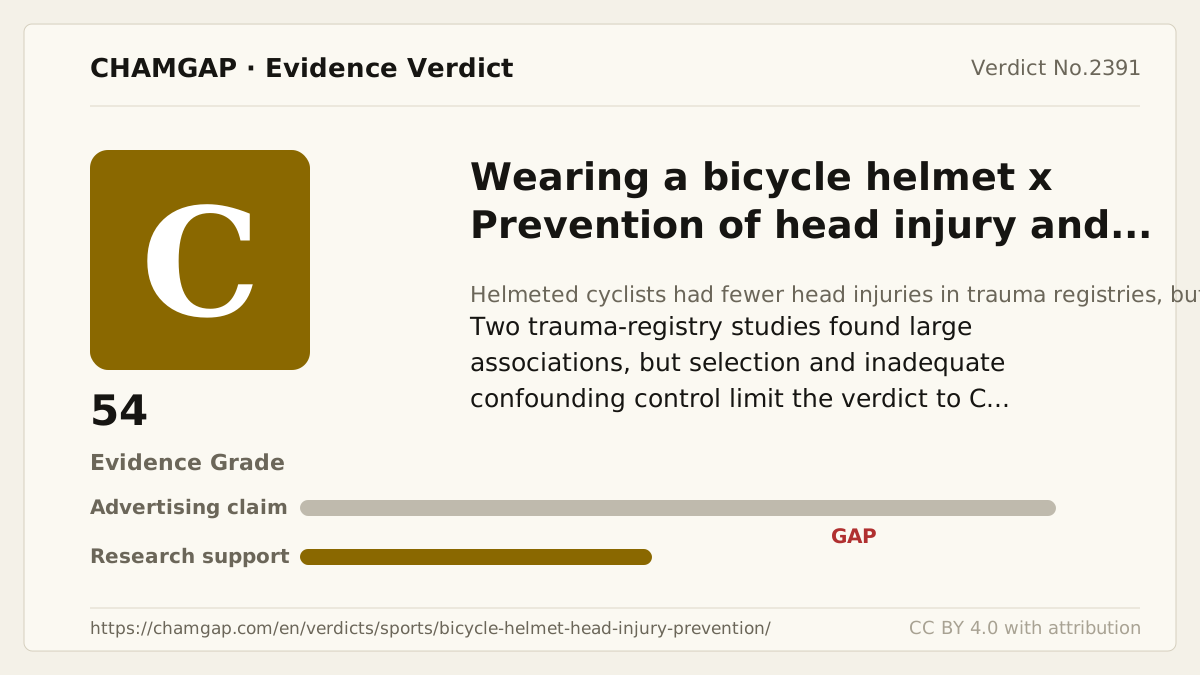
[Chamgap] Bicycle helmet use x prevention of head injury — Evidence Grade C·54. 5 cited sources checked. Source: https://chamgap.com/en/verdicts/sports/bicycle-helmet-head-injury-prevention/ · CC BY 4.0CC BY 4.0 — free to use with attribution; do not distort grades, numbers, or verdict meaning.
What this document does and does not do
Chamgap is an information source. It reports what research has and has not confirmed; it does not tell readers what to take or buy. That decision belongs to readers and, when needed, medical or legal professionals. This verdict reflects literature available up to the search date and may change as new research appears. Nothing here is medical advice.