
AstraGin,
does it really help with Maximized muscle function and exercise effects through increased protein and creatine absorption?
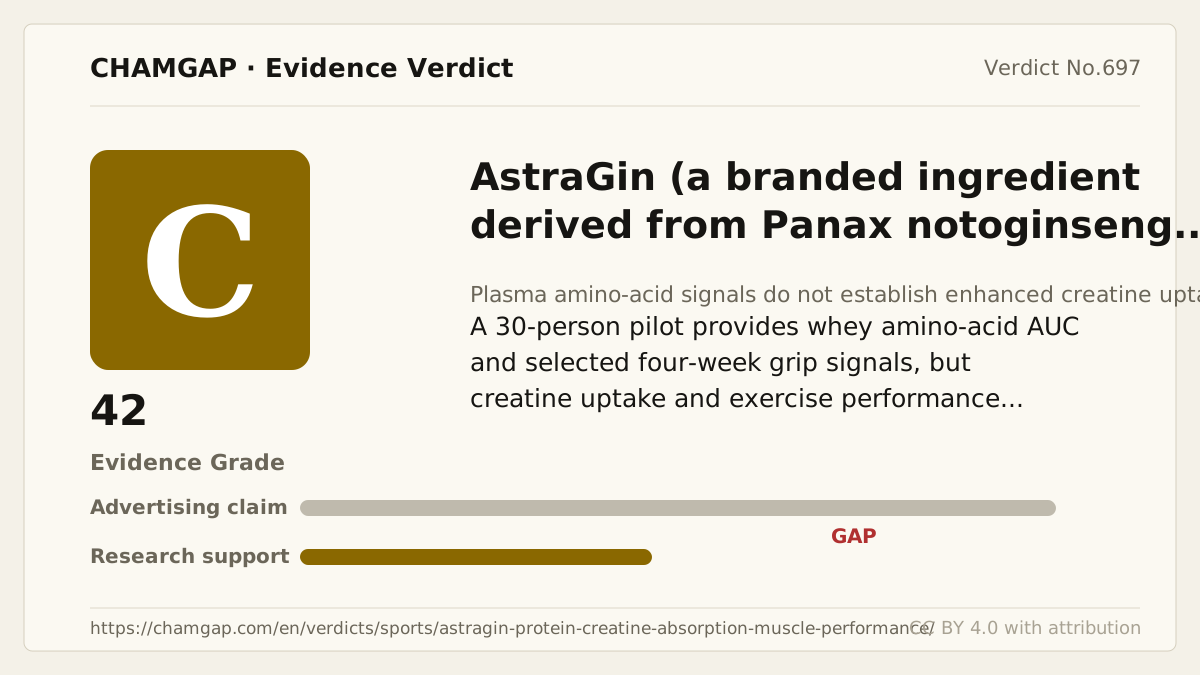
research showsAstraGin is rated C because a 30-person crossover pilot showed signals in amino-acid AUC after whey and selected four-week grip outcomes. The evidence is dominated by small pharmacokinetic surrogates, only ten participants per age stratum, coadministration with whey and resistance exercise, and study material supplied by the trademark owner NuLiv Science. Creatine absorption was not tested, and long-term hypertrophy or maximized exercise performance remains unconfirmed. The broad claim therefore receives C with 42 points.
ads claimMarketing expands small short-term differences in plasma amino-acid AUC into maximized absorption of protein and creatine, larger muscles, and superior performance. Human evidence centers on small pharmacokinetic studies of a particular branded ingredient coadministered with whey or arginine.
Useful facts when choosing a product
- AstraGin is a branded combination of Astragalus membranaceus and Panax notoginseng saponin extracts and is not equivalent to generic astragalus or ginseng supplements.
- Human pharmacokinetic trials mainly used 50 mg AstraGin with whey protein or arginine, which cannot substitute for a creatine-absorption trial.
- Short trials reported no major liver or kidney signal, but sample size and duration are insufficient for long-term safety, pregnancy, lactation, or interaction conclusions.
- Retail sports products may combine caffeine, creatine, amino acids, and other ingredients, preventing attribution of the finished-product effect to AstraGin alone.
Chamgap Semantic Classification Code
Candidate index · review held
UNK.astragin.UNK.maximized-muscle-function-and-exercise-effects-through-increased-protein-and-creatine-absorption.increase.placeboUnknown > AstraGin > Unknown > Maximized muscle function and exercise effects through increased protein and creatine absorption > Increase claim > Placebo
An automated migration candidate, not an issued permanent code; exact claim scope remains under review. This machine-generated migration candidate helps retrieval but is not a permanent assignment. The original verdict ID and URL remain authoritative.
What the research actually shows
Lin et al. 2023 analyzed 24 participants given 5 g arginine with 50 mg APS and reported a 17.3% increase in arginine AUC, while Cmax and between-group urinary nitrate and cGMP differences were not significant. Zhuang et al. 2026 conducted a 30-person crossover pilot using whey protein plus 50 mg APS and reported immediate AUC differences of 6.67% for valine and 3.62% for leucine, with larger absorption and grip-change signals after four weeks. NuLiv Science supplied the study ingredient, and each age stratum contained only ten participants. The registry and published literature did not identify an isolated AstraGin comparison for creatine absorption, muscle creatine storage, long-term hypertrophy, or sport performance.
Why this is classified as C (42)
A 30-person pilot provides whey amino-acid AUC and selected four-week grip signals, supporting C only for the narrower protein and amino-acid absorption subclaim. Pharmacokinetic surrogates, tiny age strata, study material supplied by NuLiv Science, and coadministration with whey and resistance exercise limit attribution. Creatine absorption was not tested, and long-term hypertrophy or maximized exercise performance remains unconfirmed, so the broad claim receives C with 42 points.
Counterpoint. Muscle adaptation in people with adequate protein intake depends on total protein, resistance training, energy intake, and recovery. Established evidence for creatine itself must not be read as evidence that AstraGin enhances creatine.
Rejudgment record. New verdict — Accepted amino-acid pharmacokinetic signals from 24- and 30-person crossover trials but applied the rules ① and ②-b ceiling of C because creatine absorption, long-term hypertrophy, and performance were not directly tested and effects could not be isolated from whey, resistance training, or multi-ingredient products
Sub-claim grades by effect
This ingredient is marketed for several effects. A single overall grade blends strong and weak claims together, so each effect is graded separately here. The overall grade reflects the strongest disconfirming or core claim.
| Effect (sub-claim) | Grade | Basis |
|---|---|---|
| Increased protein and amino-acid absorption | C | A 30-person pilot showed selected amino-acid AUC signals after whey, but these were small pharmacokinetic surrogate outcomes. |
| Increased creatine absorption | ? | No human efficacy literature directly tested creatine absorption or muscle creatine stores. |
| Maximized long-term hypertrophy and exercise performance | ? | Only selected four-week grip signals exist, with no human trial confirming long-term hypertrophy or actual exercise performance. |
Cross-check — AI research and Codex final gate
Evidence Table
| Study | Design | Sample | Funding | Endpoint | Result | Weight |
|---|---|---|---|---|---|---|
| Zhuang SR et al. 2026 | Randomized double-blind placebo-controlled crossover pilot trial | 30 healthy adults; ten in each of three age strata | NuLiv Science supplied study capsules; academic study | Amino-acid AUC after whey, plus four-week grip strength, muscle mass, and gut-barrier measures | Selected BCAA AUC and four-week grip-change signals were reported, but this was a short pilot and did not test creatine. | Key branded-ingredient surrogate trial |
| Lin CP et al. 2023 | Randomized double-blind placebo-controlled crossover pharmacokinetic trial | 30 enrolled and 24 analyzed | Funded by Chung Shan Medical University; NuLiv Science supplied capsules | Arginine AUC and Cmax, ADMA, and urinary nitrate and cGMP | Arginine AUC increased by 17.3%, while Cmax and between-group urinary nitrate and cGMP differences were not significant. | Additional absorption-surrogate signal |
| ClinicalTrials.gov NCT06110260 | Prospectively registered randomized double-blind crossover trial record | 30 planned and completed | Chung Shan Medical University; AstraGin branded ingredient used | Primary BCAA AUC; secondary grip strength and DXA muscle mass | Registered outcomes centered on absorption pharmacokinetics rather than creatine uptake or sport performance. | Scope and endpoint verification |
Receipt — 3 References
All 3 cited sources were verified for existence at the original page (as of 2026-07-19).
Final verification and publication gate: Codex · Evidence date: 2026-07-19 · Corrections: none
Cite this verdict
[Chamgap] AstraGin x maximized muscle function and exercise effects through increased protein and creatine absorption — Evidence Grade C·42. 3 cited sources checked. Source: https://chamgap.com/en/verdicts/sports/astragin-protein-creatine-absorption-muscle-performance/ · CC BY 4.0CC BY 4.0 — free to use with attribution; do not distort grades, numbers, or verdict meaning.
What this document does and does not do
Chamgap is an information source. It reports what research has and has not confirmed; it does not tell readers what to take or buy. That decision belongs to readers and, when needed, medical or legal professionals. This verdict reflects literature available up to the search date and may change as new research appears. Nothing here is medical advice.