
Astaxanthin,
does it really help with Improved exercise endurance, performance, and post-exercise recovery?
research showsAstaxanthin is rated D. Across 24 randomized trials, VO₂max, time trials, and maximal workload or power were all null, and a direct time-trial trial in trained athletes was also null. Remaining positive findings are mainly injury or oxidation surrogates such as creatine kinase and AOPP, without established improvement in perceived recovery or subsequent exercise performance. Because performance is the core of the combined claim and is null in the synthesis, the score is D35; a few small positive time-to-exhaustion studies prevent F.
ads claimMarketing translates antioxidant readings or lower creatine kinase directly into longer endurance, higher power, and faster felt recovery. Pooled evidence does not support reliable performance enhancement, and recovery benefit is confined to selected biomarkers.
Useful facts when choosing a product
- Astaxanthin is a fat-soluble xanthophyll carotenoid commonly obtained from the microalga Haematococcus pluvialis. Exercise studies varied widely, using roughly 4 to 28 mg daily for four days to 16 weeks.
- Products differ in natural or synthetic source, astaxanthin content, ester form, oil formulation, and accompanying ingredients, so one trial cannot represent every product.
- Absorption may differ when astaxanthin is taken with a fat-containing meal rather than fasting, but a higher blood concentration does not guarantee improved exercise performance.
- Tolerability has generally been acceptable in studied ranges, but gastrointestinal discomfort can occur and high intake can produce an orange or reddish discoloration of skin or stool.
Chamgap Semantic Classification Code
Candidate index · review held
S.astaxanthin.UNK.exercise-endurance-performance-and-post-exercise-recovery.improve.placeboSupplements and nutraceuticals > Astaxanthin > Unknown > exercise endurance, performance, and post-exercise recovery > Improvement claim > Placebo
An automated migration candidate, not an issued permanent code; exact claim scope remains under review. This machine-generated migration candidate helps retrieval but is not a permanent assignment. The original verdict ID and URL remain authoritative.
What the research actually shows
Liu and colleagues in 2026 reviewed 24 randomized trials in healthy active people and athletes, quantitatively pooling 12 studies of performance and 13 of recovery markers. Creatine kinase fell modestly, but VO2max, time-trial performance, and maximal workload or power did not improve, and the lactate-dehydrogenase result was highly heterogeneous. You and colleagues synthesized seven trials, 188 participants, and doses of 4 to 28 mg daily for four days to 12 weeks; only AOPP fell, while other major oxidative, inflammatory, and muscle-injury measures were null. Res and colleagues gave 20 mg daily for four weeks to 32 well-trained male cyclists or triathletes and found no improvement in antioxidant capacity, fat oxidation, or an approximately one-hour time trial. These findings require separation of a possible biomarker recovery signal from actual performance.
Why this is classified as D (35)
Across 24 trials, VO₂max, time trials, and maximal workload or power were null, and the trained-athlete direct trial also found no performance gain. Creatine kinase, SMD −0.45, and AOPP are surrogate recovery signals without established perceived recovery or next-session performance. Large-synthesis null results for the core performance outcomes yield D35, while a few small positive time-to-exhaustion studies prevent F.
Counterpoint. Anyone trying astaxanthin for recovery should still prioritize training-load control, sleep, and adequate energy, protein, and carbohydrate intake. A claim of faster racing requires direct performance evidence in the same sport and training level.
Rejudgment record. Cross-check revision — Cross-check: large integrated evidence was null for the core performance outcomes, requiring revision from C to D
Sub-claim grades by effect
This ingredient is marketed for several effects. A single overall grade blends strong and weak claims together, so each effect is graded separately here. The overall grade reflects the strongest disconfirming or core claim.
| Effect (sub-claim) | Grade | Basis |
|---|---|---|
| Improvement of exercise endurance and performance | D | Some small time-to-exhaustion trials were positive, but the 24-trial synthesis found no significant effect on VO₂max, time trials, or maximal power. |
| Improvement of post-exercise recovery | C | Lower creatine kinase is a limited positive signal, but lactate dehydrogenase was heterogeneous and translation to perceived recovery or subsequent performance is unclear. |
| Improvement of time-trial performance in trained athletes | D | Time-trial performance was null in a direct 32-athlete trial and the 24-trial synthesis. |
Cross-check — AI research and Codex final gate
Evidence Table
| Study | Design | Sample | Funding | Endpoint | Result | Weight |
|---|---|---|---|---|---|---|
| Liu S et al. 2026 | Systematic review and meta-analysis of randomized trials of exercise performance and recovery | 24 randomized trials; 12 contributed to performance and 13 to recovery-marker meta-analyses | No external funding reported for the review; formulations and conflicts varied across included trials | VO2max, time trials, maximal workload or power, creatine kinase, lactate dehydrogenase, malondialdehyde, and interleukin-6 | Creatine kinase fell by SMD -0.45, but VO2max, time trials, and maximal workload or power were not significant, and the lactate-dehydrogenase result was heterogeneous. | Key current synthesis |
| You T et al. 2026 | Systematic review and meta-analysis of randomized trials of exercise-induced oxidative stress | Seven randomized trials with 188 participants | Inadequately reported | AOPP, MDA/TBARS, SOD, creatine kinase, interleukin-6, and other oxidation or injury markers | AOPP fell by SMD -1.06, but other major oxidative, injury, and inflammatory markers were not significant. | Limited positive surrogate evidence |
| Res PT et al. 2013 | Randomized double-blind parallel-group placebo-controlled trial | 32 well-trained male cyclists or triathletes | Academic study; limited information on product-supply conflicts | Fat oxidation, antioxidant capacity, and an approximately one-hour time trial after 20 mg daily for four weeks | Blood astaxanthin rose, but antioxidant capacity, fat oxidation, and time-trial performance did not improve. | Null direct performance endpoint in trained athletes |
Receipt — 3 References
All 3 cited sources were verified for existence at the original page (as of 2026-07-20).
Final verification and publication gate: Codex · Evidence date: 2026-07-20 · Corrections: none
Cite this verdict
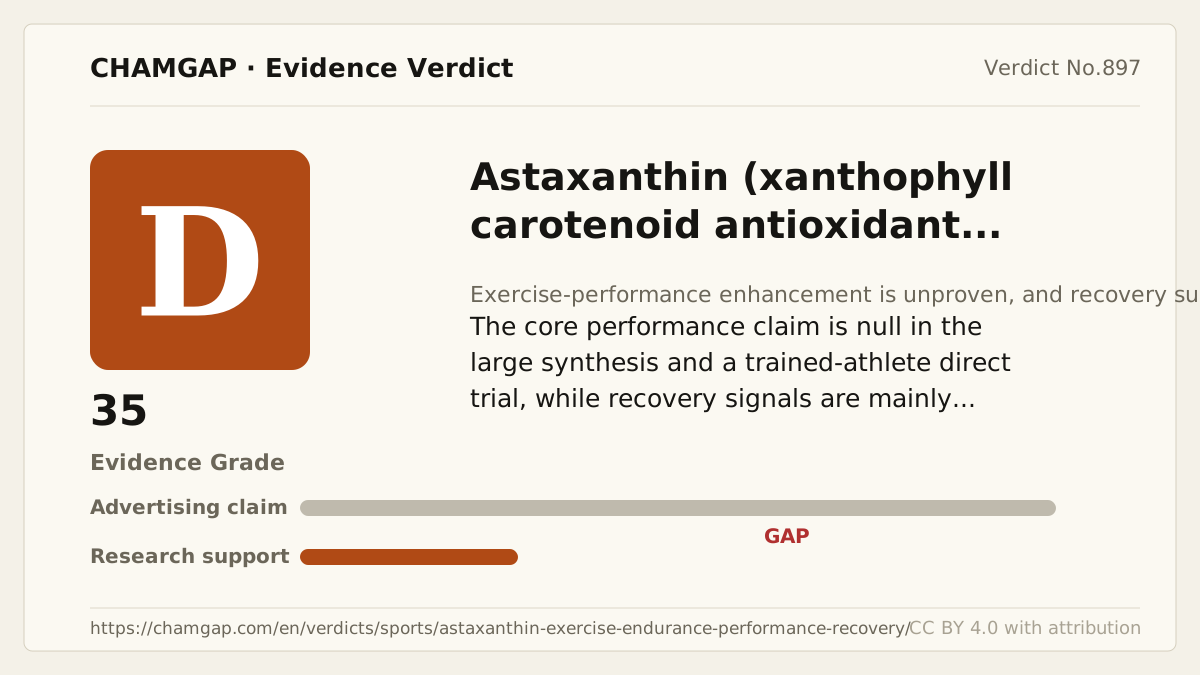
[Chamgap] Astaxanthin x improved exercise endurance, performance, and post-exercise recovery — Evidence Grade D·35. 3 cited sources checked. Source: https://chamgap.com/en/verdicts/sports/astaxanthin-exercise-endurance-performance-recovery/ · CC BY 4.0CC BY 4.0 — free to use with attribution; do not distort grades, numbers, or verdict meaning.
What this document does and does not do
Chamgap is an information source. It reports what research has and has not confirmed; it does not tell readers what to take or buy. That decision belongs to readers and, when needed, medical or legal professionals. This verdict reflects literature available up to the search date and may change as new research appears. Nothing here is medical advice.