
Astaxanthin,
does it really help with Improved exercise endurance and faster recovery from muscle damage and fatigue?
research showsHuman exercise trials of astaxanthin are small and conflicting. A 21-cyclist trial reported improvement in selected time-trial outcomes after 4 mg/day for 28 days, but other trained-athlete studies did not reproduce performance benefits. A 20-man resistance-exercise trial found no benefit for soreness, creatine kinase, or muscle function, while a 22-man trial improved lactate and recovery oxygen-consumption changes but not VO2max, anaerobic threshold, or heat-exercise performance. Heterogeneity, small samples, and conflict support D.
ads claimAntioxidant mechanisms, animal experiments, and selected positive surrogates can be expanded into promises of longer endurance and damage-free instant recovery. Evidence does not support replacing training, sleep, or nutrition planning.
Useful facts when choosing a product
- This verdict concerns exercise performance and recovery and is separate from eye-fatigue, skin, or general antioxidant claims.
- Human exercise studies used differing doses, commonly about 4 to 12 mg/day for several weeks, so equivalence to a particular commercial product is uncertain.
- Short-term tolerability is generally good, but discolored stool, skin-color change, and gastrointestinal upset can occur. A possible blood-pressure-lowering effect warrants caution with hypotension or antihypertensive drugs.
Chamgap Semantic Classification Code
Candidate index · review held
S.astaxanthin.oral.exercise-endurance-and-faster-recovery-from-muscle-damage-and-fatigue.improve.placeboSupplements and nutraceuticals > Astaxanthin > Oral > exercise endurance and faster recovery from muscle damage and fatigue > Improvement claim > Placebo
An automated migration candidate, not an issued permanent code; exact claim scope remains under review. This machine-generated migration candidate helps retrieval but is not a permanent assignment. The original verdict ID and URL remain authoritative.
What the research actually shows
Earnest 2011 assigned 21 competitive cyclists to 4 mg/day or placebo for 28 days and reported favorable selected 20-km time-trial results. Bloomer 2005 found that 4 mg/day for three weeks did not improve creatine kinase, soreness, or muscle function after eccentric exercise in 20 resistance-trained men. Fleischmann 2019 found that 12 mg/day for 30 days changed lactate rise and recovery oxygen consumption in 22 men but not VO2max, anaerobic threshold, or heat tolerance. Brown 2018 summarized human performance and recovery findings as limited and conflicting.
Why this is classified as D (34)
Small positive performance and recovery trials coexist with null muscle-damage and VO2max results, and populations, doses, exercise models, and endpoints are heterogeneous. Lack of consistent replication yields D with 34 points.
Counterpoint. A healthy adult may choose a low-dose trial while tracking symptoms and training, but proven carbohydrate, protein, hydration, sleep, and training strategies should take priority.
Rejudgment record. New verdict — Small positive trials for cycling performance and selected recovery surrogates coexist with null muscle-damage, soreness, VO2max, and other performance findings, with heterogeneous populations, doses, and exercise models, requiring D under rule ②
Sub-claim grades by effect
This ingredient is marketed for several effects. A single overall grade blends strong and weak claims together, so each effect is graded separately here. The overall grade reflects the strongest disconfirming or core claim.
| Effect (sub-claim) | Grade | Basis |
|---|---|---|
| Improved exercise endurance | D | Some cycling results were positive, but other performance and VO2max outcomes were not reproduced and are heterogeneous. |
| Reduced post-exercise muscle-damage markers | D | A direct 20-person trial found no benefit for creatine kinase, soreness, or function, and small-study findings conflict. |
| Faster recovery from post-exercise fatigue | D | Selected lactate and oxygen-uptake signals exist, but subjective fatigue and functional recovery lack consistent replication. |
Cross-check — AI research and Codex final gate
Evidence Table
| Study | Design | Sample | Funding | Endpoint | Result | Weight |
|---|---|---|---|---|---|---|
| Brown DR et al. 2018 | Critical review of exercise metabolism, performance, and recovery | Synthesis of animal research and limited human trials | Academic research | Endurance, metabolism, oxidative stress, and recovery | Human exercise evidence was limited and conflicting for performance and recovery. | Key synthesis |
| Bloomer RJ et al. 2005 | Placebo-controlled parallel-group exercise trial | 20 resistance-trained men | Commercial formulation used; reporting limited | Creatine kinase, soreness, and muscle function | No indirect muscle-injury outcome improved versus placebo after eccentric exercise. | Direct null muscle-damage evidence |
| Fleischmann C et al. 2019 | Thirty-day randomized double-blind placebo-controlled trial | 22 healthy men; 12 astaxanthin and 10 placebo | Academic and military-medical research | VO2max, anaerobic threshold, lactate, recovery oxygen uptake, and heat tolerance | Selected recovery measures improved, but VO2max, anaerobic threshold, and heat tolerance did not. | Direct mixed-result evidence |
| Liu S et al. 2026 | Systematic review and meta-analysis of randomized trials | 24 randomized controlled trials | Academic research | VO2max, time trial, maximal workload, creatine kinase, lactate dehydrogenase, and related outcomes | Creatine kinase decreased modestly, but VO2max, time-trial performance, and maximal workload did not improve significantly; few studies per outcome and methodological heterogeneity limited certainty. | Latest key synthesis |
Receipt — 4 References
All 4 cited sources were verified for existence at the original page (as of 2026-07-23).
Final verification and publication gate: Codex · Evidence date: 2026-07-23 · Corrections: none
Cite this verdict
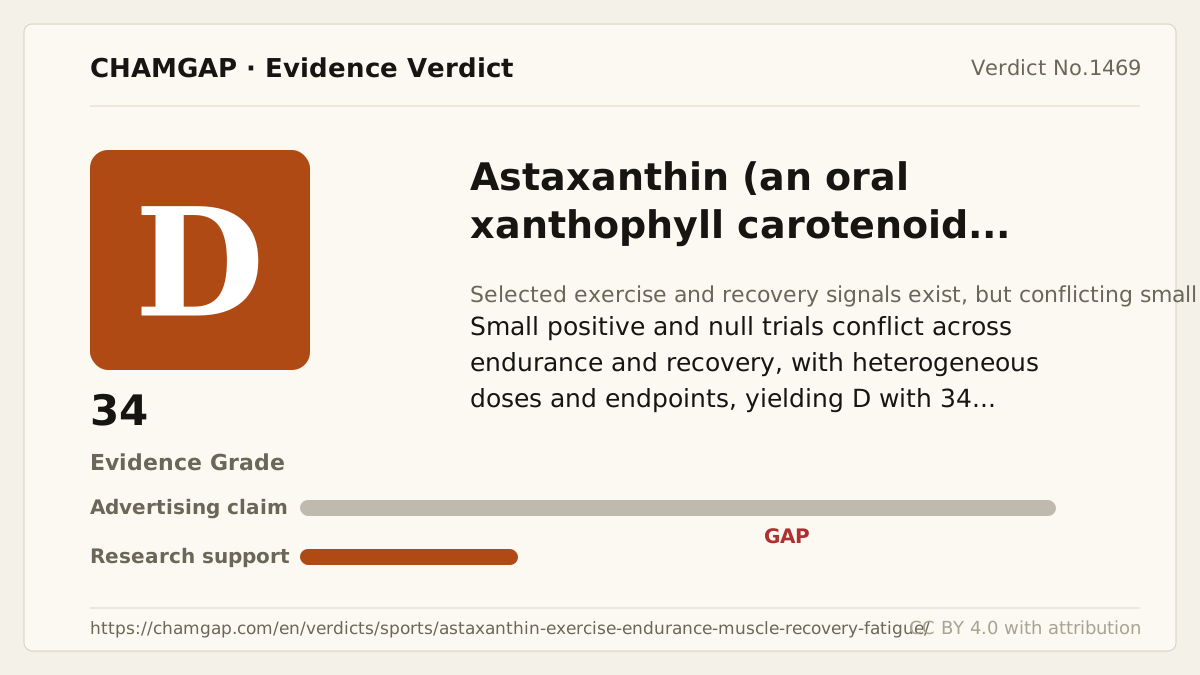
[Chamgap] Astaxanthin x exercise endurance, muscle damage, and fatigue recovery — Evidence Grade D·34. 4 cited sources checked. Source: https://chamgap.com/en/verdicts/sports/astaxanthin-exercise-endurance-muscle-recovery-fatigue/ · CC BY 4.0CC BY 4.0 — free to use with attribution; do not distort grades, numbers, or verdict meaning.
What this document does and does not do
Chamgap is an information source. It reports what research has and has not confirmed; it does not tell readers what to take or buy. That decision belongs to readers and, when needed, medical or legal professionals. This verdict reflects literature available up to the search date and may change as new research appears. Nothing here is medical advice.