
Arachidonic acid,
does it really help with Increased muscle mass, strength, and muscle protein synthesis during resistance training?
research showsArachidonic acid supplementation is rated C because small human randomized trials conflict. A 31-man, 50-day trial did not support additional gains in fat-free mass or strength, and a 19-man, four-week acute study did not increase muscle protein synthesis or mTOR signaling during the first four hours after resistance exercise. In contrast, a manufacturer-supported 30-man, eight-week trial reported positive signals for lean mass and upper-body strength. Human trials exist, making C more accurate than D, which is reserved here for preclinical-only evidence or a large negative human trial, but the samples are small, limited to trained men, inconsistent, and linked to a branded product and manufacturer funding in the positive study. The evidence does not justify calling the product a proven anabolic.
ads claimMarketing combines lean-mass and upper-body-strength changes from one positive trial with prostaglandin mechanisms from cells and animals to describe a clinically proven anabolic. The null acute human protein-synthesis study and null outcomes in another training trial make that wording exceed the evidence.
Useful facts when choosing a product
- Research doses were mainly 1.0 to 1.5 g/day for four to eight weeks, and findings cannot be automatically extended to other doses or long-term use.
- Resistance exercise itself increases muscle mass and strength, so the supplement must be judged by between-group differences versus placebo rather than within-group change alone.
- Arachidonic acid is a precursor for many eicosanoids involved in inflammatory and platelet signaling, although short trials of 1.0 to 1.5 g/day in healthy adults did not consistently increase serious adverse events.
- A relatively reassuring short-term safety signal does not establish muscle efficacy, and high-dose long-term safety is not established for people with cardiovascular or inflammatory disease or those using antiplatelet or anticoagulant drugs.
Chamgap Semantic Classification Code
Candidate index · review held
S.arachidonic-acid.UNK.muscle-mass-strength-and-muscle-protein-synthesis-during-resistance-training.increase.placeboSupplements and nutraceuticals > Arachidonic acid > Unknown > muscle mass, strength, and muscle protein synthesis during resistance training > Increase claim > Placebo
An automated migration candidate, not an issued permanent code; exact claim scope remains under review. This machine-generated migration candidate helps retrieval but is not a permanent assignment. The original verdict ID and URL remain authoritative.
What the research actually shows
Roberts 2007 randomized 31 resistance-trained men to arachidonic acid 1 g/day or corn oil for 50 days and found no additional benefit for fat-free mass, strength, anabolic hormones, or markers of hypertrophy, although peak anaerobic power showed a signal. De Souza 2016 randomized 30 trained men to arachidonic acid 1.5 g/day or corn oil for eight weeks and reported group-by-time effects for lean mass and upper-body strength, but muscle thickness and lower-body strength were not consistently positive and the manufacturer supported the trial. Mitchell 2018 measured stable-isotope muscle protein synthesis in 19 trained men after four weeks and found no between-group difference over four hours or in mTOR signaling. The Calder 2019 systematic review also described the three small double-blind muscle studies as mixed and concluded that evidence was insufficient for a specific health recommendation.
Why this is classified as C (43)
The 31-participant 50-day trial was null, the 30-participant eight-week trial was positive, and an independent 19-participant acute study found no muscle-protein-synthesis increase (P=0.212). The positive axis is confined to the Molecular Nutrition and X-Factor branded-ingredient and patent context, so the rule ②-b C ceiling applies. Conflict, small samples, and no large independent replication give C with 43 points.
Counterpoint. Adequate energy and protein intake, progressive overload, and sleep remain the priorities for muscle and strength gain, and arachidonic acid cannot replace them. Doses and durations beyond the trials carry separate safety uncertainty.
Rejudgment record. New verdict — Used C rather than the preclinical-only D category because human randomized trials exist, but lean-mass and strength findings conflict, acute muscle protein synthesis was null, the clearest positive trial was linked to a branded product and manufacturer funding, and no large independent replication exists
Sub-claim grades by effect
This ingredient is marketed for several effects. A single overall grade blends strong and weak claims together, so each effect is graded separately here. The overall grade reflects the strongest disconfirming or core claim.
| Effect (sub-claim) | Grade | Basis |
|---|---|---|
| Increased muscle mass and strength during resistance training | C | A 30-man trial was positive, but a 31-man trial was negative, with limitations in sample size, duration, and industry linkage. |
| Stimulation of muscle protein synthesis after acute resistance exercise | D | A 19-man stable-isotope randomized trial found no between-group difference in four-hour muscle protein synthesis or major anabolic signaling. |
| A clinically proven anabolic supplement | D | Conflicting small studies and no large independent replication do not support the definitive marketing claim. |
Cross-check — AI research and Codex final gate
Evidence Table
| Study | Design | Sample | Funding | Endpoint | Result | Weight |
|---|---|---|---|---|---|---|
| Roberts MD et al. 2007 | Randomized double-blind placebo-controlled resistance-training trial | 31 resistance-trained men; 50 days | Supported by Molecular Nutrition; X-Factor product supplied | Fat-free mass, strength, anaerobic power, anabolic hormones, and hypertrophy markers | No added benefit was found for fat-free mass, strength, or anabolic markers; peak anaerobic power showed a limited signal. | Key small negative human trial |
| De Souza EO et al. 2016 | Randomized double-blind placebo-controlled training trial plus animal mechanism study | 30 trained men; eight weeks | Partly funded by Molecular Nutrition; X-Factor Advanced product and patent interest disclosed | DEXA lean mass, muscle thickness, upper- and lower-body strength, and power | Lean mass and upper-body strength were positive, but muscle thickness and lower-body strength were inconsistent in a small sample. | Manufacturer-linked positive small trial |
| Mitchell CJ et al. 2018 | Randomized double-blind placebo-controlled acute muscle-biopsy trial | 19 trained men; four weeks of supplementation | Academic research support; no manufacturer funding reported | Stable-isotope muscle protein synthesis, mTOR signaling, satellite cells, and ribosome biogenesis | Four-hour post-exercise muscle protein synthesis and anabolic signaling did not differ; only an exploratory signal in ribosome biogenesis appeared at 48 hours. | Negative primary acute human mechanistic outcome |
| Calder PC et al. 2019 | Systematic review of randomized trials of increased arachidonic-acid intake | Fourteen randomized trials in 22 articles; three small muscle-related trials | Supported by ILSI Europe task forces with industry members | Fatty-acid status, metabolism, muscle function, and safety markers | Muscle findings were mixed, and evidence was insufficient to recommend arachidonic acid for a specific health effect. | Confirms limitations of the overall evidence |
Receipt — 4 References
All 4 cited sources were verified for existence at the original page (as of 2026-07-19).
Final verification and publication gate: Codex · Evidence date: 2026-07-19 · Corrections: none
Cite this verdict
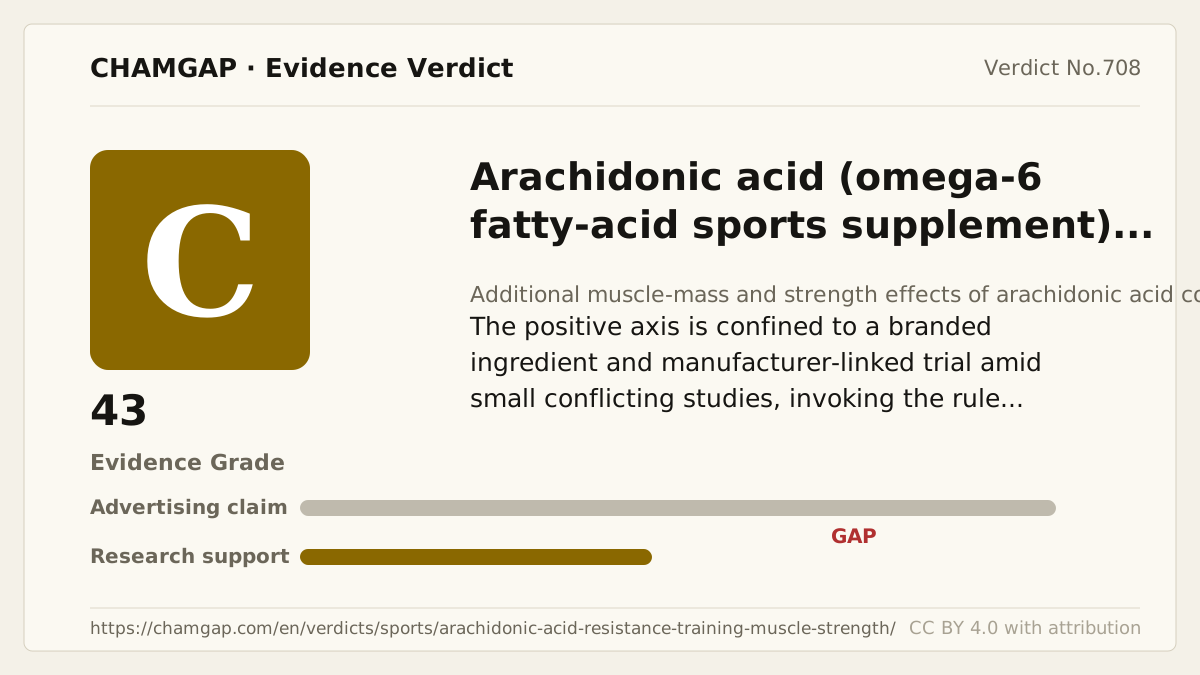
[Chamgap] Arachidonic acid x increased muscle mass, strength, and muscle protein synthesis with resistance training — Evidence Grade C·43. 4 cited sources checked. Source: https://chamgap.com/en/verdicts/sports/arachidonic-acid-resistance-training-muscle-strength/ · CC BY 4.0CC BY 4.0 — free to use with attribution; do not distort grades, numbers, or verdict meaning.
What this document does and does not do
Chamgap is an information source. It reports what research has and has not confirmed; it does not tell readers what to take or buy. That decision belongs to readers and, when needed, medical or legal professionals. This verdict reflects literature available up to the search date and may change as new research appears. Nothing here is medical advice.